Native Plants

Plant Database
Search for native plants by scientific name, common name or family. If you are not sure what you are looking for, try the Combination Search or our Recommended Species lists.
Page, Lee
Ipomopsis rubra
Ipomopsis rubra (L.) Wherry
Standing Cypress, Texas Plume, Red Texas Star, Red Gilia
Polemoniaceae (Phlox Family)
Synonym(s): Gilia rubra
USDA Symbol: IPRU2
USDA Native Status: L48 (N), CAN (I)
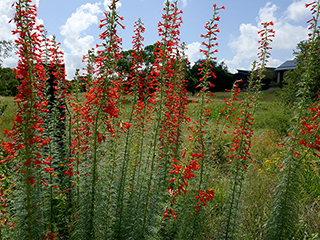
The stiff, unbranched, 2-4 ft. stem of this sparsely leaved biennial can reach 6 ft. Showy, red, tubular flowers, widely flaring at the rim, are marked with orange or yellowish spots inside. Flowers are arranged in a thick spike, opening from the tip of the stem downward.


Plant Characteristics
Duration: BiennialHabit: Herb
Fruit Type: Capsule
Size Notes: Up to about 6 feet tall, often shorter.
Bloom Information
Bloom Color: Red , Orange , YellowBloom Time: May , Jun , Jul , Aug , Sep
Distribution
USA: AL , AR , DE , FL , GA , IA , IL , IN , KS , KY , LA , MA , MD , MI , MO , MS , NC , NJ , NY , OH , OK , SC , TN , TX , VA , WINative Distribution: C. TX, e. to KY, NC & FL
Native Habitat: Dry, sandy or rocky fields; open woods. Central and east Texas. Well-drained sand, loam, or limstone.
Growing Conditions
Water Use: MediumLight Requirement: Sun , Part Shade
Soil Moisture: Dry
Soil Description: Dry, sandy or rocky soils. Gravelly, Sandy, Sandy Loam, Medium Loam
Conditions Comments: Standing cypress is stunningly beautiful and easy to cultivate in garden settings. Showy, red, tubular flowers, widely flaring at the rim, are marked with orange or yellowish spots inside. Flowers are arranged in a thick spike, opening from the tip of the stem downward. When the bloom stalk is through blooming, you can prune it off to allow replacement stalk to grow and flower.
Benefit
Use Ornamental: Attractive, Blooms ornamental, Color, ShowyUse Wildlife: Standing cypress attracts hummingbirds. Nectar-Hummingbirds
Conspicuous Flowers: yes
Interesting Foliage: yes
Attracts: Hummingbirds
Nectar Source: yes
Deer Resistant: High , Moderate
Propagation
Propagation Material: SeedsDescription: I. rubra was the most successful of over twenty individual species field-tested at the National Wildflower Research Center in 1984-85, yielding an average of over 200 seedlings per square meter when seeded at the recommended rate. Propagate by sowing seed in fall. A fall seeding recommended. Be sure the seeds are in good contact with the soil by lightly raking the seed into loose topsoil. Since it is a biennial, it is recommended that you plant two consecutive years in order to produce flowering stalks each year.
Seed Collection: After flowering ceases, allow seeds to completely mature before moving for reseeding or collecting seed to plant in a new area.
Commercially Avail: yes
Maintenance: The first year of growth will produce a ferny rosette, followed by a flower spike the second year. When the spike has bloomed out, cut it off, and new spikes will be formed.
Find Seed or Plants
Order seed of this species from Native American Seed and help support the Wildflower Center.
From the National Organizations Directory
According to the species list provided by Affiliate Organizations, this plant is on display at the following locations:Fredericksburg Nature Center - Fredericksburg, TX
Lady Bird Johnson Wildflower Center - Austin, TX
Texas Discovery Gardens - Dallas, TX
Texas Parks and Wildlife Department - Austin, TX
NPSOT - Fredericksburg Chapter - Fredericksburg, TX
NPSOT - Austin Chapter - Austin, TX
Jacob's Well Natural Area - Wimberley, TX
NPSOT - Williamson County Chapter - Georgetown, TX
Mt. Cuba Center - Hockessin, DE
Wildflower Center Seed Bank
LBJWC-GV-5 Collected 2005-07-17 in Travis County by Lady Bird Johnson Wildflower CenterBibliography
Bibref 355 - Landscaping with Native Plants of Texas and the Southwest (1991) Miller, G. O.Bibref 318 - Native Texas Plants: Landscaping Region by Region (2002) Wasowski, S. & A. Wasowski
Bibref 281 - Shinners & Mahler's Illustrated Flora of North Central Texas (1999) Diggs, G. M.; B. L. Lipscomb; B. O'Kennon; W. F...
Bibref 248 - Texas Wildflowers: A Field Guide (1984) Loughmiller, C. & L. Loughmiller
Bibref 291 - Texas Wildscapes: Gardening for Wildlife (1999) Damude, N. & K.C. Bender
Bibref 328 - Wildflowers of Texas (2003) Ajilvsgi, Geyata.
Bibref 286 - Wildflowers of the Texas Hill Country (1989) Enquist, M.
Search More Titles in Bibliography
Web Reference
Webref 23 - Southwest Environmental Information Network (2009) SEINet - Arizona ChapterResearch Literature
Reslit 1004 - Tolerance of native wildflower seedlings to imazapic (2003) J. G. Norcini, J. H. Aldrich and F. G. MartiniReslit 2040 - Effect of silverthiosulphate (STS) and sucrose on postharvest display life of cut panicles of Ipomopsis rubra L (2007) W. Mackay, N. Sankhla and C. McKenney
Reslit 2235 - Phylogenetic Significance of Chloroplast DNA Restriction Site Varition in the Ipomopsis aggregata Complex and Related Species (Polemoniaceae) (1993) P. G. Wolf, P. S. Soltis and D. E. Soltis
Reslit 2349 - Pollination of Ipomopsis rubra (Polemoniaceae) by Ruby-Throated Hummingbirds (1975) J. R. Estes and P. M. Hall
This information was provided by the Florida WIldflower Foundation.
Search More Titles in Research Literature
Additional resources
USDA: Find Ipomopsis rubra in USDA PlantsFNA: Find Ipomopsis rubra in the Flora of North America (if available)
Google: Search Google for Ipomopsis rubra
Metadata
Record Modified: 2023-02-14Research By: TWC Staff