Native Plants

Plant Database
Search for native plants by scientific name, common name or family. If you are not sure what you are looking for, try the Combination Search or our Recommended Species lists.
Wasowski, Sally and Andy
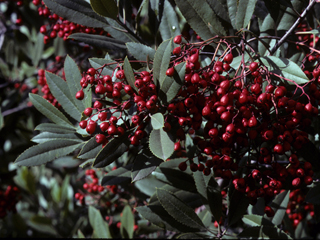
Heteromeles arbutifolia
Heteromeles arbutifolia (Lindl.) M. Roem.
Toyon, California Christmasberry, Christmasberry, California Holly, Hollywood
Rosaceae (Rose Family)
Synonym(s):
USDA Symbol: HEAR5
USDA Native Status: L48 (N), HI (I)
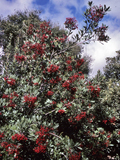
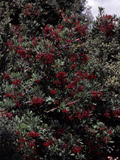
A freely branched, evergreen shrub or small tree which can grow 15-20 ft., or more, tall but usually is 6-8 ft. high and 4-5 ft. wide. Leathery, dark-green leaves provide a background for profuse white blooms and long-lasting displays of bright-red berries. The flowers and berries occur in large, terminal clusters. One of the most beautiful native shrubs or small trees, evergreen, with short trunk, many branches, and rounded crown.
The only species in its genus, Toyon is very showy in winter with evergreen leaves and abundant red fruit and is popular for Christmas decorations. A pioneer plant on eroded soil, it sprouts vigorously after fire or cutting. The common name Toyon is derived from an Ohlone word for the plant, and Hollywood, California, is thought to be named for it. It was once a major component of the chaparral that made up the original Hollywood landscape.
Plant Characteristics
Duration: PerennialHabit: Shrub , Tree
Leaf Retention: Evergreen
Fruit Type: Pome
Size Notes: Up to about 30 feet tall, usually much shorter.
Bloom Information
Bloom Color: WhiteBloom Time: Apr , May , Jun , Jul , Aug , Sep
Distribution
USA: CA , HINative Distribution: CA & Baja CA
Native Habitat: Semi-dry, brushy slopes, foothills & canyons below 4000 ft.
Growing Conditions
Light Requirement: Sun , Part Shade , ShadeSoil Moisture: Dry
Soil Description: Poor, dry, well-drained soil.
Conditions Comments: Adaptable, long-lived and drought-tolerant. Berries last from Nov. to Feb. Susceptible to fire blight and black mildew, especially near the coast. Tolerates serpentine soil. Exhibits allelopathic tendencies.
Benefit
Use Ornamental: As a hedge.Use Wildlife: Birds eat berries.
Use Food: Indigenous peoples cooked and ate the berries. They are toxic in large amounts.
Warning: Berries are toxic in large amounts.
Attracts: Birds
Value to Beneficial Insects
Special Value to Native BeesSupports Conservation Biological Control
This information was provided by the Pollinator Program at The Xerces Society for Invertebrate Conservation.
Propagation
Description: Propagation by seed is possible but germination is slow.Seed Collection: Hand snips are needed to clup the fruits. Place fruits in a warm place and allow to ferment to aid in the extraction of seeds.
Commercially Avail: yes
Find Seed or Plants
Find seed sources for this species at the Native Seed Network.
View propagation protocol from Native Plants Network.
From the National Organizations Directory
According to the species list provided by Affiliate Organizations, this plant is on display at the following locations:Santa Barbara Botanic Garden - Santa Barbara, CA
Native Seed Network - Corvallis, OR
Bibliography
Bibref 841 - Native Alternatives to Invasive Plants (2006) Burrell, C. C.Bibref 995 - Native Landscaping from El Paso to L.A. (2000) Wasowski, S. and A. Wasowski
Bibref 1218 - Tending the Wild: Native American Knowledge and the Management of California's Natural Resources (2006) Anderson, M. Kat
Search More Titles in Bibliography
Web Reference
Webref 30 - Calflora (2018) CalfloraWebref 38 - Flora of North America (2019) Missouri Botanical Garden, St. Louis, MO & Harvard University Herbaria, Cambridge, MA.
Webref 23 - Southwest Environmental Information Network (2009) SEINet - Arizona Chapter
Additional resources
USDA: Find Heteromeles arbutifolia in USDA PlantsFNA: Find Heteromeles arbutifolia in the Flora of North America (if available)
Google: Search Google for Heteromeles arbutifolia
Metadata
Record Modified: 2023-05-10Research By: TWC Staff