Native Plants

Plant Database
Search for native plants by scientific name, common name or family. If you are not sure what you are looking for, try the Combination Search or our Recommended Species lists.
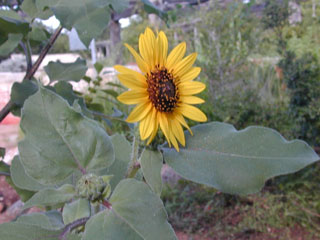
Marcus, Joseph A.
Helianthus annuus
Helianthus annuus L.
Common Sunflower, Annual Sunflower
Asteraceae (Aster Family)
Synonym(s): Helianthus annuus ssp. jaegeri, Helianthus annuus ssp. lenticularis, Helianthus annuus ssp. texanus, Helianthus annuus var. lenticularis, Helianthus annuus var. macrocarpus, Helianthus annuus var. texanus, Helianthus aridus, Helianthus lenticularis
USDA Symbol: HEAN3
USDA Native Status: L48 (N), AK (I), HI (I), PR (I), CAN (I), SPM (I)
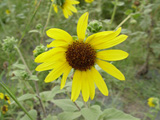
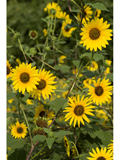
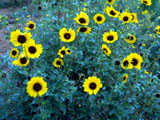
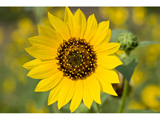
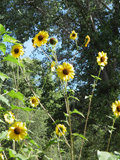
Common sunflower is a widely branching, stout annual, 1-1/2 to 10 ft. tall, with coarsely hairy leaves and stems. The terminal flowers heads are large and showy, up to 5 inches across. A tall, coarse leafy plant with a hairy stem commonly branched in the upper half and bearing several or many flower heads, the central maroon disc is surrounded by many bright yellow rays.
The state flower of Kansas. Contrary to common myth, the heads of sunflowers do not follow the sun each day. However, developing flower buds and leaves do exhibit some phototropism. The plant has been cultivated in Central North America since pre-Columbian times; yellow dye obtained from the flowers, and a black or dull blue dye from the seeds, were once important in Native American basketry and weaving. Native Americans also ground the seeds for flour and used its oil for cooking and dressing hair. It was believed, in the 19th century, that plants growing near a home would protect from malaria. Seeds from cultivated strains are now used for cooking oil and livestock feed in the United States and Eurasia. Many variants have been developed, some with one huge head topping a stalk 9-16 ft (3-5 m) tall, others with maroon rays. Prairie Sunflower (H. petiolaris), found throughout the Great Plains and similar to the wild forms of Common Sunflower, has scales on the disc in the center of the head tipped by white hairs, easily visible when the central flowers are spread apart. Developed in a single large head variety by Russians.
Plant Characteristics
Duration: AnnualHabit: Herb
Size Notes: From 1-1/2 to about 10 feet tall.
Leaf: Green
Fruit: Fruit is a cypsela (pl. cypselae). Though technically incorrect, the fruit is often referred to as an achene.
Bloom Information
Bloom Color: Red , Yellow , BrownBloom Time: Jun , Jul , Aug , Sep , Oct , Nov
Bloom Notes: Discs florets are usually reddish brown, sometimes yellow.
Distribution
USA: AK , AL , AR , AZ , CA , CO , CT , DC , DE , FL , GA , HI , IA , ID , IL , IN , KS , KY , LA , MA , MD , ME , MI , MN , MO , MS , MT , NC , ND , NE , NH , NJ , NM , NV , NY , OH , OK , OR , PA , RI , SC , SD , TN , TX , UT , VA , VT , WA , WI , WV , WYCanada: AB , MB , NT , SK
Native Distribution: Man. & MN to TX & westward; naturalized to the Atlantic
Native Habitat: Dry, open areas; disturbed sites
Growing Conditions
Water Use: MediumLight Requirement: Sun
Soil Moisture: Dry
CaCO3 Tolerance: Medium
Soil Description: Dry, disturbed clays or heavy sands.
Conditions Comments: Common sunflower spreads rapidly by seed, especially in disturbed sites. It has been shown to have an allelopathic effect on other plants. Many subspecies intergrade throught the species range. The cultivated giant sunflower is a member of H. annuus, derived through artificial selection.
Benefit
Use Wildlife: Sunflowers intermixed with other annuals provide good cover for many species of wildlife. Seeds are sought by many species of wild birds.Use Food: Sunflower seeds are popular in breads, cereals, salads and many other dishes. Although we usually think of only the seeds as edible, the bright yellow strap-like florets make a colourful salad garnish. (Kershaw)
Use Medicinal: Flower heads with bracts removed boiled to make remedy for pulmonary troubles. Poultice of flowers used for burns. (Kindscher) Crushed root applied as a mash to draw blister. (Weiner) Roots chewed and applied to swollen area of rattlesnake bites after venom was sucked out. (Steiner) American Indians used flower tea for lung ailments, malaria. Leaf tea taken for high fevers; astringent poultice on snake bites and spider bites. Seeds and leaves said to be diuretic, expectorant.
Use Other: In the 19th century it was believed that plants growing near a home would protect from malaria. (Niering)
Recent uses include making silage from the plant and extracting the oil to make soap. (Niering)
Conspicuous Flowers: yes
Attracts: Birds
Value to Beneficial Insects
Special Value to Native BeesThis information was provided by the Pollinator Program at The Xerces Society for Invertebrate Conservation.
Propagation
Description: Use treated seeds. Germination is poor.Seed Collection: Seeds are often eaten by birds, making collection tricky.
Seed Treatment: Stratification is required.
Commercially Avail: yes
Find Seed or Plants
Order seed of this species from Native American Seed and help support the Wildflower Center.
Find seed sources for this species at the Native Seed Network.
National Wetland Indicator Status
| Region: | AGCP | AK | AW | CB | EMP | GP | HI | MW | NCNE | WMVE |
| Status: | FAC | FAC | FACU | UPL | FAC | FACU | UPL | FACU | FACU | FACU |
From the National Organizations Directory
According to the species list provided by Affiliate Organizations, this plant is on display at the following locations:Fredericksburg Nature Center - Fredericksburg, TX
Lady Bird Johnson Wildflower Center - Austin, TX
Texas Discovery Gardens - Dallas, TX
Sibley Nature Center - Midland, TX
Brackenridge Field Laboratory - Austin, TX
Nueces River Authority - Uvalde, TX
National Butterfly Center - Mission, TX
Native Seed Network - Corvallis, OR
Herbarium Specimen(s)
NPSOT 0256 Collected July 24, 1992 in Comal County by Mary Beth WhiteNPSOT 0023 Collected July 11, 1990 in Bexar County by Judith C. Berry
NPSOT 0080 Collected Oct. 19, 1990 in Bexar County by Mollie Walton
Wildflower Center Seed Bank
LBJWC-209 Collected 2008-07-08 in Travis County by Lady Bird Johnson Wildflower CenterLBJWC-538 Collected 2007-07-30 in Travis County by Lady Bird Johnson Wildflower Center
Bibliography
Bibref 1207 - Earth Medicine, Earth Food (1990) Michael A. WeinerBibref 610 - Edible wild plants of the prairie : an ethnobotanical guide (1987) Kindscher, K.
Bibref 417 - Field Guide to Medicinal Plants and Herbs of Eastern and Central North America (2000) Foster, S. & J. A. Duke
Bibref 1211 - Folk Medicine: The Art and the Science (1985) Richard P. Steiner
Bibref 281 - Shinners & Mahler's Illustrated Flora of North Central Texas (1999) Diggs, G. M.; B. L. Lipscomb; B. O'Kennon; W. F...
Bibref 248 - Texas Wildflowers: A Field Guide (1984) Loughmiller, C. & L. Loughmiller
Bibref 328 - Wildflowers of Texas (2003) Ajilvsgi, Geyata.
Bibref 286 - Wildflowers of the Texas Hill Country (1989) Enquist, M.
Search More Titles in Bibliography
Web Reference
Webref 38 - Flora of North America (2019) Missouri Botanical Garden, St. Louis, MO & Harvard University Herbaria, Cambridge, MA.From the Archive
Wildflower Newsletter 1986 VOL. 3, NO.1 - Library and Clearinghouse Serve the Nation, What is a Weed, More than Just a Pre...Wildflower Newsletter 1992 VOL. 9, NO.2 - Native Landscaping City Restrictions and Homeowner Association, Director's Repor...
Additional resources
USDA: Find Helianthus annuus in USDA PlantsFNA: Find Helianthus annuus in the Flora of North America (if available)
Google: Search Google for Helianthus annuus
Metadata
Record Modified: 2022-12-28Research By: TWC Staff