Native Plants

Plant Database
Search for native plants by scientific name, common name or family. If you are not sure what you are looking for, try the Combination Search or our Recommended Species lists.
Flaigg, Norman G.
Glandularia bipinnatifida var. bipinnatifida
Glandularia bipinnatifida (Nutt.) Nutt. var. bipinnatifida
Prairie Verbena, Purple Prairie Verbena, Dakota Mock Vervain, Dakota Vervain
Verbenaceae (Verbena Family)
Synonym(s): Verbena bipinnatifida, Verbena demareei
USDA Symbol: GLBIB
USDA Native Status: L48 (N), PR (N)
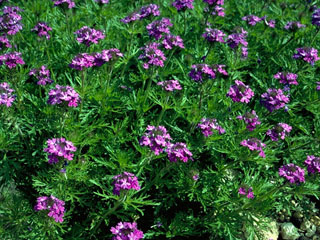
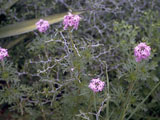
The 6-16 in. stems branch near the base, usually lying on the ground with rising tips. Plants are covered with long, whitish hairs. Leaves are opposite and deeply cut several times on both sides of the midrib; they are 1-3 1/2 inches long and 1 1/2 inches wide on a 1-inch stem. Branch-tip, ball-shaped flower heads are composed of tubular, five-lobed, purple flowers with dark centers. Individual flowers are about 1/2 inch long and 1/2 inch wide at the opening, with 5 sepals and 5 petals. Branches continue elongating throughout the season, producing new flowers.
This species is a member of the verbena family (family Verbenaceae), which includes about 75 genera and 3,000 species of herbs, shrubs, and trees, mostly of tropical and warm temperate regions. Among them, teak is a highly prized furniture wood, and Vervain, Lantana, Lippia or Frog Fruit are grown as ornamentals.


Plant Characteristics
Duration: Annual , PerennialHabit: Herb
Leaf Arrangement: Opposite
Fruit Type: Schizocarp
Size Notes: Stems decumbent, up to about 16 inches long.
Flower: Flowers in 2 inch heads
Bloom Information
Bloom Color: Pink , PurpleBloom Time: Feb , Mar , Apr , May , Jun , Jul , Aug , Sep , Oct , Nov , Dec
Distribution
USA: AL , AR , AZ , CA , CO , GA , IN , KS , KY , LA , MD , MO , MS , NE , NM , OK , SD , TN , TX , WI , WYNative Distribution: MS to AZ, n. to SD
Native Habitat: Prairie, Plains, Meadows, Pastures, Savannas
Growing Conditions
Water Use: LowLight Requirement: Sun , Part Shade
Soil Moisture: Dry
Soil Description: Sandy to gravelly soils. Sandy Loam, Medium Loam, Clay Loam, Limestone/chalky, Sandy, Clay, Limestone-based, Caliche type
Conditions Comments: The stems branch near the base, usually lying on the ground with rising tips. Branch-tip, ball-shaped flower heads are composed of tubular, purple flowers. Branches continue elongating throughout the season, producing new flowers. A short-lived perennial. It is valued for the long bloom period of its showy flowers.
Benefit
Use Ornamental: Ground cover, Rock gardens, Fall conspicuous, Showy, Blooms ornamental, Wildflower meadow, Perennial gardenUse Wildlife: Attracts butterflies.
Conspicuous Flowers: yes
Attracts: Birds , Butterflies
Nectar Source: yes
Deer Resistant: Moderate
Propagation
Propagation Material: SeedsDescription: Propagate by seed, cuttings, or transplanting of small plants in winter. Transplant rooted cuttings as soon as they form roots. Plants along highways continually produce new growth where mowed. Cuttings taken in spring do better than those taken in summer. Plants start producing new growth mid-winter.
Maintenance: Remove spent blossoms, Prevent complete soil dryness, Maintain mulch layer, Fertilize in spring with rose food
Mr. Smarty Plants says
Native plants for container gardens in Central Texas
March 11, 2008
Dear Mr. Smarty Plants: I moved to TX last year, for now living in an apartment with a good-size but shady deck; my garden in VA was full of VA native plants. What TX natives, if any, can I grow in ...
view the full question and answer
From the National Organizations Directory
According to the species list provided by Affiliate Organizations, this plant is on display at the following locations:Lady Bird Johnson Wildflower Center - Austin, TX
Brackenridge Field Laboratory - Austin, TX
Herbarium Specimen(s)
NPSOT 0026 Collected July 21, 1990 in Bexar County by Judith C. BerryNPSOT 0875 Collected May 4, 1994 in Bexar County by Harry Cliffe
NPSOT 0193 Collected Mar. 15, 1992 in Comal County by Mary Beth White
NPSOT 0591 Collected Oct 19, 1990 in Comal County by Harry Cliffe
Bibliography
Bibref 765 - McMillen's Texas Gardening: Wildflowers (1998) Howard, D.Bibref 841 - Native Alternatives to Invasive Plants (2006) Burrell, C. C.
Bibref 318 - Native Texas Plants: Landscaping Region by Region (2002) Wasowski, S. & A. Wasowski
Bibref 281 - Shinners & Mahler's Illustrated Flora of North Central Texas (1999) Diggs, G. M.; B. L. Lipscomb; B. O'Kennon; W. F...
Bibref 248 - Texas Wildflowers: A Field Guide (1984) Loughmiller, C. & L. Loughmiller
Bibref 291 - Texas Wildscapes: Gardening for Wildlife (1999) Damude, N. & K.C. Bender
Bibref 328 - Wildflowers of Texas (2003) Ajilvsgi, Geyata.
Bibref 286 - Wildflowers of the Texas Hill Country (1989) Enquist, M.
Search More Titles in Bibliography
Web Reference
Webref 23 - Southwest Environmental Information Network (2009) SEINet - Arizona ChapterAdditional resources
USDA: Find Glandularia bipinnatifida var. bipinnatifida in USDA PlantsFNA: Find Glandularia bipinnatifida var. bipinnatifida in the Flora of North America (if available)
Google: Search Google for Glandularia bipinnatifida var. bipinnatifida
Metadata
Record Modified: 2023-02-13Research By: TWC Staff