Native Plants

Plant Database
Search for native plants by scientific name, common name or family. If you are not sure what you are looking for, try the Combination Search or our Recommended Species lists.
Braden, Al
Eschscholzia californica
Eschscholzia californica Cham.
California Poppy, California Gold Poppy
Papaveraceae (Poppy Family)
Synonym(s):
USDA Symbol: ESCA2
USDA Native Status: L48 (N), AK (I), HI (I), CAN (I)
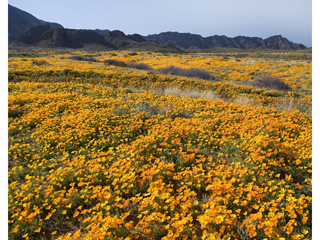
Feathery, highly-dissected, blue-green leaves clasp the 1-2 ft. stems of this popular, perennial wildflower. Showy, 1-3 in. wide, four-petaled flowers are open only on sunny days. The flowers are solitary and long-stalked and vary in color from orange to yellow. Each of the satiny petals has a deep-orange spot at its base.
California poppy is often used in wildflower mixes. It is easy to grow, drought tolerant, and reseeds so readily that is can become weedy. In natural conditions, it blooms most heavily from March to May. This bloom period can be extended with supplemental water.
The genus is named after Dr. J.F. Eschscholtz who lived from 1793 to 1831. He performed duties as a surgeon and naturalist with Russian expeditions to the Pacific coast from 1815 to 1818.


Plant Characteristics
Duration: AnnualHabit: Herb
Leaf Arrangement: Alternate
Leaf Complexity: Simple
Fruit Type: Capsule
Size Notes: Up to about 2 feet tall.
Leaf: Green
Bloom Information
Bloom Color: Orange , YellowBloom Time: Feb , Mar , Apr , May , Jun , Jul , Aug , Sep , Oct
Distribution
USA: AL , AZ , CA , CO , CT , GA , HI , ID , IL , KY , LA , MA , MI , MO , NC , NE , NH , NM , NV , NY , OH , OR , PA , SC , TN , TX , UT , WA , WI , WYNative Distribution: Most of cismontane CA, w. Mojave Desert & coastal OR also WA and NV and N. MX; escaped freely elsewhere. The native range of the E. c. ssp. mexicana includes NM and W. TX.
Native Habitat: Open or disturbed, grassy areas
Growing Conditions
Water Use: LowLight Requirement: Sun
Soil Moisture: Dry
CaCO3 Tolerance: Medium
Soil Description: Nutrient-poor, well-drained soils.
Conditions Comments: California poppy is often used in wildflower mixes. It is easy to grow, drought tolerant, and reseeds so readily that is can become weedy. In natural conditions, it blooms most heavily from March to May . This bloom period can be extended with supplemental water.
Benefit
Use Food: The Nisenan of California boiled and consumed young spring leaves.Warning: Can be poisonous if ingested. Sensitivity to a toxin varies with a person’s age, weight, physical condition, and individual susceptibility. Children are most vulnerable because of their curiosity and small size. Toxicity can vary in a plant according to season, the plant’s different parts, and its stage of growth; and plants can absorb toxic substances, such as herbicides, pesticides, and pollutants from the water, air, and soil.
Conspicuous Flowers: yes
Value to Beneficial Insects
Special Value to Native BeesSpecial Value to Bumble Bees
This information was provided by the Pollinator Program at The Xerces Society for Invertebrate Conservation.
Propagation
Description: Plant seeds in the fall directly where poppies are desired, since they do not transplant well. Rake in 1/4". Germination is rapid.Seed Collection: The fruit is a slender capsule.
Seed Treatment: Seeds germinate without pretreatment.
Commercially Avail: yes
Find Seed or Plants
Find seed sources for this species at the Native Seed Network.
View propagation protocol from Native Plants Network.
Mr. Smarty Plants says
Native, non-invasive plant seeds for each region in U.S.
June 09, 2006
I need to identify a wildflower from each region that we can package in custom packaging to use as giveaways at our member zoos and aquariums. Our project this year is called Conservation Made Simple...
view the full question and answer
From the National Organizations Directory
According to the species list provided by Affiliate Organizations, this plant is on display at the following locations:Native Seed Network - Corvallis, OR
Bibliography
Bibref 995 - Native Landscaping from El Paso to L.A. (2000) Wasowski, S. and A. WasowskiBibref 1218 - Tending the Wild: Native American Knowledge and the Management of California's Natural Resources (2006) Anderson, M. Kat
Search More Titles in Bibliography
Web Reference
Webref 38 - Flora of North America (2019) Missouri Botanical Garden, St. Louis, MO & Harvard University Herbaria, Cambridge, MA.Webref 23 - Southwest Environmental Information Network (2009) SEINet - Arizona Chapter
From the Archive
Wildflower Newsletter 1988 VOL. 5, NO.3 - Wildflowers in Bloom, Education and Tours, Poppies Brighten Barren Places, Pamel...Wildflower Newsletter 1991 VOL. 8, NO.3 - Native Plants Provide a Wealth of Foods and Fibers, Letter from the President, A...
Additional resources
USDA: Find Eschscholzia californica in USDA PlantsFNA: Find Eschscholzia californica in the Flora of North America (if available)
Google: Search Google for Eschscholzia californica
Metadata
Record Modified: 2023-02-10Research By: TWC Staff