Native Plants

Plant Database
Search for native plants by scientific name, common name or family. If you are not sure what you are looking for, try the Combination Search or our Recommended Species lists.
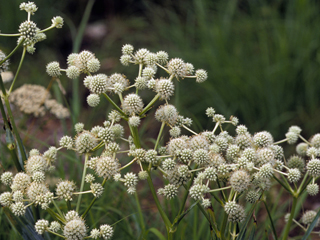
Wasowski, Sally and Andy
Eryngium yuccifolium
Eryngium yuccifolium Michx.
Rattlesnake Master, Button Eryngo, Button Snakeroot, Beargrass, Bear's Grass
Apiaceae (Carrot Family)
Synonym(s):
USDA Symbol: ERYU
USDA Native Status: L48 (N)
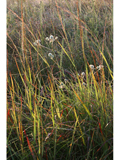
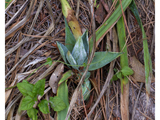
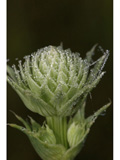
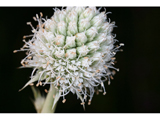
Scattered along the stiff, upright stem of this unusual perennial are tough, blue-green, yucca-like, parallel-veined leaves. Smooth, rigid stems bear thistle-like flower heads made up of small greenish-white florets mingled with pointed bracts. The individual, greenish-white flowers cluster into unique, globular heads. These occur on branch ends atop the 6 ft. plant.
Their spiny leaves make walking through clumps of these plants difficult, and also make them unpalatable to grazing livestock. They were once credited with a variety of curative powers. Their flower heads develop a bluish cast with maturity.
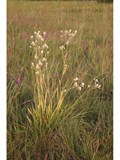
Plant Characteristics
Duration: PerennialHabit: Herb
Fruit Type: Schizocarp
Size Notes: Up to about 6 feet tall.
Flower: Flowers in 1 inch globes.
Bloom Information
Bloom Color: White , GreenBloom Time: May , Jun , Jul , Aug
Distribution
USA: AL , AR , CT , FL , GA , IA , IL , IN , KS , KY , LA , MD , MI , MN , MO , MS , NC , NE , NJ , OH , OK , SC , TN , TX , VA , WINative Distribution: FL to coastal & blackland prairies in TX, n. to NJ, w. IN, s. MN & NE
Native Habitat: Prairies; sandy roadsides; open woods
Growing Conditions
Water Use: MediumLight Requirement: Sun
Soil Moisture: Moist
Soil Description: Various well-drained soils.
Conditions Comments: Rattlesnake master can be an aggressive self-seeder. Remove seed heads to keep the plant in check. Scattered along the stiff, upright stem of this unusual perennial are tough, blue-green, yucca-like, parallel-veined leaves. Smooth, rigid stem bearing thistle-like flower heads made up of small greenish-white florets. The individual, greenish-white flowers cluster into unique, globular heads. Their spiny leaves make walking through clumps of these plants difficult.
Benefit
Use Ornamental: Bog or pond area, Water gardenConspicuous Flowers: yes
Value to Beneficial Insects
Special Value to Native BeesSupports Conservation Biological Control
This information was provided by the Pollinator Program at The Xerces Society for Invertebrate Conservation.
Propagation
Description: Usually propagated by seed planted outdoors in fall or stored, stratified and planted in spring. Mature plants can be divided in late spring or early fall.Seed Collection: Collect seed in fall when the seed heads have turned brown. Tap the seed out of the heads and air-dry, storing with the chaff in sealed, refrigerated containers.
Seed Treatment: Cold-moist stratify at 40 degrees for 2 months.
Commercially Avail: yes
Find Seed or Plants
Order seed of this species from Native American Seed and help support the Wildflower Center.
Find seed sources for this species at the Native Seed Network.
View propagation protocol from Native Plants Network.
National Wetland Indicator Status
| Region: | AGCP | AK | AW | CB | EMP | GP | HI | MW | NCNE | WMVE |
| Status: | FAC | FAC | FACW | FAC | FAC |
From the National Organizations Directory
According to the species list provided by Affiliate Organizations, this plant is on display at the following locations:Delaware Nature Society - Hockessin, DE
Stengl Biological Research Station - Smithville, TX
Native Seed Network - Corvallis, OR
First United Methodist Church of Jefferson City - Jefferson City, TN
NPSOT - Williamson County Chapter - Georgetown, TX
Bibliography
Bibref 1620 - Gardening with Native Plants of the South (Reprint Edition) (2009) Wasowski, S. with A. WasowskiBibref 946 - Gardening with Prairie Plants: How to Create Beautiful Native Landscapes (2002) Wasowski, Sally
Bibref 765 - McMillen's Texas Gardening: Wildflowers (1998) Howard, D.
Bibref 1294 - The Midwestern Native Garden: Native Alternatives to Nonnative Flowers and Plants An Illustrated Guide (2011) Adelman, Charlotte and Schwartz, Bernard L.
Bibref 328 - Wildflowers of Texas (2003) Ajilvsgi, Geyata.
Search More Titles in Bibliography
Web Reference
Webref 23 - Southwest Environmental Information Network (2009) SEINet - Arizona ChapterResearch Literature
Reslit 522 - Light microscopy and determination of Eryngium yuccifolium Michaux leaf material in twined slippers from Salts Cave, Kentucky (2001) A. Gordon and R. C. KeatingReslit 336 - Photosynthetic Symmetry of Sun and Shade Leaves of Different Orientations (1991) E. H. Delucia, H. D. Shenoi, S. L. Naidu and T. A....
Reslit 316 - Impact of floral herbivory by Coleotechnites eryngiella Bottimer (Lepidoptera : Gelechiidae) on the reproductive output of Eryngium yuccifolium Michaux (Apiaceae): a test of the reserve ovary model (2008) C. A. Danderson, B. Molano-Flores and S. Raghu
Reslit 946 - Reproductive biology of Eryngium yuccifolium (Apiaceae), a prairie species (2001) B. Molano-Flores
Reslit 947 - Insect Herbivory of Ovules and Seeds in Native and Restored Prairies (2009) B. Molano-Flores
Reslit 1012 - Ecophysiological responses to neighbor removal in an old-field and a prairie in northeastern Kansas, USA (1999) F. Norman and C. E. Martin
Reslit 1250 - The effects of rudimentary embryos and elevated oxygen on seed dormancy of Eryngium yuccifolium Michx. (Apiaceae) (2005) B. Schutte and M. Knee
Reslit 1574 - Phenolic compounds and rare polyhydroxylated triterpenoid saponins from Eryngium yuccifolium (2008) Z. Z. Zhang, S. Y. Li, S. Ownby, P. Wang, W. Yuan,...
Reslit 1599 - First report of Cucumber mosaic virus in Eryngium yuccifolium (Rattlesnake master) in Ohio (2004) K. R. Whitten and S. G. P. Nameth
Reslit 1841 - Effects of Herbivory and Inflorescence Size on Insect Visitation to Eryngium yuccifolium (Apiaceae) a Prairie Plant (2010) C. A. Danderson and B. Molano-Flores
This information was provided by the Florida WIldflower Foundation.
Search More Titles in Research Literature
Additional resources
USDA: Find Eryngium yuccifolium in USDA PlantsFNA: Find Eryngium yuccifolium in the Flora of North America (if available)
Google: Search Google for Eryngium yuccifolium
Metadata
Record Modified: 2023-02-10Research By: TWC Staff