Native Plants

Plant Database
Search for native plants by scientific name, common name or family. If you are not sure what you are looking for, try the Combination Search or our Recommended Species lists.
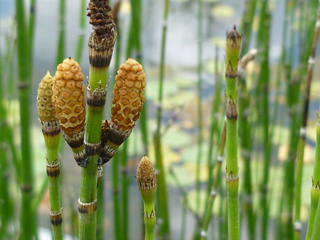
Page, Lee
Equisetum hyemale
Equisetum hyemale L.
Scouring-rush Horsetail, Horsetail, Scouring Rush, Canuela
Equisetaceae (Horsetail Family)
Synonym(s):
USDA Symbol: EQHY
USDA Native Status: L48 (N), AK (N), CAN (N), GL (N)
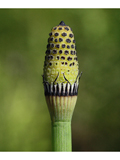
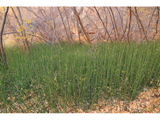
Common Scouring Rush is a spreading, reed-like perennial to 3 ft (0.9 m) tall. The evergreen stems are cylindrical, about 1/3 in (0.8 cm) in diameter, jointed, hollow, usually unbranched, and have rough longitudinal ridges. The tiny leaves are joined together around the stem, forming a narrow black-green band or sheath at each joint. Like other Pteridophytes (ferns and their relatives), Scouring Rush does not produce flowers or seeds.
Plant Characteristics
Duration: PerennialHabit: Herb
Leaf Retention: Evergreen
Leaf Arrangement: Whorled
Fruit Type: Cone
Size Notes: Up to about 6 feet tall.
Bloom Information
Bloom Color: Not ApplicableBloom Notes: Not a flowering plant. Reproduces by spores contained within sporangia borne on peltate sporophylls. Sporulates year-round.
Distribution
USA: AK , AL , AR , AZ , CA , CO , CT , DC , DE , FL , GA , IA , ID , IL , IN , KS , KY , LA , MA , MD , ME , MI , MN , MO , MS , MT , NC , ND , NE , NH , NJ , NM , NV , NY , OH , OK , OR , PA , RI , SC , SD , TN , TX , UT , VA , VT , WA , WI , WV , WYCanada: AB , BC , MB , NB , NL , NS , ON , PE , QC , SK
Native Habitat: In open or wooded areas along streams, on alluvial flats, and on wet ledges; throughout Texas, most common in Blackland Prairies and on the Edwards Plateau. Sand, loam, clay, or limestone; poor drainage okay or in shallow water.
Growing Conditions
Water Use: MediumLight Requirement: Sun , Part Shade , Shade
Soil Moisture: Moist , Wet
Soil Description: Occurs in wet places, including pond margins, swamps, floodplains and ditches.
Conditions Comments: Horsetail's smooth, segmented, upright foliage appears striking in a container, pond or landscape setting. It is one of the best dragonfly perches. The plant does not have true fruit, it has interesting cones instead. It is best to contain it in a pot with no holes and be watchful that it doesn't creep over the edge. It is very aggressive.
Benefit
Use Ornamental: Bog or pond area, Water garden, Erosion control. Often grown in Japanese-style gardens, at the edge of ponds and in the margins of ornamental water gardens.Use Medicinal: Used as a homeopathic remedy
Use Other: A dense stand of scouring rush along the margin of an ornamental pool can be very attractive and will exclude weeds.
Interesting Foliage: yes
Deer Resistant: High
Propagation
Propagation Material: Root DivisionCommercially Avail: yes
Mr. Smarty Plants says
Native shade plants around fountain in California
March 18, 2009
Hi, we just put a fountain in our front yard. It is in a mostly shady area. I need to know what plants would go best around the fountain and survive in the shade.
view the full question and answer
Native plants to stop pond bank erosion
June 04, 2008
I recently purchased a home with a small pond in which a nearby stream daylights. The former owner placed large field stone around the pond and the small stream; however, the area around the pond and...
view the full question and answer
Native plants for container gardens in Central Texas
March 11, 2008
Dear Mr. Smarty Plants: I moved to TX last year, for now living in an apartment with a good-size but shady deck; my garden in VA was full of VA native plants. What TX natives, if any, can I grow in ...
view the full question and answer
National Wetland Indicator Status
| Region: | AGCP | AK | AW | CB | EMP | GP | HI | MW | NCNE | WMVE |
| Status: | FACW | FACW | FACW | FACW | FACW | FACW | FAC | FACW |
From the National Organizations Directory
According to the species list provided by Affiliate Organizations, this plant is on display at the following locations:Santa Barbara Botanic Garden - Santa Barbara, CA
Texas Discovery Gardens - Dallas, TX
Delaware Nature Society - Hockessin, DE
Nueces River Authority - Uvalde, TX
NPSOT - Austin Chapter - Austin, TX
Bibliography
Bibref 318 - Native Texas Plants: Landscaping Region by Region (2002) Wasowski, S. & A. WasowskiSearch More Titles in Bibliography
Web Reference
Webref 38 - Flora of North America (2019) Missouri Botanical Garden, St. Louis, MO & Harvard University Herbaria, Cambridge, MA.Webref 23 - Southwest Environmental Information Network (2009) SEINet - Arizona Chapter
Additional resources
USDA: Find Equisetum hyemale in USDA PlantsFNA: Find Equisetum hyemale in the Flora of North America (if available)
Google: Search Google for Equisetum hyemale
Metadata
Record Modified: 2023-03-30Research By: TWC Staff, TMH