Native Plants

Plant Database
Search for native plants by scientific name, common name or family. If you are not sure what you are looking for, try the Combination Search or our Recommended Species lists.
Loughmiller, Campbell and Lynn
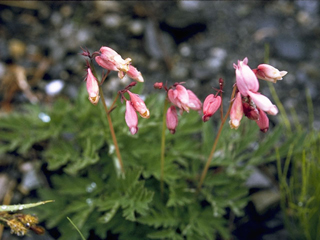
Dicentra formosa
Dicentra formosa (Haw.) Walp.
Pacific Bleeding Heart, Pacific Bleedinghearts, Western Bleedingheart
Fumariaceae (Fumitory Family)
Synonym(s):
USDA Symbol: DIFO
USDA Native Status: L48 (N), CAN (N)
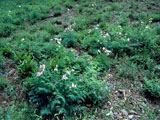
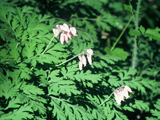
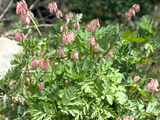
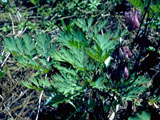
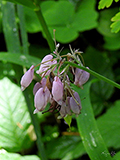
Drooping clusters of pink, heart-shaped flowers, flushed with lavender, are attached to the leafless stems of this perennial. Pink, heart-shaped flowers hang in small, branched clusters above soft, fern-like, bluish-green leaves at base. The airy, fern-like foliage occurs on separate stalks. Pacific bleedinghearts grows from 6-18 in. in height.
One of the nursery-trade species. Bleeding Heart (D. spectabilis), from Japan, has larger, rosy-red or white flowers, about 1" (2.5 cm) long.
Plant Characteristics
Duration: PerennialHabit: Herb
Leaf Arrangement: Alternate
Fruit Type: Capsule
Size Notes: Up to about 18 inches tall.
Leaf: Green
Bloom Information
Bloom Color: White , Pink , Yellow , PurpleBloom Time: Mar , Apr , May , Jun , Jul , Aug , Sep
Distribution
USA: CA , MA , OR , WACanada: BC
Native Distribution: C. CA to w. B.C.
Native Habitat: Cool, damp woods
Growing Conditions
Water Use: LowLight Requirement: Sun , Part Shade , Shade
Soil Moisture: Moist
CaCO3 Tolerance: None
Soil Description: Moist, well-drained, humus-rich soil.
Conditions Comments: Western bleeding heart must be kept mulched with decaying humus, especially in cold winters. Extensive rhizome systems spread to establish colonies.
Benefit
Use Wildlife: HummingbirdsWarning: POISONOUS PARTS: All parts. Toxic only in large quantities. Causes minor skin irritation when touched, lasting only for a few minutes. Symptoms includes trembling, staggering, vomiting, diarrhea, convulsions, labored breathing. Skin irritation after repeated contact with the cell sap. Toxic Principle: Several isoquinolone alkaloids. (Poisonous Plants of N.C.);
Seeds are spread by ants.
Conspicuous Flowers: yes
Attracts: Hummingbirds
Propagation
Description: Divisions from rhizomes should be planted vertically in wet peat pots with the eye at soil level. Small, blooming plants will be ready the following year. This plant can also be propagated by seed, however it takes several years for seedlings to grow toSeed Collection: Collect seeds in the summer.
Seed Treatment: Seeds need moist, cold stratification if they have not been given a natural overwinter treatment outdoors.
Commercially Avail: yes
Find Seed or Plants
Find seed sources for this species at the Native Seed Network.
National Wetland Indicator Status
| Region: | AGCP | AK | AW | CB | EMP | GP | HI | MW | NCNE | WMVE |
| Status: | FACU | FACU | FACU |
From the National Organizations Directory
According to the species list provided by Affiliate Organizations, this plant is on display at the following locations:Santa Barbara Botanic Garden - Santa Barbara, CA
Native Seed Network - Corvallis, OR
Web Reference
Webref 38 - Flora of North America (2019) Missouri Botanical Garden, St. Louis, MO & Harvard University Herbaria, Cambridge, MA.Webref 23 - Southwest Environmental Information Network (2009) SEINet - Arizona Chapter
Additional resources
USDA: Find Dicentra formosa in USDA PlantsFNA: Find Dicentra formosa in the Flora of North America (if available)
Google: Search Google for Dicentra formosa
Metadata
Record Modified: 2023-02-06Research By: TWC Staff