Native Plants

Plant Database
Search for native plants by scientific name, common name or family. If you are not sure what you are looking for, try the Combination Search or our Recommended Species lists.
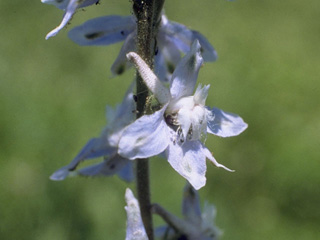
Dana, Michael
Delphinium carolinianum ssp. virescens
Delphinium carolinianum Walter ssp. virescens (Nutt.) R.E. Brooks
Carolina Larkspur, Prairie Larkspur, Plains Larkspur
Ranunculaceae (Buttercup Family)
Synonym(s): Delphinium albescens, Delphinium carolinianum ssp. penardii, Delphinium penardii, Delphinium virescens, Delphinium virescens ssp. penardii, Delphinium virescens var. macroceratilis, Delphinium virescens var. penardii
USDA Symbol: DECAV2
USDA Native Status: L48 (N), CAN (N)
Prairie larkspur is a slender, erect perennial, unbranched or branched near the ground to form a clump 1-3 ft. tall. A terminal spike of white, spurred flowers, tinged purple, is borne well above the mostly basal, deeply cleft leaves.
Mature plants may disappear in hot weather, reappearing when the weather has become cooler.


Plant Characteristics
Duration: PerennialHabit: Herb
Fruit Type: Follicle
Size Notes: Up to about 3 feet tall.
Bloom Information
Bloom Color: White , Blue , PurpleBloom Time: Mar , Apr , May , Jun , Jul
Distribution
USA: AR , CO , IA , KS , MN , MO , ND , NE , OK , SD , TX , WINative Distribution: Alt. to WI, s. to AZ & AL
Native Habitat: Prairies; dry, open woodlands
Growing Conditions
Light Requirement: SunSoil Moisture: Moist
Soil Description: Various mesic to dry, limey soils.
Conditions Comments: Mature plants may disappear in hot weather, reappearing when the weather has become cooler.
Benefit
Use Medicinal: Seeds ground and soaked in alcohol to kill head lice.Warning: Plants of the genus Delphinium contain toxins, and no parts of them should ever be eaten. They can be fatally poisonous to both humans and animals. Sensitivity to a toxin varies with a person’s age, weight, physical condition, and individual susceptibility. Children are most vulnerable because of their curiosity and small size. Toxicity can vary in a plant according to season, the plant’s different parts, and its stage of growth; and plants can absorb toxic substances, such as herbicides, pesticides, and pollutants from the water, air, and soil.
Conspicuous Flowers: yes
Value to Beneficial Insects
Special Value to Bumble BeesThis information was provided by the Pollinator Program at The Xerces Society for Invertebrate Conservation.
Propagation
Propagation Material: SeedsDescription: Sow fresh seeds in fall or dry stratifited seed in May. Germination may take months. Adult plants can be divided in spring.
Seed Collection: Collect seed in May.
Seed Treatment: Very slow-growing and vulnerable to damping off. Seed out in Nursery bed, rather than growing in greenhouse.
Commercially Avail: yes
From the National Organizations Directory
According to the species list provided by Affiliate Organizations, this plant is on display at the following locations:Lady Bird Johnson Wildflower Center - Austin, TX
Herbarium Specimen(s)
NPSOT 0167 Collected Apr. 24, 1987 in Bexar County by Harry CliffeNPSOT 1081 Collected May 10, 1996 in Guadalupe County by Elizabeth W. Hughes
Bibliography
Bibref 946 - Gardening with Prairie Plants: How to Create Beautiful Native Landscapes (2002) Wasowski, SallySearch More Titles in Bibliography
Web Reference
Webref 38 - Flora of North America (2019) Missouri Botanical Garden, St. Louis, MO & Harvard University Herbaria, Cambridge, MA.Webref 23 - Southwest Environmental Information Network (2009) SEINet - Arizona Chapter
Additional resources
USDA: Find Delphinium carolinianum ssp. virescens in USDA PlantsFNA: Find Delphinium carolinianum ssp. virescens in the Flora of North America (if available)
Google: Search Google for Delphinium carolinianum ssp. virescens
Metadata
Record Modified: 2023-02-06Research By: TWC Staff