Native Plants

Plant Database
Search for native plants by scientific name, common name or family. If you are not sure what you are looking for, try the Combination Search or our Recommended Species lists.
Vick, Albert F. W.
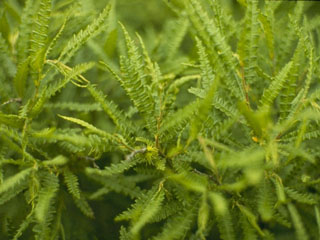
Comptonia peregrina
Comptonia peregrina (L.) J.M. Coult.
Sweet-fern, Sweetfern
Myricaceae (Bayberry Family)
Synonym(s): Comptonia peregrina var. aspleniifolia, Myrica aspleniifolia, Myrica aspleniifolia var. tomentosa, Myrica peregrina
USDA Symbol: COPE80
USDA Native Status: L48 (N), CAN (N)
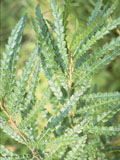
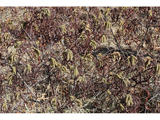
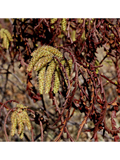
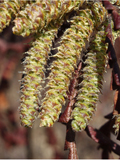
A small, aromatic mound-shaped shrub, 2-5 ft. tall, occuring in dense colonies. Multiple stems with loose, spreading branches. Long, narrow, olive-green leaves, the edges of which have rolled back edges and rounded, fern-like division. Flowers are brown catkins that appear before the leaves unfold. A small nut is enclosed in a bur-like husk.
Sweet-fern is a member of the wax-myrtle or bayberry family (family Myricaceae), which occurs nearly worldwide, with about 40 species of small trees and shrubs; 5 native tree species and 3 shrub species in North America. The leaves are very aromatic when crushed.
Plant Characteristics
Duration: PerennialHabit: Shrub
Leaf Retention: Deciduous
Leaf Arrangement: Alternate
Leaf Complexity: Simple
Fruit Type: Nut
Size Notes: Up to about 5 feet tall.
Leaf: Green
Autumn Foliage: yes
Fruit: Green, Brown - nutlets.
Bloom Information
Bloom Color: White , GreenBloom Time: May , Jun , Jul , Aug
Distribution
USA: CT , DC , DE , GA , IL , IN , KY , MA , MD , ME , MI , MN , NC , NH , NJ , NY , OH , PA , RI , SC , TN , VA , VT , WI , WVCanada: NB , NS , ON , PE
Native Distribution: N.S. to Sask., s. to GA, KY, n. IL & n. MN
Native Habitat: Dry, open woods; roadsides; sandy barrens
Growing Conditions
Water Use: LowLight Requirement: Part Shade
Soil Moisture: Dry
Soil pH: Acidic (pH<6.8)
CaCO3 Tolerance: Low
Soil Description: Sandy, acid soils.
Conditions Comments: No serious disease or insect problems.
Benefit
Use Wildlife: Throughout its range, the grey hairstreak feeds on many families of plants. For unknown reasons the grey hairstreak is restricted to feeding on sweetfern in the northern limits of its range. (Canadian BIF)Attracts: Birds , Butterflies
Larval Host: Grey Hairstreak butterfly (Strymon melinus)
Butterflies and Moths of North America (BAMONA)
|
Gray Hairstreak (Strymon melinus) 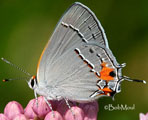 Larval Host |
Propagation
Description: Root cuttings are the principal means of propagation. Place horizontally, 1/2 in. deep, in sand: sphagnum. Stem cuttings must be taken from juvenile growth. Collect juvenile stems 3 in. or less in length. Germination of seed is difficult.Commercially Avail: yes
Mr. Smarty Plants says
Attracting butterflies in Tennessee
July 03, 2009
What flowers and plants do the caterpillars in Tennessee eat? And do you know what butterflies live in Tipton Co. Tennessee?
view the full question and answer
From the National Organizations Directory
According to the species list provided by Affiliate Organizations, this plant is on display at the following locations:Delaware Nature Society - Hockessin, DE
Mt. Cuba Center - Hockessin, DE
Bibliography
Bibref 1186 - Field Guide to Moths of Eastern North America (2005) Covell, C.V., Jr.Bibref 1185 - Field Guide to Western Butterflies (Peterson Field Guides) (1999) Opler, P.A. and A.B. Wright
Search More Titles in Bibliography
Web Reference
Webref 38 - Flora of North America (2019) Missouri Botanical Garden, St. Louis, MO & Harvard University Herbaria, Cambridge, MA.Webref 23 - Southwest Environmental Information Network (2009) SEINet - Arizona Chapter
Additional resources
USDA: Find Comptonia peregrina in USDA PlantsFNA: Find Comptonia peregrina in the Flora of North America (if available)
Google: Search Google for Comptonia peregrina
Metadata
Record Modified: 2023-01-11Research By: TWC Staff