Native Plants

Plant Database
Search for native plants by scientific name, common name or family. If you are not sure what you are looking for, try the Combination Search or our Recommended Species lists.
Marcus, Joseph A.
Condalia hookeri
Condalia hookeri M.C. Johnst.
Bluewood Condalia, Brasil, Brasilwood, Bluewood, Logwood, Purple Haw, Capul Negro
Rhamnaceae (Buckthorn Family)
Synonym(s):
USDA Symbol: COHO
USDA Native Status: L48 (N)
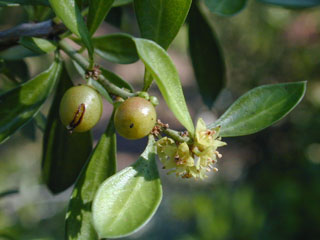
Thorny, much-branched, thicket-forming shrub or small tree with thin crown of widely spreading, stiff branches and very small leaves. Branchlets of current year's growth green, older growth gray streaked with brown. New, vibrant, lime-green leaves appear in early spring just as the previous year’s leaves finally drop. Leaves paddle shaped, the widest part nearer the tip than the base tip with a small point, margins smooth to weakly toothed toward the tip, the remainder of the blade tapering to the petiole. Fruits, in various stages of ripeness, range from green to red to black. Flowers small, green, inconspicuous. Fruit spherical, about 5/16 inch in diameter, fleshy, black, ripening in summer.
The species of this plant is named for William Jackson Hooker (1785-1865) who was Director of Kew Gardens from 1841-1865. He wrote “Flora boreali-americana” and many other works. He was founder and editor of “Journal of Botany”.
Jelly can be made from the edible fruit, but the impenetrable thickets with thorny twigs make the fruit difficult to harvest. The common name refers to a blue dye obtained from the wood, which is also prized for fuel.


Plant Characteristics
Duration: PerennialHabit: Shrub , Tree
Leaf Retention: Semi-evergreen
Leaf Arrangement: Alternate
Leaf Complexity: Simple
Leaf Shape: Obovate
Leaf Pubescence: Glabrous
Leaf Margin: Entire
Leaf Apex: Mucronate
Breeding System: Flowers Bisexual
Inflorescence: Axillary , Thyrse , Umbel
Fruit Type: Drupe
Size Notes: Up to about 20 feet tall when growing as a tree. Much shorter when shrubby.
Flower: Corolla absent.
Fruit: Globose, 0.5 cm.
Bloom Information
Bloom Color: GreenBloom Time: Mar , Apr , May , Jun , Jul , Aug , Sep , Oct
Bloom Notes: Main flowering period is April - July.
Distribution
USA: TXNative Distribution: C. TX, s. to northeastern Mex.
Native Habitat: Dry, brushy pastures & woods
Growing Conditions
Water Use: LowLight Requirement: Part Shade
Soil Moisture: Dry
Cold Tolerant: yes
Soil Description: Dry soils. Sandy, Sandy Loam, Medium Loam, Clay Loam, Clay, Caliche type
Conditions Comments: Condalia hookeri can be grown from seed collected after the fruit has turned a black or purplish color. It can also be propagated from semihardwood cuttings. The shrub has dense folliage and the new leaves are a fresh bright green. Each branch is stiff and ends in a sharp thorn. Condalia hookeri can be grown from seed collected after the fruit has turned a black or purplish color. It can also be propagated from semihardwood cuttings. The shrub has dense folliage and the new leaves are a fresh bright green. Each branch is stiff and ends in a sharp thorn. It is a good wildlife habitat plant providing dense cover and fruit throughout the summer eaten by the gray fox, raccoon, and various birds.
Benefit
Use Ornamental: Attractive, Fruits ornamentalUse Wildlife: Good wildlife habitat. Fruit is eaten by fox, raccoon, and various birds. Fruit-birds, Cover, Nesting site, Nectar-insects.
Interesting Foliage: yes
Attracts: Birds , Butterflies
Larval Host: Snout butterfly.
Butterflies and Moths of North America (BAMONA)
|
Tamaulipan agapema (Agapema galbina)  Larval Host |
From the National Organizations Directory
According to the species list provided by Affiliate Organizations, this plant is on display at the following locations:Lady Bird Johnson Wildflower Center - Austin, TX
Brackenridge Field Laboratory - Austin, TX
Texas Parks and Wildlife Department - Austin, TX
NPSOT - Austin Chapter - Austin, TX
National Butterfly Center - Mission, TX
Bibliography
Bibref 1186 - Field Guide to Moths of Eastern North America (2005) Covell, C.V., Jr.Bibref 298 - Field Guide to Texas Trees (1999) Simpson, B.J.
Bibref 1185 - Field Guide to Western Butterflies (Peterson Field Guides) (1999) Opler, P.A. and A.B. Wright
Bibref 355 - Landscaping with Native Plants of Texas and the Southwest (1991) Miller, G. O.
Bibref 354 - Native & Naturalized Woody Plants of Austin & the Hill Country (1981) Lynch, D.
Bibref 318 - Native Texas Plants: Landscaping Region by Region (2002) Wasowski, S. & A. Wasowski
Bibref 291 - Texas Wildscapes: Gardening for Wildlife (1999) Damude, N. & K.C. Bender
Bibref 297 - Trees of Central Texas (1984) Vines, Robert A.
Search More Titles in Bibliography
Web Reference
Webref 3 - Flora of North America (2014) Missouri Botanical Garden, St. Louis, MO & Harvard University Herbaria, Cambridge, MA.Additional resources
USDA: Find Condalia hookeri in USDA PlantsFNA: Find Condalia hookeri in the Flora of North America (if available)
Google: Search Google for Condalia hookeri
Metadata
Record Modified: 2022-10-03Research By: NPC