Native Plants

Plant Database
Search for native plants by scientific name, common name or family. If you are not sure what you are looking for, try the Combination Search or our Recommended Species lists.
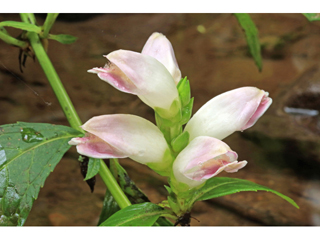
Cressler, Alan
Chelone glabra
Chelone glabra L.
White Turtlehead
Scrophulariaceae (Figwort Family)
Synonym(s): Chelone chlorantha, Chelone glabra var. chlorantha, Chelone glabra var. dilatata, Chelone glabra var. elatior, Chelone glabra var. elongata, Chelone glabra var. linifolia, Chelone glabra var. ochroleuca, Chelone glabra var. typica, Chelone montana
USDA Symbol: CHGL2
USDA Native Status: L48 (N), CAN (N), SPM (N)
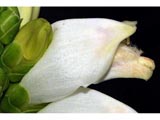
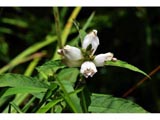
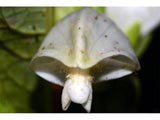
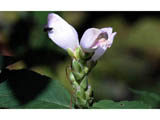
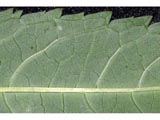
This smooth plant has tight terminal clusters of white (often lavender-tinged) tubular, 2-lipped flowers resembling turtle heads. White turtlehead, a robust perennial, usually grows 1-4 ft. tall. Its erect stems end in spikes of white to pinkish flowers, the shape of which suggests a turtle head. The leaves are elongate and arranged opposite each other along the stem.
The distinctive shape of this flower is reflected in the genus name, derived from the Greek chelone ("a tortoise").
Plant Characteristics
Duration: PerennialHabit: Herb
Fruit Type: Capsule
Size Notes: Up to about 6 feet tall, often much shorter.
Bloom Information
Bloom Color: White , Red , Pink , PurpleBloom Time: Jul , Aug , Sep , Oct , Nov
Bloom Notes: All white to white in tube and distally greenish white, pink, red or purplish.
Distribution
USA: AL , AR , CT , DC , DE , GA , IA , IL , IN , KY , MA , MD , ME , MI , MN , MO , MS , NC , NH , NJ , NY , OH , PA , RI , SC , TN , VA , VT , WI , WVCanada: NB , NL , NS , ON , PE , QC
Native Distribution: Nf. to MN, s. to GA & n.e. AR
Native Habitat: Brushy marshes; stream banks; wet ditches; low meadows; woodlands
Growing Conditions
Light Requirement: Sun , Part Shade , ShadeSoil Moisture: Moist , Wet
Soil pH: Acidic (pH<6.8)
Soil Description: Light, rich, wet to moist soils.
Benefit
Conspicuous Flowers: yesAttracts: Butterflies , Hummingbirds
Larval Host: Baltimore Checkerspot (Euphydryas phaeton).
Butterflies and Moths of North America (BAMONA)
|
Baltimore (Euphydryas phaeton) 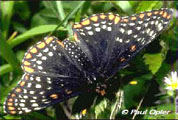 Larval Host |
Propagation
Description: Plant seeds outside in fall or moist-chill and plant in spring. Seedlings germinate after one year and flower after two. Roots can be divided in early spring or late fall with the plant is dormant. Space divisions 18 in. apart. Make stem cuttings inSeed Collection: The papery capsule turns darker shades of brown when the seeds approach maturity. The seeds are usually ready for harvest at or near the first frost. Air-dry the capsules, separate the seeds and store in sealed, refrigerated containers.
Seed Treatment: Moist-chill stored seeds six weeks prior to sowing.
Commercially Avail: yes
Find Seed or Plants
Find seed sources for this species at the Native Seed Network.
Mr. Smarty Plants says
Native wildflowers for Northern Indiana
May 08, 2007
I had the wonderful opportunity to visit the Lady Bird Johnson Wildflower Center
on Saturday April 21. What a beautiful place. I thoroughly enjoyed my visit. I was
wondering how I could find out w...
view the full question and answer
National Wetland Indicator Status
| Region: | AGCP | AK | AW | CB | EMP | GP | HI | MW | NCNE | WMVE |
| Status: | OBL | OBL | OBL | OBL | OBL |
From the National Organizations Directory
According to the species list provided by Affiliate Organizations, this plant is on display at the following locations:Native Plant Center at Westchester Community College, The - Valhalla, NY
Delaware Nature Society - Hockessin, DE
Native Seed Network - Corvallis, OR
Mt. Cuba Center - Hockessin, DE
Bibliography
Bibref 1186 - Field Guide to Moths of Eastern North America (2005) Covell, C.V., Jr.Bibref 1185 - Field Guide to Western Butterflies (Peterson Field Guides) (1999) Opler, P.A. and A.B. Wright
Bibref 1294 - The Midwestern Native Garden: Native Alternatives to Nonnative Flowers and Plants An Illustrated Guide (2011) Adelman, Charlotte and Schwartz, Bernard L.
Search More Titles in Bibliography
Web Reference
Webref 38 - Flora of North America (2019) Missouri Botanical Garden, St. Louis, MO & Harvard University Herbaria, Cambridge, MA.Webref 23 - Southwest Environmental Information Network (2009) SEINet - Arizona Chapter
Additional resources
USDA: Find Chelone glabra in USDA PlantsFNA: Find Chelone glabra in the Flora of North America (if available)
Google: Search Google for Chelone glabra
Metadata
Record Modified: 2022-12-06Research By: TWC Staff