Native Plants

Plant Database
Search for native plants by scientific name, common name or family. If you are not sure what you are looking for, try the Combination Search or our Recommended Species lists.
Cressler, Alan
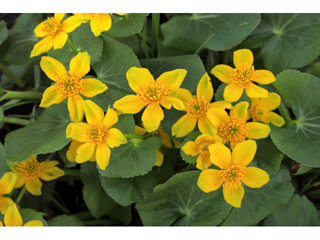
Caltha palustris
Caltha palustris L.
Yellow Marsh Marigold, Cowslip
Ranunculaceae (Buttercup Family)
Synonym(s):
USDA Symbol: CAPA5
USDA Native Status: L48 (N), AK (N), CAN (N)
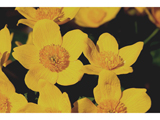
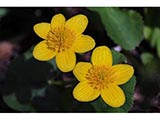
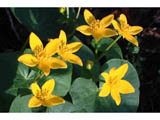
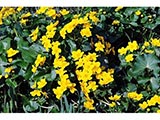
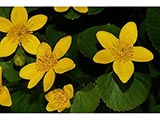
A succulent plant with glossy, heart- or kidney-shaped leaves and a thick, hollow, branching stem with bright, shiny yellow flowers. Yellow marsh-marigold is a mounded perennial, 1-2 ft. tall, with thick stems; broadly heart-shaped leaves; and clusters of large, showy, buttercup-like, yellow flowers.
The flowers of this showy spring plant resemble large buttercups rather than the marigolds. The leaves are sometimes used as potherbs but require several short boilings with changes of water between. They should not be eaten raw. A smaller species, Floating Marsh Marigold (C. natans), found from Alaska southeastward to northern Minnesota, has small white or pinkish flowers, kidney-shaped leaves, and stems that often float.
Plant Characteristics
Duration: PerennialHabit: Herb
Fruit Type: Follicle
Size Notes: Up to about 2 feet tall.
Leaf: Green
Bloom Information
Bloom Color: YellowBloom Time: Apr , May
Distribution
USA: AK , CA , CT , DE , IA , IL , IN , KY , MA , MD , ME , MI , MN , MO , NC , ND , NE , NH , NJ , NY , OH , OR , PA , RI , SC , SD , TN , VA , VT , WA , WI , WVCanada: BC , MB , NB , NL , NS , ON , PE , QC
Native Distribution: Transcontinental Canada, s. to NC, TN & IA
Native Habitat: Wet woods, marshy hollows, stream edges
Growing Conditions
Water Use: HighLight Requirement: Part Shade , Shade
Soil Moisture: Moist , Wet
Soil pH: Acidic (pH<6.8)
CaCO3 Tolerance: Low
Soil Description: Muddy, humus-rich soil.
Conditions Comments: Marsh marigold requires little care other than protection from drying, winter and early spring winds.
Benefit
Use Food: EDIBLE PARTS: Cooked, early spring greens are edible. Cover the young leaves with 2-3 changes of boiling water until barely tender; cut into bite-sized pieces, salt lightly, and cover with butter and some vinegar. Tightly closed buds can be pickled after covering with boiling water as described for leaves. Do not boil. The leaves are sometimes used as potherbs but require several short boilings with changes of water between. (Niering)Warning: Plant juices can cause blistering or inflammation on skin or mucous membranes on contact, and gastric illness if ingested. POISONOUS PARTS: Leaves. Toxic only in large quantities. Symptoms include burning of the throat, vomiting, bloody diarrhea, dizziness, fainting, and convulsions. Toxic Principle: Protoanemonin. (Niering)
Conspicuous Flowers: yes
Attracts: Birds
Propagation
Description: Seeds should be sown immediately upon ripening and should not be allowed to dry out before sowing. Seedlings do not flower until the third year following germination. Also reproduces rapidly by division.Seed Collection: Approximate collection date in northern U.S.: early to mid Jun.
Commercially Avail: yes
Find Seed or Plants
Find seed sources for this species at the Native Seed Network.
National Wetland Indicator Status
| Region: | AGCP | AK | AW | CB | EMP | GP | HI | MW | NCNE | WMVE |
| Status: | OBL | OBL | OBL | OBL | OBL | OBL | OBL | OBL |
From the National Organizations Directory
According to the species list provided by Affiliate Organizations, this plant is on display at the following locations:Delaware Nature Society - Hockessin, DE
Native Seed Network - Corvallis, OR
Mt. Cuba Center - Hockessin, DE
Bibliography
Bibref 841 - Native Alternatives to Invasive Plants (2006) Burrell, C. C.Bibref 1294 - The Midwestern Native Garden: Native Alternatives to Nonnative Flowers and Plants An Illustrated Guide (2011) Adelman, Charlotte and Schwartz, Bernard L.
Search More Titles in Bibliography
Web Reference
Webref 38 - Flora of North America (2019) Missouri Botanical Garden, St. Louis, MO & Harvard University Herbaria, Cambridge, MA.Webref 23 - Southwest Environmental Information Network (2009) SEINet - Arizona Chapter
Additional resources
USDA: Find Caltha palustris in USDA PlantsFNA: Find Caltha palustris in the Flora of North America (if available)
Google: Search Google for Caltha palustris
Metadata
Record Modified: 2023-01-31Research By: TWC Staff