Native Plants

Plant Database
Search for native plants by scientific name, common name or family. If you are not sure what you are looking for, try the Combination Search or our Recommended Species lists.
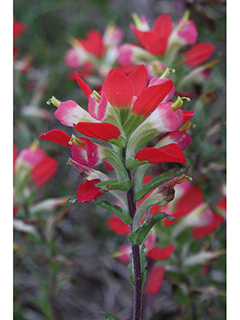
Smith, R.W.
Castilleja indivisa
Castilleja indivisa Engelm.
Texas Indian Paintbrush, Entireleaf Indian Paintbrush, Texas Paintbrush, Indian Paintbrush, Scarlet Paintbrush
Scrophulariaceae (Figwort Family)
Synonym(s):
USDA Symbol: CAIN13
USDA Native Status: L48 (N)
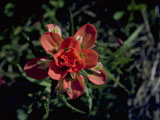
One of the popular paintbrushes, this showy annual or biennial grows 6-18 in. high. Its several unbranched stems form clumps topped by bright-red, paintbrush-like spikes. The flowers are less conspicuous than the bracts and greenish at the base, they are subtended by showy, typically red-tipped bracts. They sometimes produce a light yellow or pure white variation mixed in with the reds. Together, the flowers and bracts form 3-8 in. spikes.
This and other Castilleja species are hemiparasitic, especially on grasses, penetrating these "host" roots to obtain a portion of their nutrients. Transplanting paintbrush may kill it. Indian paintbrush has a reputation for being unpredictable. In some years, when bluebonnets (which flower at approximately the same time as Indian paintbrush) are especially colorful, paintbrush will have only an average flowering year. Other years, paintbrush is spectacular.


Plant Characteristics
Duration: AnnualHabit: Herb
Leaf Margin: Entire
Fruit Type: Capsule
Size Notes: Up to about 18 inches tall.
Flower: Flowers in 3 inch spikes.
Bloom Information
Bloom Color: White , Red , Orange , Yellow , GreenBloom Time: Jan , Feb , Mar , Apr , May , Jun , Jul , Aug , Sep , Oct , Nov , Dec
Bloom Notes: Castilleja is an unusual member of the Scrophulariaceae, the snapdragon family. Its vivid “flower” color is actually provided by bracts – not flower petals - which are grouped around and under each of the inconspicuous flowers located on the upper third of the plant. Main flowering season is spring and summer. May flower sporadically year-round.
Distribution
USA: AR , LA , OK , TXNative Distribution: S.e. OK, e. TX & LA
Native Habitat: Prairie, Plains, Meadows, Pastures, Savannas, Woodlands' edge, Opening, Roadsides
Growing Conditions
Water Use: MediumLight Requirement: Sun
Soil Moisture: Dry
Soil pH: Acidic (pH<6.8)
Soil Description: Sandy soils. Sandy Loam, Sandy, Medium Loam, Clay Loam, Clay
Conditions Comments: The roots of this plant will grow until they touch the roots of other plants, frequently grasses, penetrating these "host" roots to obtain a portion of their nutrients. Transplanting paintbrush may kill it.
Benefit
Use Ornamental: Pocket prairie, Wildflower meadow, Shortgrass meadow, Grows in clumps, GardenUse Wildlife: Nectar-Hummingbirds, Nectar-insects.
Conspicuous Flowers: yes
Attracts: Butterflies
Larval Host: Buckeye butterfly.
Propagation
Propagation Material: SeedsDescription: Seed in open, sunny sites for best results. Indian paintbrush seed may require a cold wet period in the winter to germinate. Plant the seed in the fall and rake it into loose topsoil to ensure good seed/soil contact. Seeds are exceptionally small (4 million seeds per pound), commercially available, depending on the previous year’s seed crop and can be expensive. The recommended seeding rate in 1/4 pound per acre.
Seed Collection: Seeds are formed in capsules at the base of each flower. Seed capsules may be carefully collected by hand April – May when the capsules are dry and brown.
Commercially Avail: yes
Maintenance: After flowering ceases, allow seeds to completely mature before mowing for reseeding or collecting to plant in a new area. Since C. indivisa is an annual, it is essential that this species be allowed to reseed for an abundant display for the following year.
Find Seed or Plants
Order seed of this species from Native American Seed and help support the Wildflower Center.
Mr. Smarty Plants says
Parasitic paintbrush
March 29, 2009
Many years ago I tried to grow some paintbrush seedlings with some seeds you sent me and found it difficult. Based on pictures in the literature I noticed that paintbrushes do not seem to affect their...
view the full question and answer
Wildlife uses of wildflowers in Central Texas
May 01, 2006
How are wildflowers in Central Texas used by wildlife?
view the full question and answer
National Wetland Indicator Status
| Region: | AGCP | AK | AW | CB | EMP | GP | HI | MW | NCNE | WMVE |
| Status: | FAC | FAC | FAC | FAC |
From the National Organizations Directory
According to the species list provided by Affiliate Organizations, this plant is on display at the following locations:Fredericksburg Nature Center - Fredericksburg, TX
Lady Bird Johnson Wildflower Center - Austin, TX
Pineywoods Native Plant Center - Nacogdoches, TX
Stengl Biological Research Station - Smithville, TX
Texas Parks and Wildlife Department - Austin, TX
Wildflower Center Seed Bank
LBJWC-1282 Collected 2009-04-25 in Brazoria County by Lady Bird Johnson Wildflower CenterBibliography
Bibref 765 - McMillen's Texas Gardening: Wildflowers (1998) Howard, D.Bibref 318 - Native Texas Plants: Landscaping Region by Region (2002) Wasowski, S. & A. Wasowski
Bibref 281 - Shinners & Mahler's Illustrated Flora of North Central Texas (1999) Diggs, G. M.; B. L. Lipscomb; B. O'Kennon; W. F...
Bibref 248 - Texas Wildflowers: A Field Guide (1984) Loughmiller, C. & L. Loughmiller
Bibref 291 - Texas Wildscapes: Gardening for Wildlife (1999) Damude, N. & K.C. Bender
Bibref 328 - Wildflowers of Texas (2003) Ajilvsgi, Geyata.
Bibref 286 - Wildflowers of the Texas Hill Country (1989) Enquist, M.
Search More Titles in Bibliography
Web Reference
Webref 38 - Flora of North America (2019) Missouri Botanical Garden, St. Louis, MO & Harvard University Herbaria, Cambridge, MA.Webref 23 - Southwest Environmental Information Network (2009) SEINet - Arizona Chapter
From the Archive
Wildflower Newsletter 1989 VOL. 6, NO.2 - Wildflower Network Operates in Louisiana, Wildflower Handbook Published, Researc...Wildflower Newsletter 1989 VOL. 6, NO.5 - Educator\\\'s Native Plants Poster Perfected, Pass a Law, Protect a Tree, Resear...
Wildflower Newsletter 1990 VOL. 7, NO.1 - Congress Eyes Larger Issue, Research Update, Director's Report, Carlton B. Lees ...
Wildflower Newsletter 1990 VOL. 7, NO.3 - Is Wildflower Collecting a Good School Activity, Wildflower Center Study Finds C...
Wildflower Newsletter 1990 VOL. 7, NO.6 - Members Respond to Grasslands Appeal, Wildflower Center Opening Midwest Regional...
Wildflower Newsletter 1992 VOL. 9, NO.3 - Water and Landscaping with Native Plants, Research Update, Research Director's R...
Wildflower Newsletter 1992 VOL. 9, NO.5 - Ten Year Anniversary Celebration, A Look Back at Our First Decade, Celebration o...
Additional resources
USDA: Find Castilleja indivisa in USDA PlantsFNA: Find Castilleja indivisa in the Flora of North America (if available)
Google: Search Google for Castilleja indivisa
Metadata
Record Modified: 2023-01-11Research By: TWC Staff