Native Plants

Plant Database
Search for native plants by scientific name, common name or family. If you are not sure what you are looking for, try the Combination Search or our Recommended Species lists.
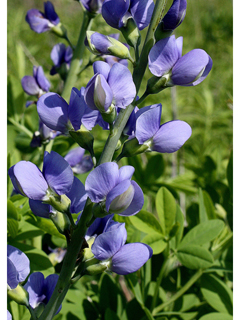
Smith, R.W.
Baptisia australis
Baptisia australis (L.) R. Br.
Blue Wild Indigo, Wild Blue Indigo, Blue False Indigo
Fabaceae (Pea Family)
Synonym(s):
USDA Symbol: BAAU
USDA Native Status: L48 (N), CAN (I)
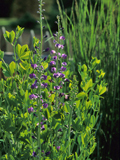
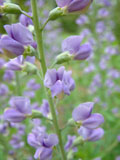
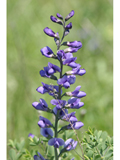
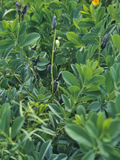
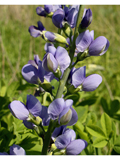
Rising 2-4 ft. high from a woody base, blue wild indigo is a bushy, robust perennial. Flowers are blue-purple and pea-like, congested in dense, upright, terminal spikes, 4-16 in. long. Leaves are divided into three leaflets. In late fall the plant turns silvery-gray, sometimes breaking off at ground level and tumbling about in the wind.
Like other members of the pea family, this plant requires the presence of microorganisms that inhabit nodules on the plant's root system and produce nitrogen compounds necessary for the plant's survival.
Plant Characteristics
Duration: PerennialHabit: Herb
Leaf Arrangement: Alternate
Fruit Type: Legume
Size Notes: 3 to 5 feet tall by 3 feet wide
Leaf: Blue
Bloom Information
Bloom Color: Blue , PurpleBloom Time: Apr , May , Jun , Jul
Distribution
USA: AL , AR , CT , DC , GA , IA , IL , IN , KS , KY , MA , MD , MI , MO , NC , NE , NH , NJ , NY , OH , OK , PA , TN , TX , VA , VT , WVNative Distribution: PA to s. IN, s. to GA & TN; introduced in New England; var. minor ranges from IA & s.e. NE to TX
Native Habitat: Wood edges; limestone glades; prairies
Growing Conditions
Water Use: MediumLight Requirement: Sun
Soil Moisture: Moist
Soil pH: Acidic (pH<6.8) , Circumneutral (pH 6.8-7.2)
CaCO3 Tolerance: Medium
Soil Description: Moist, well-drained, clays. Tolerates lime.
Benefit
Use Medicinal: Amerindians used root tea as emetic and purgative; cold tea given to stop vomiting. Root poulticed as an anti-inflammatory. Held in mouth to treat toothaches. Toxic.Use Other: Plant juice turns purple on exposure and is a fair substitute for true indigo in making blue dye.
Warning: Other plants in this genus are poisonous if ingested, although no human fatalities have been recorded. Sensitivity to a toxin varies with a person’s age, weight, physical condition, and individual susceptibility. Children are most vulnerable because of their curiosity and small size. Toxicity can vary in a plant according to season, the plant’s different parts, and its stage of growth; and plants can absorb toxic substances, such as herbicides, pesticides, and pollutants from the water, air, and soil.
Conspicuous Flowers: yes
Value to Beneficial Insects
Special Value to Native BeesSpecial Value to Bumble Bees
This information was provided by the Pollinator Program at The Xerces Society for Invertebrate Conservation.
Propagation
Description: Seeds may be sown outside in late fall or the following spring without any cold treatment. Plant 1/2" deep. Plants germinate quickly but do not flower for up to 3 years. The tough rootstock can be divided in fall or spring when the plant is dormant. TSeed Collection: About six weeks past flowering, the pods should be black and beginning to open. Collect at this time comb the seeds from the pod. Mature, viable seeds will be brownish, hard and rounded. Store in sealed, refrigerated containers.
Commercially Avail: yes
Find Seed or Plants
Order seed of this species from Native American Seed and help support the Wildflower Center.
Find seed sources for this species at the Native Seed Network.
View propagation protocol from Native Plants Network.
National Wetland Indicator Status
| Region: | AGCP | AK | AW | CB | EMP | GP | HI | MW | NCNE | WMVE |
| Status: | FACU |
From the National Organizations Directory
According to the species list provided by Affiliate Organizations, this plant is on display at the following locations:Delaware Nature Society - Hockessin, DE
Natural Biodiversity - Johnstown, PA
Native Seed Network - Corvallis, OR
NPSOT - Williamson County Chapter - Georgetown, TX
Mt. Cuba Center - Hockessin, DE
Bibliography
Bibref 417 - Field Guide to Medicinal Plants and Herbs of Eastern and Central North America (2000) Foster, S. & J. A. DukeBibref 1620 - Gardening with Native Plants of the South (Reprint Edition) (2009) Wasowski, S. with A. Wasowski
Bibref 946 - Gardening with Prairie Plants: How to Create Beautiful Native Landscapes (2002) Wasowski, Sally
Bibref 1294 - The Midwestern Native Garden: Native Alternatives to Nonnative Flowers and Plants An Illustrated Guide (2011) Adelman, Charlotte and Schwartz, Bernard L.
Bibref 328 - Wildflowers of Texas (2003) Ajilvsgi, Geyata.
Search More Titles in Bibliography
Additional resources
USDA: Find Baptisia australis in USDA PlantsFNA: Find Baptisia australis in the Flora of North America (if available)
Google: Search Google for Baptisia australis
Metadata
Record Modified: 2022-07-08Research By: TWC Staff