Native Plants

Plant Database
Search for native plants by scientific name, common name or family. If you are not sure what you are looking for, try the Combination Search or our Recommended Species lists.
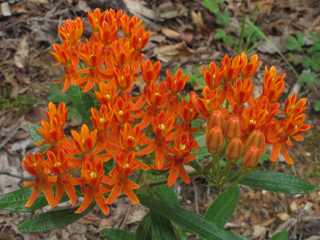
Cressler, Alan
Asclepias tuberosa
Asclepias tuberosa L.
Butterflyweed, Butterfly Weed, Butterfly Milkweed, Orange Milkweed, Pleurisy Root, Chigger Flower, Chiggerweed
Asclepiadaceae (Milkweed Family)
Synonym(s):
USDA Symbol: ASTU
USDA Native Status: L48 (N), CAN (N)
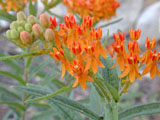
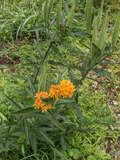
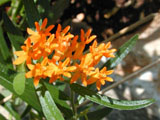
This bushy, 1 1/2-2 ft. perennial is prized for its large, flat-topped clusters of bright-orange flowers. The leaves are mostly alternate, 1 1/2-2 1/4 inches long, pointed, and smooth on the edge. The yellow-orange to bright orange flower clusters, 2-5 inches across, are at the top of the flowering stem. The abundance of stiff, lance-shaped foliage provides a dark-green backdrop for the showy flower heads.
This showy plant is frequently grown from seed in home gardens. Its brilliant flowers attract butterflies. Because its tough root was chewed by the Indians as a cure for pleurisy and other pulmonary ailments, Butterfly Weed was given its other common name, Pleurisy Root. Although it is sometimes called Orange Milkweed, this species has no milky sap.
Plant Characteristics
Duration: PerennialHabit: Herb
Leaf Retention: Deciduous
Leaf Arrangement: Alternate
Leaf Shape: Lanceolate , Linear , Oblong
Fruit Type: Follicle
Size Notes: 1-2 ft (30-60 cm).
Leaf: Linear to oblong to lanceolate. Bottom of leaf is a lighter green then the top of the leaf. 2-4 in (5-10cm) long and 3/8 - 3/4 in (1 -2 cm) wide.
Flower: Corolla, hoods, and horns are orange. Glabrous. Hoods are 3/16 - 1/4 in (5-6 mm) long, and horns just slightly smaller 1/8 in (3 mm). Horns protrude through the hoods. Corolla reflexes backward. The flowers are usually orange, rarely yellow or red. Populations west of the 100th meridian tend to be dominated by yellow colored flowers.
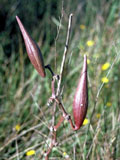
Fruit: Pod color is grayish green. Narrow, 4-8 in (10-20 cm) long by 1-2 1/2 in (2 1/2 - 6 cm) wide. Covered in short hairs.
Bloom Information
Bloom Color: Orange , YellowBloom Time: May , Jun , Jul , Aug , Sep
Distribution
USA: AL , AR , AZ , CA , CO , CT , DC , DE , FL , GA , IA , IL , IN , KS , KY , LA , MA , MD , ME , MI , MN , MO , MS , NC , NE , NH , NJ , NM , NY , OH , OK , PA , RI , SC , SD , TN , TX , UT , VA , VT , WI , WVCanada: NB , NL , NS , ON , QC
Native Distribution: Ontario to Newfoundland; New England south to Florida; west to Texas; north through Colorado to Minnesota.
Native Habitat: Grows in prairies, open woods, canyons, and hillsides throughout most of the state, common in eastern two thirds of Texas, uncommon in the Hill Country. Plant in well-drained sand, loam, clay, or limestone.
Growing Conditions
Water Use: LowLight Requirement: Sun
Soil Moisture: Dry , Moist
CaCO3 Tolerance: Medium
Drought Tolerance: High
Soil Description: Prefers well-drained sandy soils. Tolerates drought.
Conditions Comments: Butterfly weed has an interesting and unusual flower structure. Plant it among other mid-sized perennials. Inevitably butterfly weed will get aphids; you can leave them for ladybugs to eat or spray the insects and foliage with soapy water. Aphids can also be removed by blasting the plant with a high pressure stream of water.
Benefit
Use Ornamental: Butterfly weed makes a delightful cut flower. Strong color, Blooms ornamental, Showy, Long-living, Perennial garden.Use Medicinal: Its tough root was chewed by First Nations People as a cure for pleurisy and other pulmonary ailments explaining its other common name, pleurisy root. (Niering) Fresh root chewed for bronchitis and other respiratory complaints. Tea of root for diarrhea.
Use Other: This showy plant is frequently grown from seed in home gardens.
Warning: POISONOUS PARTS: Roots, plant sap from all parts. Not edible. Toxic only if eaten in large quantities. Symptoms include vomiting, stupor, weakness, spasms. Toxic Principle: Resinoid, cardiac glycoside. (Poisonous Plants of N.C.)
Conspicuous Flowers: yes
Attracts: Butterflies , Hummingbirds
Larval Host: Grey Hairstreak, Monarch, Queens
Nectar Source: yes
Deer Resistant: High
Value to Beneficial Insects
Special Value to Native BeesSpecial Value to Bumble Bees
Special Value to Honey Bees
Supports Conservation Biological Control
This information was provided by the Pollinator Program at The Xerces Society for Invertebrate Conservation.
Butterflies and Moths of North America (BAMONA)
|
Monarch (Danaus plexippus) 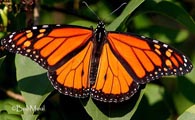 Larval Host |
Queen (Danaus gilippus) 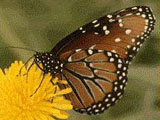 Larval Host |
Propagation
Propagation Material: Root Cuttings , SeedsDescription: The easiest method of propagation is root cuttings. In the fall, cut the taproot into 2-inch sections and plant each section vertically, keeping the area moist.
Seed Collection: Watch plants closely for seedpods in late summer/early fall. Allow seeds to completely mature before collecting seed to establish new plants in another location. A long pod is produced containing hundreds of seeds with tufts of long, silky hairs (an adaptation for wind dispersal).
Commercially Avail: yes
Maintenance: Needs to be transplanted carefully and requires good drainage. It takes 2 – 3 years before A. tuberosa produces its vibrant flowers, which appear in 2 – 3 inch clusters of orangish-red. Once established, it lasts for years, becoming thicker each year.
Find Seed or Plants
Order seed of this species from Native American Seed and help support the Wildflower Center.
Find seed sources for this species at the Native Seed Network.
View propagation protocol from Native Plants Network.
Mr. Smarty Plants says
Native flowers for Door County, Wisconsin
September 02, 2009
We recently were required to put in a new septic system on our vacation property in Door County, WI. This left us with a clearing on our wooded lot where the septic field is now located. The installer...
view the full question and answer
Attracting butterflies in Tennessee
July 03, 2009
What flowers and plants do the caterpillars in Tennessee eat? And do you know what butterflies live in Tipton Co. Tennessee?
view the full question and answer
Evergreen privacy hedge and drought-resistant garden
July 21, 2008
I am looking for a hardy evergreen hedge for privacy in Northern Michigan. I have sandy soil. Also am interested in planting a drought garden with mostly sun in same sandy soil.
view the full question and answer
Native wildflowers for Northern Indiana
May 08, 2007
I had the wonderful opportunity to visit the Lady Bird Johnson Wildflower Center
on Saturday April 21. What a beautiful place. I thoroughly enjoyed my visit. I was
wondering how I could find out w...
view the full question and answer
Toxicity and invasiveness of Scarlet Wisteria
May 04, 2007
I recently purchased seeds for Scarlet Wisteria (Chinese rattlebox tree). I spoke to a neighbor about this and she warned me not to plant them as they were poisonous to hummingbirds. Can you clarify...
view the full question and answer
From the National Organizations Directory
According to the species list provided by Affiliate Organizations, this plant is on display at the following locations:Naval Air Station Kingsville - Kingsville, TX
Fredericksburg Nature Center - Fredericksburg, TX
Lady Bird Johnson Wildflower Center - Austin, TX
Native Plant Center at Westchester Community College, The - Valhalla, NY
Texas Discovery Gardens - Dallas, TX
Delaware Nature Society - Hockessin, DE
United States Botanic Garden - Washington, DC
Stengl Biological Research Station - Smithville, TX
Texas Parks and Wildlife Department - Austin, TX
Natural Biodiversity - Johnstown, PA
Longwood Gardens - Kennett Square, PA
NPSOT - Austin Chapter - Austin, TX
Native Seed Network - Corvallis, OR
NPSOT - Williamson County Chapter - Georgetown, TX
Mt. Cuba Center - Hockessin, DE
Bibliography
Bibref 610 - Edible wild plants of the prairie : an ethnobotanical guide (1987) Kindscher, K.Bibref 1186 - Field Guide to Moths of Eastern North America (2005) Covell, C.V., Jr.
Bibref 1185 - Field Guide to Western Butterflies (Peterson Field Guides) (1999) Opler, P.A. and A.B. Wright
Bibref 1620 - Gardening with Native Plants of the South (Reprint Edition) (2009) Wasowski, S. with A. Wasowski
Bibref 946 - Gardening with Prairie Plants: How to Create Beautiful Native Landscapes (2002) Wasowski, Sally
Bibref 355 - Landscaping with Native Plants of Texas and the Southwest (1991) Miller, G. O.
Bibref 765 - McMillen's Texas Gardening: Wildflowers (1998) Howard, D.
Bibref 318 - Native Texas Plants: Landscaping Region by Region (2002) Wasowski, S. & A. Wasowski
Bibref 281 - Shinners & Mahler's Illustrated Flora of North Central Texas (1999) Diggs, G. M.; B. L. Lipscomb; B. O'Kennon; W. F...
Bibref 248 - Texas Wildflowers: A Field Guide (1984) Loughmiller, C. & L. Loughmiller
Bibref 291 - Texas Wildscapes: Gardening for Wildlife (1999) Damude, N. & K.C. Bender
Bibref 1294 - The Midwestern Native Garden: Native Alternatives to Nonnative Flowers and Plants An Illustrated Guide (2011) Adelman, Charlotte and Schwartz, Bernard L.
Bibref 328 - Wildflowers of Texas (2003) Ajilvsgi, Geyata.
Bibref 286 - Wildflowers of the Texas Hill Country (1989) Enquist, M.
Search More Titles in Bibliography
Research Literature
Reslit 447 - Evolution of inflorescence design: Theory and data (1996) M. Fishbein and D. L. VenableReslit 448 - Diversity and temporal change in the effective pollinators of Asclepias tuberosa (1996) M. Fishbein and D. L. Venable
Reslit 442 - Attractiveness of Michigan native plants to arthropod natural enemies and herbivores (2007) A. K. Fiedler and D. A. Landis
Reslit 379 - Propagation of Asclepias tuberosa from Short Root Segments (1993) R. Ecker and A. Barzilay
Reslit 568 - Identification and distribution of oviposition stimulants for monarch butterflies in hosts and nonhosts (1998) M. Haribal and J. A. A. Renwick
Reslit 1413 - Wilt and root diseases of Asclepias tuberosa L (1997) L. Tsror, M. Hazanovski, O. Erlich and N. Dagityar
Reslit 1529 - Membrane fluidity changes in embryogenic and non-embryogenic cultures of Asclepias and Daucus in response to auxin removal (1991) K. J. Wilson, W. Stillwell, T. Maxam and T. Baldri...
Reslit 1563 - Plant latex and first-instar monarch larval growth and survival on three North American milkweed species (1999) M. P. Zalucki and S. B. Malcolm
Reslit 1896 - Propagation of Asclepias tuberosa via asexual embryogenesis (1979) M. Zilis
Reslit 1943 - Micropropagation of Butterfly Weed (Asclepias tuberosa L) (1984) R. S. Stahl and J. Badenhope
This information was provided by the Florida WIldflower Foundation.
Search More Titles in Research Literature
From the Archive
Wildflower Newsletter 1985 VOL. 2, NO.2 - Guide to Black-Eyed Susan, Parkways, Wildflowers for the East, Arboretum Mall to...Wildflower Newsletter 1986 VOL. 3, NO.3 - Fall Planting Tips, Growth Provides Enthusiasm, 1985 Financial Facts, Gathering ...
Wildflower Newsletter 1987 VOL. 4, NO.4 - Wildflower Center Sows Seeds for the Country, Hotline for Texas, New Goals Plans...
Wildflower Newsletter 1996 VOL. 13, NO.3 - Hummingbird Gardening, Blooms Beget Butterflies, Butterflies and Hummingbirds Fo...
Additional resources
USDA: Find Asclepias tuberosa in USDA PlantsFNA: Find Asclepias tuberosa in the Flora of North America (if available)
Google: Search Google for Asclepias tuberosa
Metadata
Record Modified: 2022-12-18Research By: TWC Staff, RLU