Native Plants

Plant Database
Search for native plants by scientific name, common name or family. If you are not sure what you are looking for, try the Combination Search or our Recommended Species lists.
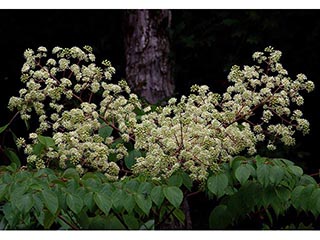
Smith, R.W.
Aralia spinosa
Aralia spinosa L.
Devil's Walking Stick, Hercules Club, Angelica Tree, Pigeon Tree, Shotbush, Prickly Elder, Prickly Ash
Araliaceae (Ginseng Family)
Synonym(s):
USDA Symbol: ARSP2
USDA Native Status: L48 (N)
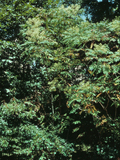
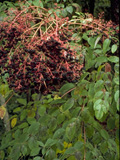
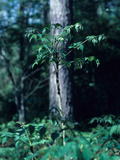
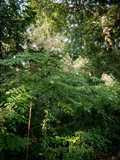
A large, few-stemmed shrub,12-15 ft., can reach 20 ft. Each spring it shoots up a tall stem covered with orange prickles. Enormous, divided, spiny leaves at the top of the stem can be 3-4 ft. long and just as wide. Topping the umbrella of leaves are 1-4 ft. tall clusters of whitish flowers. Black fruits on bright pink fruiting stalks crown the plant in fall.
Plant Characteristics
Duration: PerennialHabit: Tree
Root Type: Tap
Leaf Retention: Deciduous
Leaf Arrangement: Alternate
Leaf Complexity: Bipinnate , Tripinnate
Leaf Shape: Ovate
Leaf Margin: Serrate
Fruit Type: Berry
Size Notes: Up to about 20 feet tall.
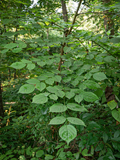
Leaf: Alternate, doubly or triply pinnately compound, with very numerous leaflets; leaflets ovate to lance-ovate, pointed at the tip, tapering or rounded at the base, coarsely toothed, usually with a few prickles on the veins or the lower surface of the leaves, up to 3 inches long, up to 1 1/2 inches wide.
Autumn Foliage: yes
Flower: Numerous in many umbrella-shaped clusters; each flower borne on a purple, hairy stalk.
Fruit: Spherical to ovoid, black-purple, up to 1/4 inch long.
Bloom Information
Bloom Color: WhiteBloom Time: Jun , Jul , Aug , Sep
Distribution
USA: AL , AR , CT , DC , DE , FL , GA , IL , IN , KY , LA , MA , MD , ME , MO , MS , NC , NJ , NY , OH , OK , PA , RI , SC , TN , TX , VA , WVNative Distribution: FL to e. TX, n. to NY & Ohio R. valley; naturalized northward
Native Habitat: Open woods; thickets; flood plains; rocky pastures
Growing Conditions
Water Use: HighLight Requirement: Part Shade
Soil Moisture: Moist
CaCO3 Tolerance: High
Soil Description: Moist, well-drained, fertile to poor soils. pH tolerant. Sandy Loam, Medium Loam, Clay Loam.
Conditions Comments: Colonizes freely by rhizomes and suckers. These can be dug out, but A. spinosa is still far too aggressive for small spaces. A pioneering species in the wild, this plant often disappears as the forest develops around it.
Benefit
Use Ornamental: Showy, Attractive, Fall conspicuous, Fast growing, Accent tree or shrub. Occasionally planted in the Victorian era as a grotesque ornamental.Use Wildlife: Seeds are favored by birds; leaves are browsed by deer. Nectar-insects, Nectar-butterflies, Nectar-bees, Browse, Fruit-birds
Use Medicinal: The aromatic spicy roots and fruit were used by early settlers in home remedies, including a cure for toothaches.
Conspicuous Flowers: yes
Attracts: Birds
Propagation
Description: Use one of the following methods for propagation: fresh seed sown in fall or stratified seed sown in spring; dormant root cuttings stored in cool, damp sand until spring; and/or transplanting of suckers.Seed Collection: Seed is mature when outer covering of nutlet is hard and brittle. This may be before the fruit pulp has darkened. Clean seeds immediately to avoid fermentation. Plant or stratify immediately.
Seed Treatment: Stratification is for 30-60 days at 41 degrees.
Commercially Avail: yes
National Wetland Indicator Status
| Region: | AGCP | AK | AW | CB | EMP | GP | HI | MW | NCNE | WMVE |
| Status: | FAC | FAC | FACU | FACW | FAC |
From the National Organizations Directory
According to the species list provided by Affiliate Organizations, this plant is on display at the following locations:Pineywoods Native Plant Center - Nacogdoches, TX
Crosby Arboretum - Picayune, MS
Natural Biodiversity - Johnstown, PA
Wellspring Organic Farm and Education Center - West Bend, WI
Bibliography
Bibref 298 - Field Guide to Texas Trees (1999) Simpson, B.J.Bibref 1620 - Gardening with Native Plants of the South (Reprint Edition) (2009) Wasowski, S. with A. Wasowski
Bibref 841 - Native Alternatives to Invasive Plants (2006) Burrell, C. C.
Bibref 318 - Native Texas Plants: Landscaping Region by Region (2002) Wasowski, S. & A. Wasowski
Bibref 291 - Texas Wildscapes: Gardening for Wildlife (1999) Damude, N. & K.C. Bender
Search More Titles in Bibliography
Web Reference
Webref 23 - Southwest Environmental Information Network (2009) SEINet - Arizona ChapterAdditional resources
USDA: Find Aralia spinosa in USDA PlantsFNA: Find Aralia spinosa in the Flora of North America (if available)
Google: Search Google for Aralia spinosa
Metadata
Record Modified: 2023-05-29Research By: TWC Staff