Native Plants

Plant Database
Search for native plants by scientific name, common name or family. If you are not sure what you are looking for, try the Combination Search or our Recommended Species lists.
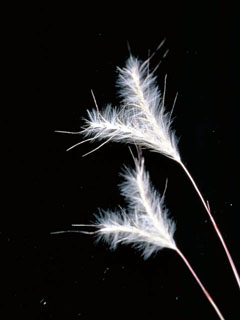
Flaigg, Norman G.
Andropogon ternarius
Andropogon ternarius Michx.
Splitbeard Bluestem, Split Bluestem
Poaceae (Grass Family)
Synonym(s):
USDA Symbol: ANTE2
USDA Native Status: L48 (N)
This is a 1 1/2 ft. bunchgrass which can reach 4 ft. in height. Ribbon-like leaves are often purplish and the silvery-white seed tufts are borne in yellow bracts along the stem. Mature plants are 6-12 in. in diameter. Split-beard bluestem is a perennial.
Frequently found growing with Little Bluestem (Schizachyrium scoparium) in southeastern areas with well-drained sandy or gravelly soil, Splitbeard Bluestem is notable primarily for its silvery white seed tufts, which catch the light and look particularly attractive with the sun behind them.


Plant Characteristics
Duration: PerennialHabit: Grass/Grass-like
Root Type: Fibrous
Leaf Arrangement: Alternate
Leaf Complexity: Simple
Leaf Venation: Parallel
Fruit Type: Caryopsis
Size Notes: 1.5 to 4 feet high
Leaf: Green
Fruit: silvery white
Bloom Information
Bloom Color: BrownBloom Time: Aug , Sep , Oct , Nov
Distribution
USA: AL , AR , DC , DE , FL , GA , IL , IN , KS , KY , LA , MD , MO , MS , NC , NJ , OK , SC , TN , TX , VANative Distribution: Delaware and New Jersey south to the Gulf states
Native Habitat: Plains, prairies, meadows, savannas, open woodlands, verges, often in sandy soil
Growing Conditions
Water Use: LowLight Requirement: Sun , Part Shade
Soil Moisture: Dry
CaCO3 Tolerance: Medium
Soil Description: Well-drained sand or sandy loam
Benefit
Use Ornamental: An attractive bunchgrass that can be used as a garden accent or in a wildflower meadow or prairie.Use Wildlife: Seeds-granivorous birds, Seeds-Small mammals, Nesting material, Graze
Attracts: Birds
Deer Resistant: No
Value to Beneficial Insects
Provides Nesting Materials/Structure for Native BeesThis information was provided by the Pollinator Program at The Xerces Society for Invertebrate Conservation.
Propagation
Propagation Material: Root Division , SeedsDescription: Seed and root division during winter dormancy
Commercially Avail: yes
Maintenance: Stems may be cut back in winter, after the grass has gone to seed.
National Wetland Indicator Status
| Region: | AGCP | AK | AW | CB | EMP | GP | HI | MW | NCNE | WMVE |
| Status: | FACU | FACU | FACU | FACU |
From the National Organizations Directory
According to the species list provided by Affiliate Organizations, this plant is on display at the following locations:Mt. Cuba Center - Hockessin, DE
Wildflower Center Seed Bank
LBJWC-1000 Collected 2006-11-28 in Harrison County by Lady Bird Johnson Wildflower CenterBibliography
Bibref 1620 - Gardening with Native Plants of the South (Reprint Edition) (2009) Wasowski, S. with A. WasowskiBibref 841 - Native Alternatives to Invasive Plants (2006) Burrell, C. C.
Bibref 318 - Native Texas Plants: Landscaping Region by Region (2002) Wasowski, S. & A. Wasowski
Bibref 291 - Texas Wildscapes: Gardening for Wildlife (1999) Damude, N. & K.C. Bender
Search More Titles in Bibliography
Research Literature
Reslit 46 - Changes in understory vegetation and soil characteristics following silvicultural activities in a southeastern mixed pine forest (2007) J. K. Archer, D. L. Miller and G. W. TannerReslit 1430 - Vegetation of frequently burned old-growth longleaf pine (Pinus palustris mill.) savannas on choccolocco mountain, Alabama, USA (2003) J. M. Varner, J. S. Kush and R. S. Meldahl
Reslit 1485 - Effects of individual bunchgrasses on potential C and N mineralization of longleaf pine savanna soils (2004) J. B. West and L. A. Donovan
This information was provided by the Florida WIldflower Foundation.
Search More Titles in Research Literature
Additional resources
USDA: Find Andropogon ternarius in USDA PlantsFNA: Find Andropogon ternarius in the Flora of North America (if available)
Google: Search Google for Andropogon ternarius
Metadata
Record Modified: 2021-12-02Research By: TWC Staff