Native Plants

Plant Database
Search for native plants by scientific name, common name or family. If you are not sure what you are looking for, try the Combination Search or our Recommended Species lists.
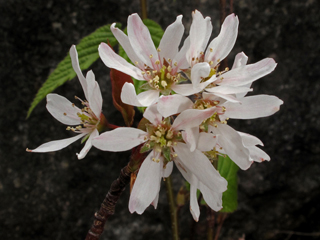
Cressler, Alan
Amelanchier laevis
Amelanchier laevis Wiegand
Allegheny Serviceberry, Allegheny Service-berry, Serviceberry
Rosaceae (Rose Family)
Synonym(s): Amelanchier arborea ssp. laevis, Amelanchier arborea var. cordifolia, Amelanchier arborea var. laevis, Amelanchier laevis var. nitida, Amelanchier ×grandiflora
USDA Symbol: AMLA
USDA Native Status: L48 (N), CAN (N), SPM (N)
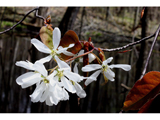
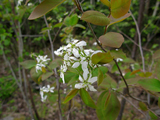
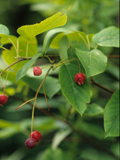
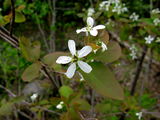
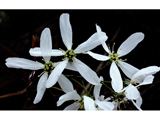
This service-berry is usually a multiple-trunked tree or shrub, 15-25 ft. tall, with dense, fine-textured branching. White flowers occur in terminal clusters before the leaves appear and are followed by summer berries turning from red to purple or nearly black. Blue-green summer foliage can become orange or red in fall. The bark is smooth and slate-gray with white, longitudinal stripes.
Very easy to grow and provides year-round interest. Berries are edible and juicier than those of the similar A. arborea. Sensitive to drought. Serviceberries are subject to many disease and insect problems, but damage from these problems is usually cosmetic rather than life threatening. The sweet, juicy fruits are edible and rich in iron and copper. (Kershaw)
Native peoples dried the small pomes like raisins or mashed and dried them in cakes. Often the dried fruits were mixed with meat and fat to form pemmican, a light-weight, high-energy food that could support winter travellers for long periods if the diet was supplemented with vitamin C to prevent scurvy. (Kershaw)
Plant Characteristics
Duration: PerennialHabit: Tree
Leaf Retention: Deciduous
Fruit Type: Pome
Size Notes: Up to about 25 feet tall as a multi-trunked shrub. When growing as a single-trunked tree, may be up to about 75 feet tall.
Leaf: Green
Autumn Foliage: yes
Fruit: Black, Purple, Red
Bloom Information
Bloom Color: WhiteBloom Time: Mar , Apr , May , Jun
Distribution
USA: AL , CT , DC , DE , GA , IA , IL , IN , KY , MA , MD , ME , MI , MN , NC , NH , NJ , NY , OH , PA , RI , SC , TN , VA , VT , WI , WVCanada: NB , NL , NS , ON , PE , QC
Native Distribution: Nf. to s. Ont., s. to DE, KY & IA; also mts. to GA & TN
Native Habitat: Cool, rich woods; moist to drier thickets; swamp margins & clearings
Growing Conditions
Water Use: MediumLight Requirement: Sun , Part Shade , Shade
Soil Moisture: Dry , Moist
Soil pH: Acidic (pH<6.8)
CaCO3 Tolerance: Medium
Soil Description: Coarse to medium loams; moist to slightly dry.
Conditions Comments: Very easy to grow and provides year-round interest. Berries are edible and juicier than those of the similar A. arborea. Sensitive to drought. Serviceberries are subject to many disease and insect problems, but damage from these problems is usually cosmetic rather than life threatening.
Benefit
Use Wildlife: A food plant for birds and small mammals.Use Food: The sweet, juicy fruits are edible and rich in iron and copper (Kershaw). Native peoples dried the small pomes like raisins or mashed and dried them in cakes. Often the dried fruits were mixed with meat and fat to form pemmican, a light-weight, high-energy food that could support winter travellers for long periods if the diet was supplemented with vitamin C to prevent scurvy. (Kershaw)
Conspicuous Flowers: yes
Fragrant Flowers: yes
Attracts: Birds
Value to Beneficial Insects
Special Value to Native BeesThis information was provided by the Pollinator Program at The Xerces Society for Invertebrate Conservation.
Propagation
Description: This species can be rooted from early spring hardwood cuttings or softwood cutting taken in the summer. Sow untreated seeds in fall or cold-stratified seed in spring.Seed Collection: Collect fruits as soon as they ripen (if you can beat the birds) and clean seeds immediately to prevent fermentation. Fertile seeds are dark brown with a leathery seed coat. Seed extraction is usually by macerating the fruit and washing them over screens. Air dry and store in sealed, refrigerated containers for up to five years.
Seed Treatment: Cold-moist stratification for 90-120 days.
Commercially Avail: yes
Find Seed or Plants
View propagation protocol from Native Plants Network.
Mr. Smarty Plants says
Edible Plants for North Georgia
January 10, 2010
We are planning a forest food garden in the hollers of the N GA Mountains.
Which edible fruit, nut, berry, herb and creepers would be best for this reddish, clay-like soil? The food garden is in...
view the full question and answer
From the National Organizations Directory
According to the species list provided by Affiliate Organizations, this plant is on display at the following locations:Delaware Nature Society - Hockessin, DE
Natural Biodiversity - Johnstown, PA
Longwood Gardens - Kennett Square, PA
Mt. Cuba Center - Hockessin, DE
Bibliography
Bibref 841 - Native Alternatives to Invasive Plants (2006) Burrell, C. C.Bibref 1258 - Trees of Ontario (2007) Kershaw, Linda
Search More Titles in Bibliography
Web Reference
Webref 38 - Flora of North America (2019) Missouri Botanical Garden, St. Louis, MO & Harvard University Herbaria, Cambridge, MA.Webref 23 - Southwest Environmental Information Network (2009) SEINet - Arizona Chapter
Additional resources
USDA: Find Amelanchier laevis in USDA PlantsFNA: Find Amelanchier laevis in the Flora of North America (if available)
Google: Search Google for Amelanchier laevis
Metadata
Record Modified: 2023-05-08Research By: TWC Staff