Native Plants

Plant Database
Search for native plants by scientific name, common name or family. If you are not sure what you are looking for, try the Combination Search or our Recommended Species lists.
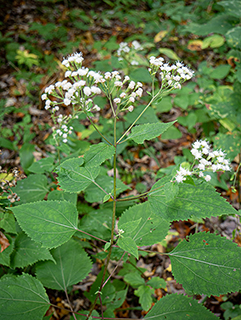
Brundage, Stephanie
Ageratina altissima
Ageratina altissima (L.) King & H. Rob.
White Snakeroot
Asteraceae (Aster Family)
Synonym(s):
USDA Symbol: AGAL5
USDA Native Status: L48 (N), CAN (N)
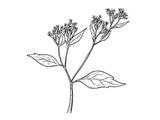
Solitary or clustered firm stems bear flat-topped clusters of small fuzzy white flower heads composed entirely of disc flowers.
This plant used to be placed in the genus Eupatorium, as did Smaller White Snakeroot (A. aromatica), a nonaromatic plant despite its name; it has less coarsely toothed leaves, the upper ones stalkless. Other similar species are Late-flowering Thoroughwort (Eupatorium serotinum), which has long-stalked lanceolate leaves with 3-5 main veins, and Hyssop-leaf Thoroughwort (E. hyssopifolium), with very narrow leaves in whorls of 3-4.



Plant Characteristics
Duration: PerennialHabit: Herb
Size Notes: Up to about 4 feet tall, often shorter.
Fruit: Fruit is a cypsela (pl. cypselae). Though technically incorrect, the fruit is often referred to as an achene.
Bloom Information
Bloom Color: WhiteBloom Time: Jul , Aug , Sep , Oct , Nov
Distribution
USA: AL , AR , CT , DC , DE , FL , GA , IA , IL , IN , KS , KY , LA , MA , MD , ME , MI , MN , MO , MS , NC , ND , NE , NH , NJ , NY , OH , OK , PA , RI , SC , SD , TN , TX , VA , VT , WI , WVCanada: NB , NS , ON , SK
Native Distribution: S. Ontario to New Brunswick; south through New England to Virginia and upland Georgia; west to Louisiana and ne. Texas; north to Wisconsin.
Native Habitat: Woods and thickets.
Growing Conditions
Water Use: LowLight Requirement: Sun , Part Shade
Soil Moisture: Dry , Moist
Drought Tolerance: High
Conditions Comments: Prefers full sun but will tolerate shade in more southern locations.
Value to Beneficial Insects
Supports Conservation Biological ControlThis information was provided by the Pollinator Program at The Xerces Society for Invertebrate Conservation.
National Wetland Indicator Status
| Region: | AGCP | AK | AW | CB | EMP | GP | HI | MW | NCNE | WMVE |
| Status: | FACU | FACU | UPL | FACU | FACU |
Bibliography
Bibref 875 - Armitage's Native Plants for North American Gardens (2006) Armitage, A. M.Bibref 946 - Gardening with Prairie Plants: How to Create Beautiful Native Landscapes (2002) Wasowski, Sally
Search More Titles in Bibliography
Web Reference
Webref 3 - Flora of North America (2014) Missouri Botanical Garden, St. Louis, MO & Harvard University Herbaria, Cambridge, MA.Additional resources
USDA: Find Ageratina altissima in USDA PlantsFNA: Find Ageratina altissima in the Flora of North America (if available)
Google: Search Google for Ageratina altissima
Metadata
Record Modified: 2022-10-06Research By: TWC Staff