Native Plants

Plant Database
Search for native plants by scientific name, common name or family. If you are not sure what you are looking for, try the Combination Search or our Recommended Species lists.
Acer circinatum
Acer circinatum Pursh
Oregon Vine Maple, Vine Maple
Aceraceae (Maple Family)
Synonym(s):
USDA Symbol: ACCI
USDA Native Status: L48 (N), AK (N?), CAN (N)
Shrub or small tree with short trunk or several branches turning and twisting from base; often vinelike and leaning or sprawling. Vine maple or Oregon vine maple is often vine-like and reclining, commonly grown as a multi-stemmed tree, 10-20 ft. tall. The trunks have bright, reddish-green bark, topped with foliage displayed in an elegant, tiered pattern. The deciduous leaves are almost round in general outline with 7-9 palmate lobes. Fall foliage is ranges from yellow-orange to red. This handsome ornamental is dramatically colored in most seasons with bright green foliage turning orange and red in autumn, purple and white flowers in spring, and young red fruit in summer. The scientific name, meaning "rounded" or "circular," refers to the leaf shape.
From the Image Gallery
No images of this plant
Plant Characteristics
Duration: PerennialHabit: Shrub , Tree
Leaf Retention: Deciduous
Leaf Arrangement: Opposite
Leaf Complexity: Simple
Leaf Shape: Cordate
Leaf Venation: Palmate
Leaf Pubescence: Glabrous
Leaf Margin: Lobed
Breeding System: Flowers Unisexual , Monoecious
Inflorescence: Corymb
Fruit Type: Samara
Size Notes: Height 25-30 feet, can reach 40 ft or larger, spread 25-35 feet. Multiple stems.
Leaf: Reddish when immature, dull green on top, pale green below when mature, red and orange in the Fall.
Autumn Foliage: yes
Fruit: Bright red when mature. 1-2 inches long.
Bloom Information
Bloom Color: White , Red , Green , PurpleBloom Time: Mar , Apr , May
Bloom Notes: Reddish or purple sepals and greenish-white petals. Monoecious; flowers are small and borne in short terminal clusters.
Distribution
USA: AK , CA , OR , WACanada: BC
Native Distribution: B.C. to coastal n. CA; more common w. of Cascades
Native Habitat: Moist woods; stream banks
Growing Conditions
Water Use: MediumLight Requirement: Part Shade , Shade
Soil Moisture: Moist
CaCO3 Tolerance: None
Cold Tolerant: yes
Heat Tolerant: yes
Soil Description: Moist soils.
Conditions Comments: This plant will tolerate drier situations. It often propagates vegetatively by layering and sometimes forms dense thickets.
Benefit
Use Wildlife: The seeds of this and other maples are consumed by songbirds, game birds, and large and small mammals.Use Other: Coast Salish people have used the vine maple for frames for fishing nets, and the lower Thompson peopled have used it for making snowshoes and cradle frames. Coastal Aboriginal peoples have boiled the bark of the roots to make a tea for colds.
Conspicuous Flowers: yes
Interesting Foliage: yes
Attracts: Butterflies
Butterflies and Moths of North America (BAMONA)
|
Western Tiger Swallowtail (Papilio rutulus) 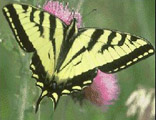 Larval Host |
Propagation
Propagation Material: Seeds , Softwood CuttingsDescription: Vine maple can be grown from seeds or from well-rooted, layered branches. Seeds should be sown soon after harvest.
Seed Collection: The winged fruit of maples is called a samara. Seed is usually not extracted from the samara. Samaras are reddish when mature.
Seed Treatment: Best results from seeds are obtained by alternating warm & cold stratification.
Commercially Avail: yes
Maintenance: Pruning is required to control and shape.
Find Seed or Plants
Find seed sources for this species at the Native Seed Network.
National Wetland Indicator Status
| Region: | AGCP | AK | AW | CB | EMP | GP | HI | MW | NCNE | WMVE |
| Status: | FAC | FAC | FAC | FAC |
From the National Organizations Directory
According to the species list provided by Affiliate Organizations, this plant is on display at the following locations:Santa Barbara Botanic Garden - Santa Barbara, CA
Native Seed Network - Corvallis, OR
Bibliography
Bibref 1186 - Field Guide to Moths of Eastern North America (2005) Covell, C.V., Jr.Bibref 1185 - Field Guide to Western Butterflies (Peterson Field Guides) (1999) Opler, P.A. and A.B. Wright
Search More Titles in Bibliography
Additional resources
USDA: Find Acer circinatum in USDA PlantsFNA: Find Acer circinatum in the Flora of North America (if available)
Google: Search Google for Acer circinatum
Metadata
Record Modified: 2007-01-01Research By: TWC Staff