Native Plants
Q. Who is Mr. Smarty Plants?
A: There are those who suspect Wildflower Center volunteers are the culpable and capable culprits. Yet, others think staff members play some, albeit small, role. You can torture us with your plant questions, but we will never reveal the Green Guru's secret identity.
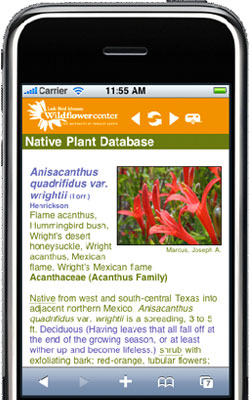
Did you know you can access the Native Plant Information Network with your web-enabled smartphone?

Ask Mr. Smarty Plants
Ask Mr. Smarty Plants is a free service provided by the staff and volunteers at the Lady Bird Johnson Wildflower Center.
rate this answer

Saturday - October 07, 2006
From: Austin, TX
Region: Southwest
Topic: Edible Plants
Title: Plants for making dyes for organic cotton
Answered by: Nan Hampton
QUESTION:
Looking to dye my own organic cotton for my new line of organic clothing and I want to grow the plants for making the dyes in my own garden. Any suggestions?ANSWER:
Delena Tull in her book, Edible and Useful Plants of Texas and the Southwest: A Practical Guide (University of Texas Press, 1999) has an excellent section called "Colorful Dyes with Texas Plants" in which she lists notable Texas dye plants along with an indication of the brilliance of the color and resistance to fading. She also has information about whether the dye needs a mordant and, especially important, whether the plant has toxic qualities that you need to be aware of. Most of the plants she lists are Texas natives, but she does list some non-natives (e.g., Common mullein (Verbascum thapsus)) that have been introduced and are now commonly found in the state. You can check the nativity of the plants she lists by searching in our Native Plants Database or the USDA Plants Database. Here is a short list of some of the plants she lists that do well in the Austin area:
Prickly pear (Opuntia engelmannii) red, magenta, or tan depending on dyeing method
Turk's cap (Malvaviscus arboreus) peach, mauve, or tan depending on dyeing method and mordant
Agarita (Mahonia trifoliolata syn. Berberis trifoliolata) yields yellow to yellow-orange
Bitterweed (Tetraneuris scaposa syn. Hymenoxys scaposa) yellow dye
Bluebonnet (Lupinus texensis) light lime green
Old man’s beard (Clematis drummondii) golden brown, brown or yellow depending on the plant part used
Goldenrod (Solidago spp.) a range of colors from yellow, orange, tan, olive and gray depending on the plant part and mordant used
Greenbriar (Smilax bona-nox) grays, greens, yellows, and reds depending the plant part and mordant used
Pokeweed (Phytolacca americana) pink, orange, red, blue and black depending on mordant and dyeing method
These are only a few of the plants listed in the book. Many trees (such as oaks, pecans, and walnuts) that grow in Austin have material that make good dyes as well.
More Edible Plants Questions
Is the fruit of American Beautyberry (French Mulberry) edible?
March 22, 2012 - I am trying to find out if the "American Beautyberry" or "French Mulberry" fruit is edible? Can you tell me? Your website's information about this plant has been the most informative informatio...
view the full question and answer
Niagara and Concord grape crop failure
September 01, 2008 - Hi, I have been growing niagara grapes and concord grapes for 3 years now and this year I found myself without any fruits. The plant itself if full of leaves and is healthy. I was wondering why this w...
view the full question and answer
Looking for fruit and nut trees to plant in San Augustine, TX
April 05, 2011 - I am setting up residence in San Augustine, Texas on approximately 9 acres of land. We wanted to plant a few of each type of fruit and nut trees that would prosper in the area (for wildlife and for o...
view the full question and answer
Edible Native Plants for a Small Austin Garden
March 15, 2010 - Hello Mr. Smarty Plants (or Mrs. or Miss, whomever is answering this go'round)!
First off, thank you so much for all the help you have given me in the past. Secondly, the company my husband works ...
view the full question and answer
Edible plants in Lycoming County, Pennsylvania
March 02, 2014 - Hi again! Thanks for answering my one question. I have another though. Do you know of any edible plants with no nasty side effects ( like stomach aches or being nauseous) that grow in Lycoming County ...
view the full question and answer
| Support the Wildflower Center by Donating Online or Becoming a Member today. |