Native Plants

Q. Who is Mr. Smarty Plants?
A: There are those who suspect Wildflower Center volunteers are the culpable and capable culprits. Yet, others think staff members play some, albeit small, role. You can torture us with your plant questions, but we will never reveal the Green Guru's secret identity.
Did you know you can access the Native Plant Information Network with your web-enabled smartphone?

Ask Mr. Smarty Plants
Ask Mr. Smarty Plants is a free service provided by the staff and volunteers at the Lady Bird Johnson Wildflower Center.

rate this answer

Tuesday - November 06, 2012
From: Salina, KS
Region: Midwest
Topic: Plant Identification, Poisonous Plants, Vines
Title: Plant with dark black/purple berries in a cluster
Answered by: Nan Hampton
QUESTION:
Today at our local dog park we noticed a bush/vine that's been growing up the fence is producing berries. It didn't flower at all. The berries look to have started out green and now are changing to a dark almost black/purple. They are in a small cluster of about 7-10 together. I popped one and inside is a big seed and a bright green liquid. The stem is a little fuzzy. The leaves are very soft and silky but not shiny. The leaves are also slightly pointed at the end. Can take a picture if this will help. Just let me know. We'd like to know what it is and if it's poisonous if the dogs should the eat any. Please answer back and thank you.ANSWER:
Below are five suggestions of vines native to Kansas for the identification of your plant. Only the first is reported to be toxic. Hopefully, what you found is one of the non-toxic plants so that you don't have to worry about your dog eating the fruits.
The fruits of Menispermum canadense (Common moonseed) are reportedly highly toxic according to the Poisonous Plants of North Carolina. Here are more photos and information from the Herbarium at University of Wisconsin-Green Bay.
There are two species of Smilax:
Smilax herbacea (Smooth carrionflower) and here are more photos and information from the Plant Diversity Website at the University of Michigan.
Smilax lasioneura (Blue ridge carrionflower) and here are more photos and information from the Plant Diversity Website at the University of Michigan and from the Freckman Herbarium at the University of Wisconsin.
Smilax herbacea is on the "Plants Non-Toxic to Dogs" list on the ASPCA Toxic and Non-Toxic Plant List - Dogs. Smilax lasioneura is not on either the "Plants Toxic..." or "Plants Non-Toxic..." lists.
There are two grape species:
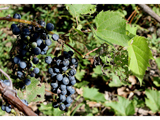
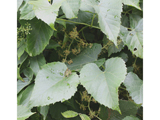
Vitis riparia (Riverbank grape) and here are more photos and information from the Herbarium at University of Wisconsin-Green Bay.
Vitis vulpina (Frost grape) and here are more photos and information from Duke University.
Neither of the Vitis species occurs on any toxic plant list that I could find.
If none of these are the vine you saw, please visit the Plant Identification page to find links to several plant identification forums that will accept photos of plants for identification.
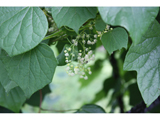
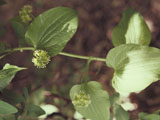
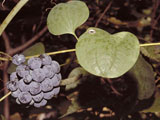
From the Image Gallery


More Vines Questions
Vine Choices Scarce in Beaverton Oregon
June 08, 2012 - Hi,
I am looking for a hearty vine that we could use to cling to and cover a cement wall that is about 8 feet tall and 30 feet long. It is on the south side of our house but never gets direct sunli...
view the full question and answer
Can you root a crossvine?
May 31, 2009 - Can you root a crossvine?
view the full question and answer
Salt-tolerant plants in Central Texas
September 16, 2009 - Do you have any suggestions for salt-tolerant plants in Central Texas? Thanks.
view the full question and answer
Shade tolerant plants for erosion from Austin
May 03, 2014 - I live in Austin and my house backs up to Shoal Creek. I am looking for a native creeping vine or something that will grow on the shaded bank to help prevent erosion. It should be able to tolerate the...
view the full question and answer
Sources for plants from Abingdon MD
August 02, 2012 - What stores or nursuries in Harford County sell already grown Coral honeysuckle, Purple passion flower, trumpet creeper, and crossvine?
view the full question and answer
| Support the Wildflower Center by Donating Online or Becoming a Member today. |