Native Plants

Q. Who is Mr. Smarty Plants?
A: There are those who suspect Wildflower Center volunteers are the culpable and capable culprits. Yet, others think staff members play some, albeit small, role. You can torture us with your plant questions, but we will never reveal the Green Guru's secret identity.
Did you know you can access the Native Plant Information Network with your web-enabled smartphone?

Ask Mr. Smarty Plants
Ask Mr. Smarty Plants is a free service provided by the staff and volunteers at the Lady Bird Johnson Wildflower Center.

rate this answer

Friday - November 02, 2012
From: Anaconda, MT
Region: Rocky Mountain
Topic: Poisonous Plants, Privacy Screening, Shrubs, Trees
Title: Puppy-friendly privacy screen in Montana
Answered by: Nan Hampton
QUESTION:
I need some puppy-friendly short(< 30') privacy from the gigantic windows of my next door neighbor. But- there are power lines above the area that I needed to plant! I had planned on an aspen grove, had utilities marked below, dug a huge hole.. then looked up, oops! Power lines. Bummer. I did search and found a slightly similar question, but mine is different, because I really need a shorter tree/shrub. Evergreen would be nice, but not nescessary, we do play outside all year round and would like to get rid of that "being watched" feeling. Man you should see these windows she has! They are thirty feet high, with no shades that I have ever seen closed (eewww, exhibitionist?) and houses are super close in town. Thank you very much! Lisa.ANSWER:
Let's see what we can find to keep you from feeling "watched". First, we can do a COMBINATION SEARCH in our Native Plant Database choosing "Montana" from Select State or Province and either "Shrub" or "Tree" from Habit (general appearance) and both "6-12" and "12-36" from Height (in feet). Below are some possibilities that I chose from these searches. You can also do the searches yourself to see if there are other trees or shrubs that fit your requirements.
Acer glabrum (Rocky mountain maple) is deciduous and grows from 10 to 30 feet tall. Here are photos and more information from Southwestern Colorado Wildflowers. Calflora lists this plant as potentially causing dermatitis, but no listing of ingestion toxicity.
Betula occidentalis (Mountain birch) is deciduous and grows 20 to 30 feet tall. Here are more photos from Flora of Eastern Washington and Adjacent Idaho.
Cercocarpus montanus (Alderleaf mountain mahogany) is described as having "almost-evergreen leaves" and grows from 8 to 20 feet tall. Here are more photos and in formation from Southwestern Colorado Wildflowers and from Utah State University.
Rhus glabra (Smooth sumac) is a deciduous 10-20 feet shrub that forms colonies. Here is more information from Texas A&M Aggie Horticulture.
Shepherdia argentea (Silver buffaloberry) is deciduous and grows from 6 to 20 feet tall. Here is more information from Las Pilitas Nursery in California.
Juniperus osteosperma (Utah juniper) is evergreen and grows to 10-20 feet. Here is more information from Utah State University.
The following plants from the list, although attractive and of the proper size, probably should not be used because of their potential toxicity for your puppy:
Prunus virginiana (Chokecherry) is deciduous, often forms thickets and grows to 30 feet. It is an attractive tree, but the ASPCA Toxic and Non-Toxic Plant List – Dogs lists plants in the genus Prunus (including apricot, plum, peach and cherry) as toxic to dogs. None of the other species above is listed as toxic to dogs by the ASPCA. Montana Plant Life also lists chokecherry as toxic, especially the seeds.
Sambucus nigra ssp. caerulea [syn. = Sambucus cerulea](Blue elder) is deciduous and grows from 6 to 24 feet tall and Sambucus racemosa (Red elderberry) is deciduous and grows to 8-20 feet. Montana Plant Life reports that the leaves, green fruits and stems of the genus Sambucus are poisonous. They say:
"The stems, bark, leaves and roots contain cyanide-producing glycosides, and are therefore poisonous, especially when fresh. The fruit of this species has been known to cause stomach upsets. Any toxin the fruit might contain is considered to be of low toxicity and is destroyed when the fruit is cooked."
Amelanchier alnifolia (Saskatoon serviceberry) is deciduous and grows from 3 to 18 feet tall and Amelanchier utahensis (Utah service-berry) is deciduous and grows to 15 feet. The ASPCA says that the plants of the genus Amelanchier contain cyanogenic glycosides that can cause vomiting, diarrhea, respiratory problems and, if consumed in large amounts, potentially death. The Canadian Poisonous Plants Information System lists Amelanchier alnifolia as toxic.
If you do find other native shrubs or trees in our Native Plant Database that you would like to check for toxicity, use the following toxic plant databases and search using the botanical name rather than the common name:
From the Image Gallery
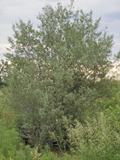
More Privacy Screening Questions
Privacy screen for garden and pool in California
October 13, 2008 - I need a fast growing screen for privacy. Here are the issues:1. we have a 3 story apartment building looking right into our backyard. so trees need to be at least 15' tall and dense. 2. we have a po...
view the full question and answer
Evergreen screen for newly constructed metal building
March 31, 2010 - Neighbor built a 12' tall metal building right by my gate. I want to screen it with fast-growing evergreen natives. I have lots of ashe juniper on my property, but none where I need it now! Can AJ...
view the full question and answer
Need evergreen hedge and groundcover for shade in Carmel, Indiana
September 27, 2010 - Our property is bounded by a fencerow that is wooded and mostly shaded by mulberry and hackberry trees during the growing months. We'd like to create a 5'+ tall evergreen barrier on the property li...
view the full question and answer
Shade tolerant plants for privacy from Larchmont NY
April 19, 2014 - Love your site! We have a 4'x4'x50' stone wall, full sun, with a planting bed 30"H by 24"D. We're looking for privacy, so a hedge with pruning is needed. We have looked at Ilex Crenata (8'),...
view the full question and answer
Evergreen tree for privacy screen in Granbury Texas
December 21, 2014 - We need to put an evergreen privacy screen between our barn and our neighbor's new 132' long, unattractive building, which runs along & is just 40' away from our fence line & where they have decid...
view the full question and answer
| Support the Wildflower Center by Donating Online or Becoming a Member today. |