Native Plants
Q. Who is Mr. Smarty Plants?
A: There are those who suspect Wildflower Center volunteers are the culpable and capable culprits. Yet, others think staff members play some, albeit small, role. You can torture us with your plant questions, but we will never reveal the Green Guru's secret identity.
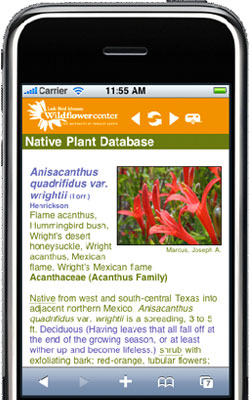
Did you know you can access the Native Plant Information Network with your web-enabled smartphone?

Ask Mr. Smarty Plants
Ask Mr. Smarty Plants is a free service provided by the staff and volunteers at the Lady Bird Johnson Wildflower Center.

rate this answer

Wednesday - June 06, 2012
From: Randolph, VT
Region: Northeast
Topic: Invasive Plants, Non-Natives, Plant Identification, Poisonous Plants
Title: Identification of plant with orange sap that glows at night
Answered by: Nan Hampton
QUESTION:
I was just pulling up a plant and noticed that its sap was a kind of orange then I noticed it glowing orange at night. What kind of plant is this and is it dangerous?ANSWER:
There are many plants with orange/yellow sap and since you didn't describe the plant itself, I can't really identify it. I did search for sap that glows/luminesces/fluoresces at night but found only one reference. Chelidonium majus (Greater celadine), a native of Europe, has orange sap, is considered invasive and highly toxic and, according to one source, is luminescent. This is the only plant that I found with orange sap that is reported to be luminescent, but there are other candidates with orange sap.
Another plant that has orange sap is also considered to be the most toxic plant native to North America—the deadly Cicuta species (water hemlocks). Both Cicuta bulbifera (Bulblet-bearing water hemlock) and Cicuta maculata (Spotted water hemlock) grow in Vermont. You can check the Canadian Poisonous Plants Information System to read about the toxicity of other Cicuta species. If this is the plant you pulled up, you will probably want to be sure it doesn't regrow and be very cautious handling it.
All of the members of the Family Papaveraceae (Poppy Family) have yellow-orange or milky white sap. Your plant could have been either of these that happens to grow in Vermont. The plants in the poppy family that grow in Vermont are:
Argemone mexicana (Mexican prickly poppy) is mildly toxic.
Sanguinaria canadensis (Bloodroot) is highly toxic.
There are, no doubt, other plants with orange sap. If you have a photo of the plant, you can visit our Plant Identification page to find links to plant identification forums that will accept photos of plants for identification.
More Invasive Plants Questions
Dietes bicolor invasive from Brisbane Australia
April 01, 2013 - We have dietes bicolor growing in our garden. I am changing the type of garden and cannot seem to kill it. I've dugged it out, spent too many weekends pulling out every new shoot, used poison, but t...
view the full question and answer
Containing roots in Kaysville UT
October 26, 2009 - I'm planting my yard in all native Rocky Mountain and Great Basin plants. Is there a way to halt or contain the root propagation of Smooth Leaf Sumac and Quaking Aspen? I've considered digging dow...
view the full question and answer
About Salvia superba
January 09, 2006 - About 10 years ago, nurseries were offering a small salvia, called salvia superba or meadow sage. A few years later, "May Night" and "Blue Hill" appeared on the market similar to this first sal...
view the full question and answer
Liriope spicata for erosion and dust suppression from Bonifay FL
August 16, 2011 - I want to plant Liriope 'spicata'. I know it can be aggressive and that's what I want. We live on dirt road and need something by road for help in erosion and it's also hard to mow this are...
view the full question and answer
Problems with Habiturf in Austin
May 10, 2014 - I have been trying to establish a Habiturf lawn in my back yard. It is approximately a 1,000 square foot area and this last seeding was the third over about one and a half years. I just recently over ...
view the full question and answer
| Support the Wildflower Center by Donating Online or Becoming a Member today. |