Native Plants
Q. Who is Mr. Smarty Plants?
A: There are those who suspect Wildflower Center volunteers are the culpable and capable culprits. Yet, others think staff members play some, albeit small, role. You can torture us with your plant questions, but we will never reveal the Green Guru's secret identity.
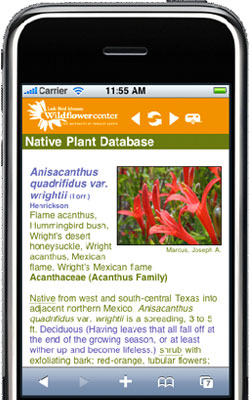
Did you know you can access the Native Plant Information Network with your web-enabled smartphone?

Ask Mr. Smarty Plants
Ask Mr. Smarty Plants is a free service provided by the staff and volunteers at the Lady Bird Johnson Wildflower Center.
rate this answer

Thursday - May 17, 2012
From: Georgetown, KY
Region: Mid-Atlantic
Topic: General Botany, Non-Natives, Plant Identification
Title: Difference between Convallaria majalis and Convallaria majuscula
Answered by: Nan Hampton
QUESTION:
How do you tell the difference in the native convallaria from the European species?ANSWER:
Determing the difference between Convallaria majalis (European Lily-of-the-Valley) and Convallaria majuscula (American lily of the valley) is not a simple matter. In fact, there is an ungoing dispute as to whether they are truly distinct species or whether C. majuscula is a subspecies or a variety of C. majalis as you will see from the following paper:
Gandhi, K.N., J.L. Reveal, and J.L. Zarucchi. 2012. Nomenclatural and taxonomic analysis of Convallaria majalis, C. majuscula, and C. montana (Ruscaceae/Liliaceae). Phytoneuron 2012-17: 1–4. Published 17 February 2012.
In this paper you will see that, in addition to its authors, there are others who believe that the American Lily of the Valley is actually a garden escapee of the European Lily of the Valley that was able to establish itself in the wild—the two are the same species but differ at the the subspecies or variety level.
Although the USDA Plants Database still considers C. majalis and C. majuscula as distinct species, ITIS (Integrated Taxonomic Information System) lists C. majuscula as the unaccepted synonym for C. majalis var. montana, American lily of the valley and C. majalis var. majalis as the accepted name for European lily of the valley. In our Native Plant Database you will still find American Lily of the Valley listed under C. majuscula because our database follows that of the USDA Plants Database. You won't find C. majalis in our database at all because it is not native to North America according to the USDA Plant Database.
In the paper listed above (Ghandhi et al.), they propose the following names Convallaria majalis subsp. majalis (European Lily of the Valley) and Convallaria majalis subsp. majuscula (American Lily of the Valley). And, although the paper notes that there is an overlap in features (length of bracts and pedicels, leaf blade size and venation, number of flowers per raceme, etc.) used to distinguish the American and European species, it offers these differences:
"1. Plants forming dense colonies; leaves green until frost, veins faint; raceme (excluding scape) about half the length of the leaves; bracts 4-10 mm long, shorter than the pedicels; seeds almost globose................subsp. majalis
1. Plants scattered or forming small groups; leaves yellowing in late summer, veins strong; raceme (excluding scape) much shorter than the leaves; bracts 8-20 mm long, usually as long or longer than pedicels; seeds oblate or lenticular...............subsp. majuscula"
Now, I hope you aren't going to ask what the difference is between naming a plant a subspecies or calling it a variety because that is another whole can of complicated worms. See:
More General Botany Questions
Wild Native Hybrids and Cultivars?
June 14, 2010 - It is my understanding that hybrids can occur with or without human intervention whereas cultivars always involve human intervention. Strictly speaking does this mean native wildflowers can never be ...
view the full question and answer
Mountain laurel with fasciation
July 24, 2014 - My Texas Mountain Laurel bush has developed several "crested branches." What causes this, is it harmful & how do I get rid of them???
Thank you!
view the full question and answer
Seaweed seed dispensers in Long Island, NY
January 03, 2013 - Several months ago, we found what are probably seaweed seed dispensers. They are dark brown, hard, four sharp points,section where it would have connected to the main plant and an open hole where the...
view the full question and answer
What do cedars do to cause cedar fever?
February 20, 2009 - What do the native cedars in Fate Tx do in the winter that causes allergies to get really bad that they have named it cedar fever
view the full question and answer
What to do about grass dying under pin oaks in Iowa
December 10, 2008 - We have 2 pin oaks about 15 years old in our front yard. The grass has started dying out under and around them. What can we do?
view the full question and answer
| Support the Wildflower Center by Donating Online or Becoming a Member today. |