Native Plants
Q. Who is Mr. Smarty Plants?
A: There are those who suspect Wildflower Center volunteers are the culpable and capable culprits. Yet, others think staff members play some, albeit small, role. You can torture us with your plant questions, but we will never reveal the Green Guru's secret identity.
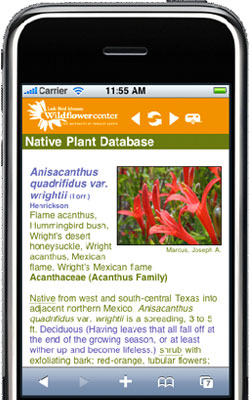
Did you know you can access the Native Plant Information Network with your web-enabled smartphone?

Ask Mr. Smarty Plants
Ask Mr. Smarty Plants is a free service provided by the staff and volunteers at the Lady Bird Johnson Wildflower Center.

rate this answer

Saturday - March 10, 2012
From: San Antonio, TX
Region: Southwest
Topic: Soils, Trees
Title: Tree to plant on rocky soil in San Antonio
Answered by: Barbara Medford
QUESTION:
I want to plant a tree in a particular spot in the yard but after digging down 10 inches I hit solid rock. I filled the hole with water and it took hours for it to go down. It is one of the higher elevations in the yard and a few feet away there is deeper soil (although the deeper soil is not a location I can plant a tree). It is not a spot that would get a lot of water unless I water it. If I build up the soil a little bit and dig a very wide hole and add decomposed granite would I be able to plant a bigtooth maple or texas ash tree there? (I know they both need good drainage but do well on rocky soil) If no, is there a tree you would suggest? I hope I have described the situation clearly enough that you could give me advice. Thank you.ANSWER:
Trees all over Central Texas, especially on the Edwards Plateau, grow in exactly those conditions. Sometimes the seeds (in wild areas) hit an area, germinate and grow a few feet and then die, because their roots have hit solid rock, or they have received insufficient rainfall, or something ate the plant down to oblivion. That is why every plant creates so many seeds, to guarantee that at least some of them live. But you don't want to garden like that on your own property; you want to put it in the ground and then see it grow up to be a fine old tree.
One thing that makes this possible is that most tree roots are within about 12" from the soil surface, to permit the exchange of gases and better access to moisture. In terms of water, any newly-planted tree, as well as other plants, will need an adequate regular source of moisture for at least the first year of its life. On our website we have lists of plants that grow dependably in various ecoregions of Texas, based on average annual moisture and soil types. We believe that the list from the Edwards Plateau is the best one to look at for your purposes. This is not to say that a plant on the list would absolutely thrive in your area or a plant not on the list would suffer; neither is true. Your chances of success are simply increased when you choose plants that have proved themselves hardy in the same area. Similarly, an adjacent ecoregion, such as the South Texas Plains could yield some good results. Follow each plant link to learn more about prospective height, bloom color and time, as well as soil types. We have checked every plant we selected to make sure it is native in or near Bexar County.
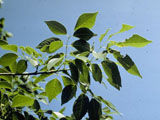
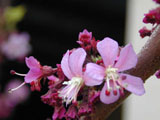
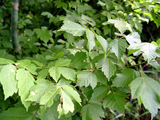
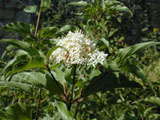
So, to your specific question. First, read our Step-by-Step article on How to Plant a Tree. We would only add to those instructions by agreeing with your suggestion of a wider hole, and also to build it up by working compost and possibly some decomposed granite into the native soil. We will go through both lists, selecting on "Tree" on Habit or General Appearance. When you look at the lists, you might choose other characteristics, such as dry soil or part shade that apply in your situation. While Fraxinus texensis (Texas ash) appears on the Edwards Plateau list, Acer grandidentatum (Big-toothed maple) appears on neither. Acer negundo (Ash-leaf maple) appears on the South Texas Plains list.
Recommended Trees from the Edwards Plateau ecoregion list:
Chilopsis linearis (Desert willow)
Cotinus obovatus (American smoke tree)
Diospyros texana (Texas persimmon)
Prunus mexicana (Mexican plum)
Ungnadia speciosa (Mexican buckeye)
Recommended Trees from the South Texas Plains ecoregion list:
Cornus drummondii (Roughleaf dogwood)
Zanthoxylum hirsutum (Texas hercules' club)
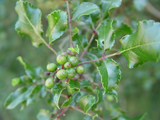
From the Image Gallery


More Trees Questions
Need small, fast growing trees for privacy screen in Buda, TX.
February 01, 2013 - Please recommend some small, but fast growing, flowering trees to plant along a western fence for privacy
view the full question and answer
Planting trees to use carbon dioxide
September 06, 2007 - How many trees must we plant to use carbon dioxide produced by the average American in a year?
view the full question and answer
Conditions for growing Prunus mexicana
March 23, 2007 - Will a native Wild Plum do well in the Cat Spring area west of Houston. The soil is quite sandy. I was told that the plum trees attract deer.
view the full question and answer
Illegal to remove an orange blossom from ground in Florida from Atlantis FL
March 28, 2012 - Is there any law that prevents someone from removing an orange blossom from the ground in Florida?
view the full question and answer
When is it time to remove diseased oak trees in Belton, TX?
May 03, 2013 - When to give up on my live oaks. We lost/mostly several live oaks since 2011 and the drought. One, died from the crown, one large mass at a time, and now resembles a 10' totem pole with scraggly gro...
view the full question and answer
| Support the Wildflower Center by Donating Online or Becoming a Member today. |