Native Plants

Q. Who is Mr. Smarty Plants?
A: There are those who suspect Wildflower Center volunteers are the culpable and capable culprits. Yet, others think staff members play some, albeit small, role. You can torture us with your plant questions, but we will never reveal the Green Guru's secret identity.
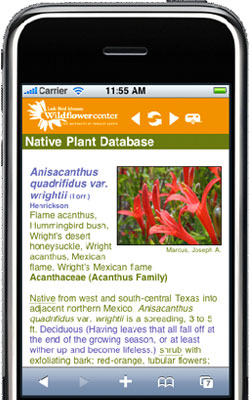
Did you know you can access the Native Plant Information Network with your web-enabled smartphone?

Ask Mr. Smarty Plants
Ask Mr. Smarty Plants is a free service provided by the staff and volunteers at the Lady Bird Johnson Wildflower Center.

rate this answer

Thursday - February 09, 2012
From: Madison, MS
Region: Southeast
Topic: Invasive Plants, Edible Plants, Vines
Title: Edibility of peppervine berries from Madison MS
Answered by: Barbara Medford
QUESTION:
I am following up on a question I've posed to many well experienced foragers and naturalists regarding the pepper vine plant or Ampelopsis arbor. There are many conflicting stories regarding the edibility of this grape and it seems to stem from the amount of carbolic acid (some people say this is tartaric acid). I can eat a handful at most of these berries and have made a fine jelly from juice that has had the acid settled and removed by settlement in the refrigerator and straining through muslin. That being said, juicing the berries was extremely painful to my hands, much like fiberglass. I'm not sure how to proceed on this plant; it clearly has the characteristics of a native grape but I could use your expertise and advice. Thank you in advance.ANSWER:
Since you have already obviously done research on Ampelopsis arborea (Peppervine), we're not sure we can add anything useful. We did find an Aggie Horticulture article (Texas A&M) on Peppervine. We also discovered, in our Native Plant Database, another plant with the common name "pepper vine," Clematis ligusticifolia (Western white clematis). From our webpage on that plant, we extracted this paragraph:
"This species’ traditional name, Pepper Vine, referred to the acrid, peppery taste of the stems and leaves, which Native Americans chewed as a remedy for colds and sore throats. It is said that the crushed roots were placed in the nostrils of tired horses to revive them. Caution is advised: The genus is known to have poisonous species."
Since you are referring to a grape-like fruit, we hope this is not the right plant; common names can be easily tripped over in plants.
Everything we found concerning edibility said it was a food liked by birds, and mammals would eat it, but preferred other food if they could get it. We also learned that it can be very invasive and absolutely crowd out other more desirable plants in the garden or woodlands.
Since, as we said, we don't have much to add, we will voice an opinion. The process is obviously tedious to extract juice from those berries, and you mentioned stinging and burning while handling it. Are you sure you want that attacking the lining of your stomach? Oh, and were you aware that another common name of this vine is "cow-itch vine?"
From the Image Gallery


More Edible Plants Questions
Who ate the Jack-in-the-Pulpit in Ontario?
July 07, 2009 - Something has dug up my clump of Jack-in-the-pulpit at my parents' cottage in the Haliburtons (Ontario, Canada). Leaves, berries and roots are gone. We know we have a black bear who likes our compo...
view the full question and answer
Edible native plants in New York
July 29, 2013 - In your plant database- which is great by the way- it does not say whether or not the plant is edible. Do you have any way to search for edible plants? Or do you have a separate database?
Thanks!
view the full question and answer
Is it safe to eat vegetables grown in the same bed as foxgloves?
August 12, 2012 - I have foxglove in my flower beds and have planted tomatoes, cucumbers, peppers and cantaloupe in the flower bed and now I am concerned about the shared root system. Also, my tomatoes are touching the...
view the full question and answer
Edibility of non-native garlic sprouts from Brancburg, NJ
March 12, 2013 - I have regular garlic in my refrigerator. It had sprouts growing out of it so I put it in a cup of water. Now that the stems are large enough to put in food, my question is.. Is that part of the garl...
view the full question and answer
Fruit trees for Kempner, Texas
November 29, 2013 - I just moved to Kempner , TX and would like to plant a couple of fruit trees in my 1 1/4 ac yard. I would like to plant a species that will do well and produce edible fruit. Any assistance will be app...
view the full question and answer
| Support the Wildflower Center by Donating Online or Becoming a Member today. |