Native Plants

Q. Who is Mr. Smarty Plants?
A: There are those who suspect Wildflower Center volunteers are the culpable and capable culprits. Yet, others think staff members play some, albeit small, role. You can torture us with your plant questions, but we will never reveal the Green Guru's secret identity.
Did you know you can access the Native Plant Information Network with your web-enabled smartphone?

Ask Mr. Smarty Plants
Ask Mr. Smarty Plants is a free service provided by the staff and volunteers at the Lady Bird Johnson Wildflower Center.

rate this answer

Saturday - August 13, 2011
From: Sandy Hook, CT
Region: Northeast
Topic: Compost and Mulch, Erosion Control, Grasses or Grass-like
Title: Stabilizing a sand bank in VT
Answered by: Anne Bossart
QUESTION:
We have a summer cottage in Burlington, Vt. and need to stabilize a mound of sand. The "bank" we are trying to stabilize has partial sun and faces south. It measures approx 4' high and is 30' long. What type of plants/materials (mulch etc.) would you recommend? Ideally we would like nothing over 4' high, and it is OK to plants these items this fall?? Many thanks,ANSWER:
If you take your cues from Mother Nature you will see many miles of sand dunes along the beaches of the Northeast that are kept in place as a critical part of a dynamic, changing ecosystem with grasses. Their fibrous root systems are adapted to keeping them in place and extracting the necessary water and nutrients that are present in the sand.
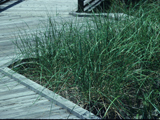
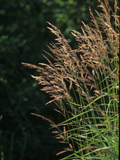
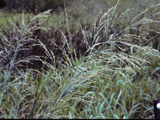
You can create a list of grasses native to Vermont by visiting our Native Plant Database and doing a Combination Search. Select: Vermont, grasses and sunny conditions. The list generated has links to detailed information pages with images. You will find vey few that are as short as you are thinking you would like them to be but again, look at how nature does it. There is very little that evokes the sense of the beach and summer better that tall grasses moving in the breeze with their flower heads highlighted by the sun.
Planting the plants in the fall is ideal ... the soil is warm and moist enough to promote root growth and the air is not so hot and dry as in high summer. So they will have a chance to get established before winter. Because I am not certain of your exact conditions I am not sure what to recommend regarding mulch. If you have a clean, bare sand dune where weeds are not a huge issue, I would say there is no need to mulch. If it is really just a mound of sandy soil that is full of "weeds", pull them out, plant the grasses and mulch with a nice dark shredded bark mulch (nothing evokes the sense of a strip mall quite like orange mulch!).
Here are some grasses that would not only do the job for you but would be quite attractive when planted in drifts:
Ammophila breviligulata (American beach grass) (this plant can be very aggressive)
Calamagrostis canadensis (Bluejoint)
Hierochloe odorata (Sweetgrass)
Panicum virgatum (Switchgrass)
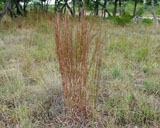
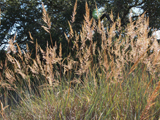
From the Image Gallery

More Grasses or Grass-like Questions
Drought-Tolerant Plants for Arizona
July 16, 2015 - Slowly turning south-facing lawn to drought-tolerant plantings with gravel paths. Mature Ponderosa and several blue spruce and junipers surround area. Grass area I'm converting with a few larger tr...
view the full question and answer
Ground cover under Spruces from West Chester PA
December 06, 2012 - Trying to get a native groundcover (or any grass/wildflower/fern) planting established under a small stand of spruces. Established stand (30+ years old), so lots of needles on ground. Just about tot...
view the full question and answer
Plants for a sunny, sandy site in Central Texas
January 22, 2015 - I live between La Grange and Schulenburg, Texas. My soil is sandy. Full sun, no trees. I am a senior citizen with limited funds who is allergic to Rye and Bermuda grass. I tried planting a lawn of...
view the full question and answer
Muhly grass slow to green up from Spring Hill FL
August 04, 2012 - Have lots of muhly grass planted 3 yrs ago. This yr about 1/3 are VERY slow. Still look like hay stacks. No pattern in the bed. You mentioned pesticides being too close?
view the full question and answer
Caring for a wildflower meadow in Austin, TX.
March 22, 2016 - We have a meadow full of wildflowers in the country, bluebonnets, Indian paintbrushes, etc. What can we do to promote continued growth and is there a certain time of year we should mow? Should we fe...
view the full question and answer
| Support the Wildflower Center by Donating Online or Becoming a Member today. |