Native Plants
Q. Who is Mr. Smarty Plants?
A: There are those who suspect Wildflower Center volunteers are the culpable and capable culprits. Yet, others think staff members play some, albeit small, role. You can torture us with your plant questions, but we will never reveal the Green Guru's secret identity.
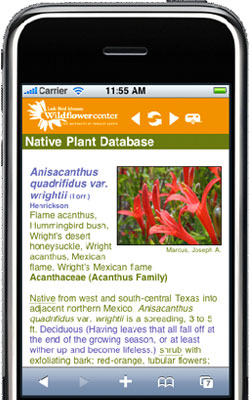
Did you know you can access the Native Plant Information Network with your web-enabled smartphone?

Ask Mr. Smarty Plants
Ask Mr. Smarty Plants is a free service provided by the staff and volunteers at the Lady Bird Johnson Wildflower Center.

rate this answer

Sunday - April 03, 2011
From: Coppell, TX
Region: Southwest
Topic: Shade Tolerant
Title: Sun and shade landscaping in Coppell TX
Answered by: Barbara Medford
QUESTION:
My two-story home in Coppell Texas faces north. The houses are ten feet apart. The sun leaves the front yard late-0ctober/early-November. It is March 24 and the beds are still in house shade. In summer most of the beds will be in full sun. My encore azalea looks kind of sick and has only one bloom (I think because he has not yet gotten direct sunlight.) Any thoughts on shrubs under four feet, smaller trees (particularly ones that would fit in a bed area 6-10 feet deep), and perennialsANSWER:
Let's start with the azalea question first, and go on from there. There are 18 azaleas native to North America, of which 4 are native to Texas. Not a single one of those native to Texas grow natively in North Central Texas, but in small clumps of counties in far East Texas. We have no personal experience with azaleas so we looked at Rhododendron oblongifolium (Texas azalea) in our Native Plant Database, and learned that they require shade, dry soil moisture, acidic, well-drained sandy soil, which describes far East Texas soil precisely. In Dallas and Denton Counties you probably have clay soil, either neutral or leaning to alkaline.
The 'Encore' azalea is a brand name, and the article we linked you to can give you more information than we can. In another source, we were told that the 'Encore' is a hybrid of a fall-blooming Asian azalea, which could explain even more why they are not doing well. Bottom line, in a clay soil you are probably not getting good enough drainage for those azalea roots, which do not tolerate wet feet. The Lady Bird Johnson Wildflower Center is dedicated to the growth, propagation and protection of plants native not only to North America but to areas in which those plants grow natively, and we feel that the nativity of the azaleas you have could be the source of your problem.
Now on to the sun/shade situation in your garden. Without being on the spot (and not being trained as landscapers anyway) the best thing we can do for you is teach you how to use our Native Plant Database. Also, we would recommend that, if at all possible, you get professional landscaping help. That landscaper would know what your soils are, what kind of drainage you have and what plants can withstand those rather severe conditions of all sun for six months and all shade for the other six. You can go to our National Suppliers Directory, type your town and state in the "Enter Search Location" box and you will get a list of native plant nurseries, seed companies and landscaping and environment consultants.
Next, the selection of plants. First, make a map of your yard, and watch during the day-this time of year, Spring, is good because the days and nights are closer to the same length. Our way of defining "sun," is that there are 6 hours or more of sun a day, "part shade" is 2 to 6 hours of shade, and "shade" is 2 hours of shade or under. If an area is sun for 6 months and shade for 6 months, that is going to severely limit what you can plant there. Blooming plants nearly all need a good deal of sun to bloom at their best. There are some plants, and we are thinking especially of some ornamental grasses, that can take that kind of limits, but heavy-blooming plants are going to be a disappointment.
Now we will introduce you to our Native Plant Database. Once you have learned your way around the database, you'll be able to search for all kinds of plants, their growing conditions and so forth. Following the plant links will take you to a page on that plant with information on light requirements, moisture preferences, bloom time and color, expected size, preferred soil, etc. That will be far more useful to you than for us to give you a list of plants which might not like your soil or needed more sun where you wished to plant, or even had the wrong color blossoms. We'll use a herbaceous blooming plant as an example, and you can go from there.
Just to start you thinking, look at our list of plants for the Post Oak Savannah which, if you look at the map of Texas at the top of the first page, you will see includes Dallas and Denton Counties.
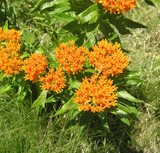
Begin by going to our Recommended Species site. Click on North Central Texas on the map, which will give you a list of 105 plants of all kinds native to East Texas. Using the sidebar on the righthand side of the page, select "herb" (herbaceous blooming plant), then Narrow Your Search. When we did this, we got a list of 40 blooming plants native to your area. If you have more specific needs, you can select on Light Requirements, Soil Moisture, even selecting what color flowers you want, and when they bloom. Each specification you add, of course, will narrow your range of choices of plants. We will walk you through one blooming plant and you can go from there to choose more blooming plants, plus shrubs, trees, vines, etc. that will suit your purposes. For our example, we chose one of our own favorite flowering native plants: Asclepias tuberosa (Butterflyweed). This USDA Plant Profile map shows that it does, indeed, grow as a native to Denton and Dallas Counties. Follow the plant link, and from our webpage on that plant, you can learn that it will grow to about 2' tall, is perennial and deciduous, and blooms orange and yellow from May to September. Butterflyweed requires low water use and either sun (6 or more hours of sun a day) or part shade (2 to 6 hours of sun a day) and prefers well-draining sandy soils. It is a larval host for the Monarch and Queen butterflies, so don't spray those caterpillars, they are baby butterflies. The flowers are also a nectar source for pollinators like bees and butterflies. There are Propagation Instructions, a list of Benefits of the plant, and even seed sources. There are pictures on the page, on which you can click and get a larger version. So, you see you can apply these instructions to select any plant native to your area that you wish, find out how to take care of it and what benefits it has, be prepared to talk to your landscape consultant about what you want and why. From our Native Plant Image Gallery:
More Shade Tolerant Questions
Nimblewill grass for a shady area in Dallas
April 04, 2013 - i have a very shady backyard and reading some of your post I think Muhlenbergia schreberi (nimblewill) will survive.
Two questions:
Is it drought resistant?
Where can I buy the seeds?
view the full question and answer
Evergreen Vine for San Antonio Trellis
November 23, 2011 - I have a new trellis at the end of my patio on which I want to grow an evergreen vine. The area is fairly shady. I had settled on Carolina Jasmine, but read that it is very toxic which is worrisome ...
view the full question and answer
Shade Tolerant Groundcover for Texas
July 13, 2016 - I live in Atascosa county in Pleasanton Texas, I have an abundance of Live Oak and Ash trees shading my property and need a groundcover for my backyard which is nothing but sand and where I have dogs ...
view the full question and answer
Wildflowers suitable for full sun and partial shade in the Dallas, Texas area
October 22, 2007 - What wildflowers are best for the Dallas area both in sunny and semi shade locations? Are you able to purchase by mail?
view the full question and answer
Plants for steep slope in shade in Iowa
July 02, 2010 - I work for a small non-profit shelter here in Dubuque, Ia. that has a very steep slope behind the building that needs some sort of plant or grass planted to stop erosion. The slope gets little to no s...
view the full question and answer
| Support the Wildflower Center by Donating Online or Becoming a Member today. |