Native Plants

Q. Who is Mr. Smarty Plants?
A: There are those who suspect Wildflower Center volunteers are the culpable and capable culprits. Yet, others think staff members play some, albeit small, role. You can torture us with your plant questions, but we will never reveal the Green Guru's secret identity.
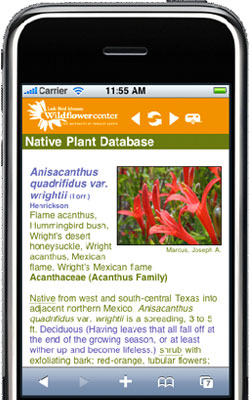
Did you know you can access the Native Plant Information Network with your web-enabled smartphone?

Ask Mr. Smarty Plants
Ask Mr. Smarty Plants is a free service provided by the staff and volunteers at the Lady Bird Johnson Wildflower Center.

rate this answer

Thursday - April 20, 2006
From: Kansas City, KS
Region: Midwest
Topic: Trees
Title: Inadvisability of mounding earth around tree in ring
Answered by: Joe Marcus
QUESTION:
We have a mimosa tree in our backyard. My husband wants to build a tree ring around it. My mother told me that some trees will die from having soil built up around it like that. Will a tree ring kill our mimosa tree?ANSWER:
This is one of the more controversial topics in arboriculture. Some arborists swear by tree rings, others say they're useless and, worse, detrimental to the trees. I take a moderate stand on this. In my opinion, tree rings are useful for two purposes: providing a temporary aid to watering a tree after transplanting and protecting the crown of the tree from lawn equipment.
The old donut watering dike that we've all seen for many, many years has recently morphed into a mound of earth around the base of the tree. I have seen these as much as 1 foot in depth! These mounds do no good and actually can do great harm. Soil and mulch mounded against the trunk of a tree can harbor both harmful insects and pathogens and provide the perfect environment for them to gain entry to the base of a tree. Moreover, some trees seem to have some critical gas exchange happening at the base and certainly depend on oxygen at the roots. A thick mound of soil over the root ball greatly diminishes the volume of gases available that are critical to the health of the tree.
Watering rings (the donut mounds) should be built outside the hole dug for the tree, not on top of the root ball as they almost always are constructed. They're really not necessary if the tree owner will spend six minutes watering their newly transplanted tree at low flow rather than two minutes with the hose gushing at full pressure. Little sprinklers running at low pressure do a great job of watering new trees.
Some people maintain rings or bare earth or loose mulch around their trees as a way to protect them from mowers and weed trimmers. This is in general a good idea as mechanical damage to the base of a tree is often the source of serious problems far into the future. However, care should be exercised not to mound soil against the trunk of the tree or to smother the roots. For small trees, I like to use curved clay tiles or bricks as a physical barrier around the base of the tree. Grass can grow right up to (and into) the barrier which I can mow up to. If grass or weeds pop up between the barrier and the tree it's a simple matter to remove the tiles or bricks, pull or trim the grass and replace the barrier. If the barrier is not placed directly in contact with the base of the tree insects and diseases won't have any better chance of getting started than if it weren't there at all.
More Trees Questions
Problems with Eastern hemlock in Greenville SC
July 02, 2009 - Dear Mr. Smarty Plants,
I have a beautiful, young, 5 and a half foot tall Eastern Hemlock. I purchased and planted it two years ago in the fall. It has been doing very well all this spring. And ne...
view the full question and answer
Reducing the Height of a Redbud Tree
January 23, 2016 - We have a very large, about 15-year old, Redbud tree that is growing so tall it's obstructing our view of the river. How and when can we prune this tree back so it does not hurt the tree.
view the full question and answer
Season to plant Pacific Wax Myrtle from Fallbrook CA
July 25, 2013 - Would like to know which season would be the best to plant Pacific Wax Myrtle in Fallbrook, CA area? I presently have invading bamboo, which I want to get rid of. Thank you!
view the full question and answer
Citrus trees for Austin
May 21, 2008 - I am looking for citrus that grows in the Austin,Tx area.
Could you offer any suggestions please?
view the full question and answer
Native violets under maples from Gettysburg PA
July 06, 2012 - Just for your info (no need to post or reply), I saw an old post of a question of something to grow under maples. In central PA, native violets grow very well under several species of maples in lawns...
view the full question and answer
| Support the Wildflower Center by Donating Online or Becoming a Member today. |