Native Plants
Q. Who is Mr. Smarty Plants?
A: There are those who suspect Wildflower Center volunteers are the culpable and capable culprits. Yet, others think staff members play some, albeit small, role. You can torture us with your plant questions, but we will never reveal the Green Guru's secret identity.
Did you know you can access the Native Plant Information Network with your web-enabled smartphone?

Ask Mr. Smarty Plants
Ask Mr. Smarty Plants is a free service provided by the staff and volunteers at the Lady Bird Johnson Wildflower Center.

rate this answer

Friday - February 11, 2011
From: Rochester, MI
Region: Midwest
Topic: Seed and Plant Sources
Title: Propagation of Aesculus parvifolia from Rochester MI
Answered by: Barbara Medford
QUESTION:
Aesculus parvifolia. I purchased one plant in spring 2010---it's about 3 ft tall. How might I propagate from this one plant, or should I buy another?ANSWER:
As you can see from this USDA Plant Profiles map, Aesculus parviflora (Bottlebrush buckeye) doesn't grow natively in Michigan at all, but rather in 3 southeastern states, Pennsylvania, New Jersey and Washington DC. You say you purchased this plant, did you purchase it locally? We realize that many people assume that if a plant is purchased locally it will grow locally, but this is not always the case. From this article from Floridata, you can get more information, including the fact that it is hardy from USDA Hardiness Zones 4 to 8. Since Oakland County appears to be Zone 5b, it could certainly survive there. However, from this University of Connecticut page on the Bottlebrush buckeye, note this comment: "in the northeastern United States, fruit set is rare due to an insufficiently long growing season."
Warning: Seeds and foliage of Aesculus species are poisonous to humans if eaten.
If you follow the plant link above, you can read our webpage on this plant. From the section on Distribution on that page:
"Native Distribution: C. GA to AL & SC
Native Habitat: Rich, mesic woods; moist ravines"
We learned from this webpage that propagation of this plant is not easy under the best circumstances:
"Description: Seeds should be planted as soon as possible after they are collected and never allowed to dry out. Softwood cuttings under mist root in fair percentages. The commercial method of propagating bottlebrush buckeye is root cuttings.
Seed Collection: Seeds dry and shrivel quickly.
Seed Treatment: Minimal cool stratification (30 days) seems beneficial."
Your original question was whether to propagate this plant or buy another. As it appears that propagation could be difficult for you, and you feel that the plant will do well in your garden, purchasing another might be a better choice.
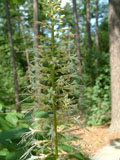
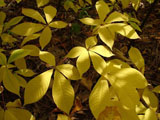
The first three pictures below were taken in Durham NC and Philadelphia PA. The last one was taken in Cass County, TX, which is in northeast Texas and is a wooded area with acidic soil.
From our Native Plant Image Gallery:
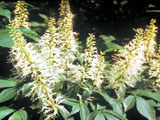
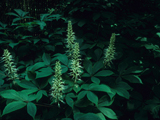
More Seed and Plant Sources Questions
Non-native lilacs for wedding bouquet in July in Salt Lake City
May 07, 2010 - My friend's daughter wants to have lilacs in her wedding bouquet, but she is not getting married until July 15th. I realize lilacs are spring flowers, but will there be anywhere in the U.S. that lila...
view the full question and answer
Source for Bumelia lanuginosa in Austin
February 24, 2005 - PLEASE HELP! I'm trying to plant several trees called Bumelia lanuginosa (synonym: Sideroxylon langinosum). The common names include but are not limited to: Ironwood, Chittamwood, Gum Elastic, Wooly...
view the full question and answer
Columbines for September wedding in CO.
August 14, 2009 - My daughter is planning a September 2010 wedding in Colorado. Is there any way for me to buy Columbines in the spring and keep them cool so that the pots all bloom in September for the wedding?
Also,...
view the full question and answer
Certified organic native grass seeds for Texas
August 10, 2014 - Thanks for your previous answer to my pasture grass seed question. We know about Native American Seed but they don't sell certified organic seeds. We're not sure whether we'll be able to find cer...
view the full question and answer
Want a source for Mexican redbud in Houston, TX
October 04, 2010 - I live in west Houston and would like to purchase and plant a Mexican redbud in my yard. I have Googled to find one and also searched the Growit site without success. Where can I find one in Texas? I ...
view the full question and answer
| Support the Wildflower Center by Donating Online or Becoming a Member today. |