Native Plants
Q. Who is Mr. Smarty Plants?
A: There are those who suspect Wildflower Center volunteers are the culpable and capable culprits. Yet, others think staff members play some, albeit small, role. You can torture us with your plant questions, but we will never reveal the Green Guru's secret identity.
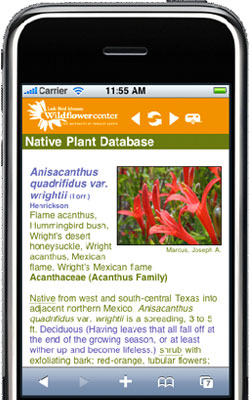
Did you know you can access the Native Plant Information Network with your web-enabled smartphone?

Ask Mr. Smarty Plants
Ask Mr. Smarty Plants is a free service provided by the staff and volunteers at the Lady Bird Johnson Wildflower Center.

rate this answer

Tuesday - February 01, 2011
From: Calgary, AB
Region: Canada
Topic: Vines
Title: Mystery vine in Alberta, Canada
Answered by: Anne Bossart
QUESTION:
Recently, I came across a vine (looked like virginia creeper/clematis type base - heavy and woody like) in Calgary, Alta - it was climbing on a metal fence that was approx 4'tall - unfortunately the vine was in its winter slumber so I can't tell you about the leaves - However the flower bulb? had gone to seed - it has small heads like a dandelion from which was a feathery/wispy/soft fluff like cotton. The heads when pulled on individually released "feathers" each with a small seed attached - I assume this feather floats on the wind to disperse the seeds. I gathered some of the seed heads but would like to know what I am planting esp if it is an invasive species. The closest I have been able to come is a plant called dog choking vine?? Is this what I might have and can you direct me to some pictures of the plant you suspect it might be.ANSWER:
Well, there is no way we can accurately ID your vine without actually seeing it, but we can point you in the right direction so that you may be able to figure out what it is.
If you visit our Native Plant Database and do a Combination Search for Alberta (the provinces are at the bottom, after the states) and selecting Vine for the plant Habit a list of 7 vines native to Alberta will be generated. Also visit Evergreen.ca and search their Native Plant database selecting: Alberta/native and invasive species at the top of the page and Vine under Characteristics further down the page. Leave everything else blank and click the "perform search" button at the bottom of the Characteristics/Growing Conditions section. It will generate a list of 20 vines. You can read about all these vines and look at the images to start the identification process. Visit the Alberta Invasive Plants Council website as well to see if your plant might be one of the ones threatening your province.
Vines have various methods of for climbing (check out the Wikipedia entry for vines). They can be twining, like wisteria, honeysuckle (or dog strangling vine) where they simply twist around strings, poles, twigs or even themselves to gain height eventually becoming a huge, matted mess. They can produce tendrils or twining petioles or leaves to wrap around a narrow support like clematis or peas, or they can produce adventitious clinging roots along the whole stem that can stick the vine to the side of a house or tree trunk like ivy (poison or English or virgina creeper). Have another look at how your mystery vine is attached to the fence and that will narrow its possible identity considerably.
You don't have a flower, but have the seeds; which sound suspiciously like clematis, a member of the Buttercup Family. All the members of that family produce seed heads that are wispy- do a Google image search buttercup seed head and you will see what I mean. Of course you can try planting the seeds and see what plant emerges or wait till spring and get a more positive identification. If you do have a clematis, you may have better luck propogating it by rooting a cutting or layering it.
Good luck!
More Vines Questions
Unusual vine in San Diego County, California
May 12, 2012 - Dear Mr. or Ms. Smarty Pants,
I came across an unusual vine winding through a young Zumaque growing off the edge of a mesa in San Diego (coastal sage scrub). The small (fingernail-sized)leaves rough...
view the full question and answer
Will an ivy vine growing up my maple kill it?
March 23, 2009 - I have a ground cover ivy vine that has grown up my big maple tree. I would like to know if this will kill the tree if left, or will I kill the tree if I take it off? What should I do with it?
view the full question and answer
Cow-itch vine name from Seguin TX
July 02, 2012 - How did Cow-Itch Vine (Cissus incisa / Cissus trifoliata) get its name?
view the full question and answer
Salt-tolerant plants in Central Texas
September 16, 2009 - Do you have any suggestions for salt-tolerant plants in Central Texas? Thanks.
view the full question and answer
Do monarchs like Cynachum laeve in Austin, TX?
May 29, 2012 - I have found what I believe is Honeyvine (Cynanchum laeve)
growing in my yard here in Austin. I tried using the LBJWC
plant data base and could not find it. I also found the plant with a diff...
view the full question and answer
| Support the Wildflower Center by Donating Online or Becoming a Member today. |