Native Plants

Q. Who is Mr. Smarty Plants?
A: There are those who suspect Wildflower Center volunteers are the culpable and capable culprits. Yet, others think staff members play some, albeit small, role. You can torture us with your plant questions, but we will never reveal the Green Guru's secret identity.
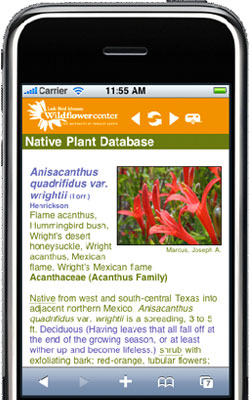
Did you know you can access the Native Plant Information Network with your web-enabled smartphone?

Ask Mr. Smarty Plants
Ask Mr. Smarty Plants is a free service provided by the staff and volunteers at the Lady Bird Johnson Wildflower Center.

rate this answer

Tuesday - December 28, 2010
From: Pulaski, VA
Region: Mid-Atlantic
Topic: Wildflowers
Title: Indoor Lantana Care from VA
Answered by: Brigid & Larry Larson
QUESTION:
I have a Lantana plant. When I moved it inside, it was fine. Then I watered it too much. Is it possible to replant( to dryer dirt) in the winter time. Is has been in the 30's here, but inside 68. The leaves are falling off and I watered it again because leaves felt dry. Please help. Thank you, HelenANSWER:
Mr. Smarty Plants has a good database showing six native Lantana species; these can be reviewed by searching the “Plant Database” using Lantana as a keyword. Pretty much all of those are native to the southern states [farther South than Virginia!], so I’m guessing your Lantana is likely a commercial cultivar like discussed here. There is a shrub, Viburnum lantanoides (hobblebush), sometimes referred to in retail trade as a Viburnum Lantana, that is native near to your area of VA. These and several previous answers [which I've included in this discussion] have a good amount of information helpful in differentiating Lantana varieties and their care.
All this advice can be summarized pretty easily. All Lantanas are deciduous and drop their leaves in the winter. The behavior you describe, especially as you brought it indoors kind of late in the season – is typical of a deciduous plant going dormant preparing for the winter [Just like the trees outside!]. Here is another reference discussing Lantanas in the winter.
Dormant plants don’t need much water, nor do inside plants. Repotting a dormant plant is not a good idea; they don’t have the strength to recover well and it is a very good idea to let it dry out. Checking the leaves to see if the plant is dry is also misleading; the leaves naturally dry out as the plant heads towards dormancy. Instead, the best method is to check the soil by using the "finger" method. Stick your finger into the soil in the pot. If the soil feels dry, to the depth of about 2-3 inches when you insert your finger in the soil, then it needs watering. Remember however that this is winter time, so let the soil dry out thoroughly before watering. It’ll be fine when it is that dry, but won’t really come back strong until the spring. Always err on the side of the plant being a little dried out, rather than overwatering and drowning the plant. Here’s a question and reply addressing several plants, including Lantana, as potted plants spending a winter indoors.
More Wildflowers Questions
Low Groundcover for Washington State
February 03, 2015 - I'm trying to find a perfect fit for my piece of land in the State of Washington. I would say that the area is partly sunny and a somewhat moist area. I'm looking for a species of very small everg...
view the full question and answer
Companion plants for non-native Santolina virens
March 23, 2015 - Can you recommend companion plant options for Santolina virens? The companion plant would be planted randomly and interspersed with the santolina and needs to be no taller than 12 inches because of th...
view the full question and answer
Project on natives in Connecticut from Chino CA
April 13, 2010 - Hi Mr. Smarty Plants,
My 10 yr. old daughter is doing a project on Ct., and would like to know what the most common plants, trees and flowers are found in this state. A few of each would be a great ...
view the full question and answer
Petals not developing on blackeyed susans from Nashville TN
July 05, 2011 - I have an established "patch" of black eyes susans. This year, the leaves are beautiful, the centers black..but the petals are practically non existent. They didn't seem to develop correctly. Any...
view the full question and answer
Resources for a green roof project from Wayne PA
April 14, 2013 - Hello! I am researching a project to create a native wildflower/ turf mix for a green roof. I would ideally like to grow it as a sod mat, and then install it in rolls. I am currently working as an i...
view the full question and answer
| Support the Wildflower Center by Donating Online or Becoming a Member today. |