Native Plants
Q. Who is Mr. Smarty Plants?
A: There are those who suspect Wildflower Center volunteers are the culpable and capable culprits. Yet, others think staff members play some, albeit small, role. You can torture us with your plant questions, but we will never reveal the Green Guru's secret identity.
Did you know you can access the Native Plant Information Network with your web-enabled smartphone?

Ask Mr. Smarty Plants
Ask Mr. Smarty Plants is a free service provided by the staff and volunteers at the Lady Bird Johnson Wildflower Center.

rate this answer

Sunday - November 28, 2010
From: Fayetteville, NC
Region: Southeast
Topic: Non-Natives
Title: Comparison of native and non-native bulbs from Fayetteville NC
Answered by: Barbara Medford
QUESTION:
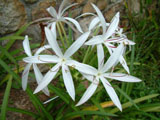
I am just a gardener seeking natives. As I could not find Crinum americanum bulbs/plants specifically, I checked further online. Here's an excerpt of what I found from the Louisiana Native Plant Society: Garden Bulbs for the South. Ogden states there are two look-alike Crinums. One is native but rare in cultivation because of its need for wet conditions (Crinum americanum), and a tropical drylander (Crinum erubescens), which is often sold as Crinum americanum ‘Robustum.’ The only difference that readily distinguishes between them is that the native is an aquatic or boggy condition grower, the tropical South American species will not grow in water, but in ordinary garden conditions. This is not the only parallel to species in the Southern United States and in subtropical South America where similar climatic conditions occur. My conclusions: I do not have the native Crinum americanum of the Gulf Coast and South Atlantic Coast. But what I have is a beautiful plant, well worth the little effort in growing. Thought you might want to know.ANSWER:
Congratulations on being a gardener seeking natives. In your discussion on the native Crinum americanum (Crinum lily) and the non-native Crinum erubescens, your facts are correct. The Native Plant Police will not be out to ticket you for permitting a non-native into your garden; even the most fervent native plant gardeners are sometimes guilty of allowing a lavender to sneak in or perhaps an old rose. Our main concern is that we not allow non-native invasives to take over and crowd out the native species in the garden.
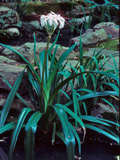
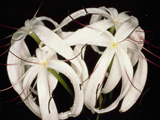
Images of Crinum erubescens from Google.
From our Native Plant Image Gallery:

More Non-Natives Questions
Distinguishing native Celastrus scandens from non-native C. Orbiculatus from Lexington MA
June 08, 2014 - Dear Mr. Plants,
I maintain a wildflower garden with the Lexington Field and Garden Club in Lexington, Massachusetts.
Every year, I pull up sprouts of Celastris orbiulatis. I want to plan...
view the full question and answer
Probably non-native crapemyrtle trees damaged by hurricane
January 15, 2009 - I have 5 crape myrtle trees. I live in Galveston, Tx and when Hurricane Ike came through in September the salt water I think killed them. They have not come back since then and are brown with no leave...
view the full question and answer
Non-native genista racemosa from Leander TX
March 28, 2012 - Hello, Mr. Smarty Plants. I fear I've made a horrible purchase at a local plant place. Bought a "broom" plant--it's not listed in your database. Latin name: genista racemosa, according to tag. ...
view the full question and answer
Fruit fly maggots attacking non-native Grumichama in Lake Worth FL
March 12, 2011 - Dear Mr. Smarty Plants
How do I prevent fruit fly maggots from attacking my Grumichama fruit?
view the full question and answer
Water for non-native Sub-Zero ivy in El Paso
March 25, 2011 - Sub-Zero Ivy: Do they require lots of water - I live El Paso, TX - dry climate. Are they dangerous to dogs? Will they do well as ground cover around a brick patio? - Thanks!
view the full question and answer
| Support the Wildflower Center by Donating Online or Becoming a Member today. |