Native Plants
Q. Who is Mr. Smarty Plants?
A: There are those who suspect Wildflower Center volunteers are the culpable and capable culprits. Yet, others think staff members play some, albeit small, role. You can torture us with your plant questions, but we will never reveal the Green Guru's secret identity.
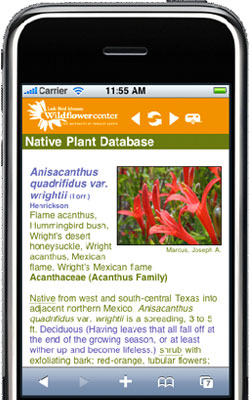
Did you know you can access the Native Plant Information Network with your web-enabled smartphone?

Ask Mr. Smarty Plants
Ask Mr. Smarty Plants is a free service provided by the staff and volunteers at the Lady Bird Johnson Wildflower Center.
rate this answer

Thursday - March 09, 2006
From: Austin, TX
Region: Southwest
Topic: Best of Smarty, User Comments, Wildflower Center
Title: True date for Earth Day
Answered by: Nan Hampton and Dean Garrett
QUESTION:
My grandson asked me to verify the correct date for Earth Day 2006. Sites on the internet say (a) Earth Day USA is April 22, 2006. (b) International Earth Day is March 20,2006... the date of the Vernal Equinox They also say that Earth Day originated in the USA... and the date selected was the date of the Vernal Equinox... which is March 20, 2006. This contradiction of dates is confusing to me. What is correct.?ANSWER:
This is the kind of topic for which a timeline is both clarifying and confusing, but here's one anyway:
1969: John McConnell proposes an Earth Day to the National UNESCO Conference in San Francisco.
September, 1969: John McConnell proposes an Earth Day to the San Francisco Board of Supervisors. The City of San Francisco proclaims the vernal equinox of 1970 to be the city's Earth Day.
September, 1969: US Sen. Gaylord Nelson announces at a Seattle conference that a nationwide grassroots demonstration in recognition of Earth Day will be held the following spring.
March 20, 1970: San Francisco observes Earth Day on the vernal equinox, with mass participation throughout the city.
April 22, 1970: circa 20 million people across the United States demonstrate in recognition of the national Earth Day, which Sen. Nelson had set in motion.
February 26, 1971: UN Secretary General U Thant issues a proclamation naming the vernal equinox, March 21, to be Earth Day, marked by the ringing of a peace bell and intended to raise awareness of both peace and environmental issues.
April 22, 1990: The 20th anniversary of the 1970 national Earth Day is celebrated in some 141 countries throughout the world, with millions of people participating. The increased interest reflects a reinvigorated environmental movement and inspires greater concern and action worldwide.
2004-2005: Berkley, San Francisco, and Denver officially recognize the vernal equinox as Earth Day, in acknowledgment of the fact that the first one (in San Francisco) was held on that date and in recognition of the traditional importance of the vernal equinox in many cultures.
No wonder you and your grandson are confused! There has obviously been some controversy over which of the two dates should be observed.
The official national date in the United States is still April 22, the date of the first massive, nation-wide observance of Earth Day in 1970. Because of the great impact made by the 20 million people across the country who participated on that historic date, and because the influential, international 1990 event was also held on that date, April 22 remains the official Earth Day in almost all US cities and in many, particularly English-speaking countries around the world. If you are in the US, unless you live in Berkley, San Francisco, or Denver, April 22 will be the only Earth Day date likely to be officially observed in your city or town in 2006. However, it is possible that Berkley, San Francisco, or Denver could recognize both the locally recognized vernal equinox date and the national date, with events taking place at both times, but I haven't checked that out.
Complicating things further is the fact that the vernal equinox (the time at which the sun crosses the equator along the ecliptic while heading north) occurs “on or about March 21,” meaning that it occasionally takes place on March 20.
Whichever date the observance falls on in your neck of the woods, it's good to keep in mind that both John McConnell and Gaylord Nelson were inspired to suggest an Earth Day because massive public involvement was already taking place at a grass roots level throughout the country. Public action preceded official observance. In researching your question in encyclopedia yearbooks and periodicals from the late 1960s, I also learned that many people had been moved to get involved in environmental issues by the first photograph of the earth from space, an image we take for granted today.
More User Comments Questions
User comment on native grass mixes from Robstown TX
March 21, 2014 - As a followup to my question on seed spreaders, native grass and prairie seed mixes seem a good fit for my location in far western Nueces County which is more semi-arrid than 30 miles away in Corpus w...
view the full question and answer
Agarita suggestion for Houston area
March 05, 2013 - Another possible plant for the following question is agarita. The question: "Looking for a very, very, thorny three or four foot tall shrub for in front of windows to deter break-ins. Considering Ro...
view the full question and answer
Would like a "try instead of" list for non-native plants in Austin, TX.
June 19, 2012 - It would be so helpful if, when asked about a non-native plant, you would do a "try instead of" list.
I have about 45 plants to reseach from my landscaping firm, and it's wearing me out to try to...
view the full question and answer
Question about commercial product from Austin
May 19, 2014 - Do you carry AquaSmart Pro? There was an article in today\\\'s Statesman about some Sun City people using AquaSmart Pro to save water on their lawns. I am always skeptical about such panaceas. ...
view the full question and answer
Are agaves really native from Pacific Palisades CA
April 30, 2013 - I just replied re agave issues, and mistakenly asked the source of your information. I see that you clearly noted it, apologies.
I would note, however, that the Riverside area is very much a hot,...
view the full question and answer
| Support the Wildflower Center by Donating Online or Becoming a Member today. |