Native Plants

Q. Who is Mr. Smarty Plants?
A: There are those who suspect Wildflower Center volunteers are the culpable and capable culprits. Yet, others think staff members play some, albeit small, role. You can torture us with your plant questions, but we will never reveal the Green Guru's secret identity.
Did you know you can access the Native Plant Information Network with your web-enabled smartphone?

Ask Mr. Smarty Plants
Ask Mr. Smarty Plants is a free service provided by the staff and volunteers at the Lady Bird Johnson Wildflower Center.

rate this answer

Sunday - July 18, 2010
From: Rock Hill, SC
Region: Southeast
Topic: Invasive Plants, Privacy Screening, Grasses or Grass-like
Title: Plants for delineating property line
Answered by: Nan Hampton
QUESTION:
I have a neighbor who does not mow his grass or take care of a strip that runs between my property and his. I would like to plant some inexpensive, low maintenance, shrubs, that would do well in full shade. I thought about planting pampas grass. I live near the North Carolina South Carolina line. What would be a good tree or shrub to plant that would help delineate my yard from his? Not too concerned with privacy.ANSWER:
Please do not plant Cortaderia selloana (pampas grass). It is native to South America and is considered to be invasive. Please look at the South Carolina Recommended page to find a list of commercially available native plants suitable for landscaping in North Carolina. Using the NARROW YOUR SEARCH option in the sidebar you can select various criteria for your plant. For instance, under GENERAL APPEARANCE, select 'Shrub' and under LIGHT REQUIREMENT select 'Sun - 6 or more hours' or whichever category applies to your situation. You can also make selections from other categories. Here are a few recommendations from that list, but you can make your own choices:
Morella cerifera (wax myrtle) grows 6 to 12 feet high and is evergreen and the female plants have pale blue berries.
Lindera benzoin (northern spicebush) grows 6 to 12 feet high and is deciduous.
Physocarpus opulifolius (common ninebark) grows 3 to 10 feet high and is fast-growing and deciduous.
Rhus aromatica (fragrant sumac) grows 6 to 12 feet high and is deciduous.
Viburnum dentatum (southern arrowwood) grows 6 to 8 feet tall and is deciduous.
You could consider putting up some sort of lattice on the property line that could hold a vine. There are two evergreen vines that grow in South Carolina, Gelsemium sempervirens (evening trumpetflower) and Lonicera sempervirens (trumpet honeysuckle).
You could also consider using a fern. Osmunda cinnamomea (cinnamon fern) will grow in sun, part shade and shade but does require adequate moisture.
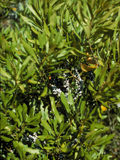
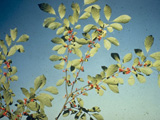
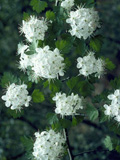
Here are photos from our Image Gallery:
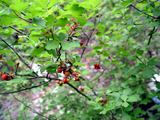
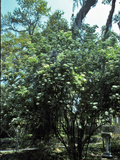
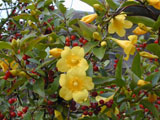

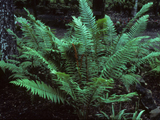
More Invasive Plants Questions
Non-native Royal Empress tree with only green leaves from Chambersburg PA
July 12, 2013 - I have 3 Royal Empress trees in my yard that are between 2-4 yrs old and have never been any color other then big Green leaves. Do you know when they will turn Purple?
view the full question and answer
Is it OK to plant Huisache in southern California?
June 15, 2009 - We have a wonderful huisache growing on a very dry rocky/dusty slope. It has now sprouted babies and we are delighted because we have room for several more on this slope. I have some room on our front...
view the full question and answer
Getting rid of invasive grasses in backyard
July 17, 2010 - Mr. Smarty Plants,
How do I rid my yard of invasive grasses? I am finding Bermuda, stickers, crabgrass and maybe even Johnson grass throughout my backyard. The invasion is substantial in one 200+...
view the full question and answer
How can I eradicate Mexican Petunia from my garden in Vacaville CA?
July 02, 2009 - Can you tell me the best way to eradicate the plant Ruellia, commonly known as Mexican Petunia, from my garden?
view the full question and answer
How to tell the difference between native and European thistles
April 19, 2011 - How can I tell the difference between invasive (European) thistles and thistles that are native to Texas? And what is the best way to eradicate the invasive varieties?
view the full question and answer
| Support the Wildflower Center by Donating Online or Becoming a Member today. |