Native Plants

Q. Who is Mr. Smarty Plants?
A: There are those who suspect Wildflower Center volunteers are the culpable and capable culprits. Yet, others think staff members play some, albeit small, role. You can torture us with your plant questions, but we will never reveal the Green Guru's secret identity.
Did you know you can access the Native Plant Information Network with your web-enabled smartphone?

Ask Mr. Smarty Plants
Ask Mr. Smarty Plants is a free service provided by the staff and volunteers at the Lady Bird Johnson Wildflower Center.

rate this answer

Monday - June 28, 2010
From: California City, CA
Region: California
Topic: Non-Natives, Septic Systems, Grasses or Grass-like
Title: Non-native smoketree for California City, CA
Answered by: Barbara Medford
QUESTION:
I was wondering if you could tell me if it would be a good or bad idea to plant a Smoke Tree (most likely European) in the vicinity of a septic tank. We are looking for something which will provide a moderate amount of privacy, since we live in the middle of the desert, and have very few neighbors. We are also considering Cordylines as an scattered around the smoke tree. Any help that you would be able to provide would be greatly appreciated. Thanks in advance. Ian KellyANSWER:
Sadly, you have presented Mr. Smarty Plants with several ideas he considers bad. First, you should never plant a woody plant, like a tree or shrub, over a septic system. Those woody roots underground are larger than the tree visible aboveground, and relentless in their progress. They can lift sidewalks, crack foundations and certainly play havoc with a septic system. Our recommendation for use over septic systems is always grasses native to the area. Their long fibrous roots will hold the soil, draw up some of the moisture in the septic lines, but will not interfere with them.
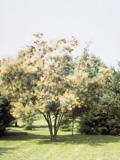
Our second version of a bad idea is to plant the European smoke tree, Cotinus coggyria, (from Floridata) which is native to southern Europe, central Asia and the Himalayas. The Lady Bird Johnson Willdflower Center is dedicated to the growth, protection and propagation of plants native not only to North America, but to the area in which that plant is being grown.
And, in spite of it being native to North America, we don't think it's a good idea to try to plant Cotinus obovatus (American smoketree), in your location in the Fremont Valley of the Mojave Desert. Although both the native and non-native smoketrees are listed as being viable in USDA Hardiness Zones 5 to 8, and your area on the eastern border of Kern County is Zones 8a to 9b, it still is a long way from the nearest area where either of them is believed to grow. A few counties in Central Texas are shown on the USDA Plant Profile as having the American smoketree growing, that is as far west as they go. The European smoke tree grows in the East and north up into Canada.
Both of these trees are relatively rare in trade and difficult to transplant. Since you should not plant it over your septic system anyway, why waste your time and effort over a tree that will probably not survive there?
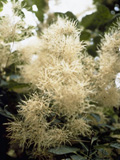
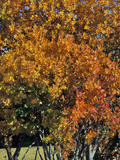
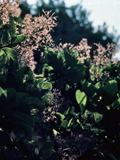
From our Native Plant Image Gallery:
More Grasses or Grass-like Questions
Invasive Indian paintbrushes in Grawn MI
June 04, 2012 - I have lots of Indian paintbrushes crowding my lawn and taking over the grass..what kills it without killing the grass?
view the full question and answer
Erosion control in Santaquin UT
August 11, 2009 - I have a hill in my backyard; it is about 40 ft tall and about 80 ft wide. It is probably a 1.5 to 1 slope ratio. I am going to be landscaping my back yard and have top soil put on the hill as well. S...
view the full question and answer
Erosion Control for a Shaded Slope in Aliquippa PA
May 07, 2014 - What plants. shrubs or trees can I plant to retard soil erosion on a steep shaded hillside in PA
view the full question and answer
Replacement for Kentucky grass in Colorado
July 02, 2012 - What kind of grass to replace "Kentucky grass"? It uses too much water. Need drought tolerant grass for the Rifle, Colorado area ("zip code is 81650"). Water bill is way too high, pushing over $10...
view the full question and answer
Buffalograss (Bouteloua dactyloides) for Ontario, Canada
June 17, 2009 - Is there a grower/distributor of Buffalo Grass in Canada? I want to seed it soon. Thanks
view the full question and answer
| Support the Wildflower Center by Donating Online or Becoming a Member today. |