Native Plants

Q. Who is Mr. Smarty Plants?
A: There are those who suspect Wildflower Center volunteers are the culpable and capable culprits. Yet, others think staff members play some, albeit small, role. You can torture us with your plant questions, but we will never reveal the Green Guru's secret identity.
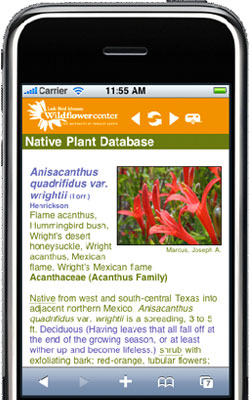
Did you know you can access the Native Plant Information Network with your web-enabled smartphone?

Ask Mr. Smarty Plants
Ask Mr. Smarty Plants is a free service provided by the staff and volunteers at the Lady Bird Johnson Wildflower Center.

rate this answer

Thursday - April 15, 2010
From: Killeen, TX
Region: Southwest
Topic: Trees
Title: Fruit trees non-toxic to dogs that will grow in Killeen TX
Answered by: Barbara Medford
QUESTION:
I live in Central Texas and I'd like to know if there is any fruit tree that is non toxic to dogs that will grow well in my area. My dog eats everything in sight. Thanks!ANSWER:
First, we need to tell you that most of the fruits you would find in a grocery store are non-native to North America and so hybridized that their origins are murky, at best. Things like apples, oranges, peaches all are native to other parts of the world, many of them China. At the Lady Bird Johnson Wildflower Center, we are dedicated to the use, protection and propagation of plants native not only to North America but to the area in which those plants are being grown. There is one genus of fruits, Prunus, that has 32 species native to North America, and 17 to Texas. The fruit on many of these can be used to make jellies, even wines. There is just one little catch, from our Native Plant Database:
"The seeds, twigs, and leaves of all Prunus species contain hydrocyanic acid and should never be eaten. Leaves are particularly high in this toxin. Sensitivity to a toxin varies with a person’s age, weight, physical condition, and individual susceptibility. Children are most vulnerable because of their curiosity and small size. Toxicity can vary in a plant according to season, the plant’s different parts, and its stage of growth; and plants can absorb toxic substances, such as herbicides, pesticides, and pollutants from the water, air, and soil."
Over time, we have accumulated a list of databases with plants poisonous to animals (and people, too, of course). So, when you are interested in a plant, native or non-native, you can go to these databases and check on the specific plant. It will be easier if you have the scientific name of the plant, but the lists will all accept common names as well.
Here is a list of websites on poisonous plants to which you can refer when choosing plants:
Toxic and Non-Toxic Plant List—Horses Poisonous Plants of North Carolina Cornell University Plants Poisonous to Livestock University of Pennsylvania Poisonous Plants Canadian Poisonous Plants Information System Toxic Plants from the University of California-Davis Pennsylvania's Poisonous Plants from the Universtiy of Pennsylvania Cornell University Plants Poisonous to Livestock ASPCA list of Plants Toxic to Horses Horse Nutrition: Poisonous Plants from Ohio State University Extension Service 10 Most Poisonous Plants for Horses from Equisearch PullmanUSA - plants poisonous to both cats and dogs
More Trees Questions
Evergreen screening tree for Wichita Falls TX
November 25, 2015 - Recommendations for a screen plant. Dry. full sun. 20 to 30 ft.high. evergreen. Wichita Falls, TX location.
view the full question and answer
Fast growing, native fruit trees for Northeast Texas
January 23, 2007 - What kind of fruit tree will grow fast and be pretty in Northeast Texas?
view the full question and answer
Premature browning of bald cypress needles in summer
July 15, 2011 - I have several 10m high taxodium distichum trees in the lawn, with drip irrigation twice a week, and same soil content, and on just one of them, several leaves have started turning brown, it seems to ...
view the full question and answer
City tree ordinance information
January 10, 2010 - Dear Mr. Smarty Plants,
I am writing to you in regards to city tree ordinances. I am a citizen of Grand Prairie, TX. and although the city is a Tree City, the city does not have a tree ordinance. T...
view the full question and answer
Relocating native oak trees in compacted soil
September 14, 2008 - Can you replant and relocate small oak trees in compacted soil and will they grow or go into shock?
view the full question and answer
| Support the Wildflower Center by Donating Online or Becoming a Member today. |