Native Plants
Q. Who is Mr. Smarty Plants?
A: There are those who suspect Wildflower Center volunteers are the culpable and capable culprits. Yet, others think staff members play some, albeit small, role. You can torture us with your plant questions, but we will never reveal the Green Guru's secret identity.
Did you know you can access the Native Plant Information Network with your web-enabled smartphone?

Ask Mr. Smarty Plants
Ask Mr. Smarty Plants is a free service provided by the staff and volunteers at the Lady Bird Johnson Wildflower Center.

rate this answer

Tuesday - January 12, 2010
From: Austin, TX
Region: Southwest
Topic: Wildlife Gardens
Title: Birds attracted to wax myrtles in Austin
Answered by: Barbara Medford
QUESTION:
Hello! We are considering planting Wax Myrtles in our relatively small SW Austin backyard. I'm excited about its ability to create quick privacy, but I was wondering specifically, what types of birds will its berries attract? Also, will we have a huge abundance of birds "taking over" or "fighting" for these berries in our yard and therefore, lots of bird poop under and around the trees? I want to know what we're "in for" before planting this tree that is so attractive to birds.ANSWER:
We once read that the wax myrtle attracted 42 different species of birds, but have never found actual documentation of that factoid. We do know from research that the berries on these bushes attract warblers (including myrtle warblers), tree swallows, cardinals, mockingbirds, catbirds, chickadees, vireos, bob whites, flickers, robins and finches. That isn't 42, but about the best we can do. As for your questions about birds taking over or fighting over the berries, we think that is more likely to happen, especially in an urban situation, when you use birdseed feeders. Our personal experience is that the wax myrtle does not attract large birds, which would weigh down the very supple branches of Morella cerifera (wax myrtle). The plague for urban bird feeders is the dove and its relative, the pigeon, with the pigeons being far and away the most offensive. Pigeons are immigrants from Europe, imported to this continent to serve as food animals and message carriers. They will drive away the smaller birds and certainly leave a mess behind. Planting the wax myrtle in the garden will mean that whatever droppings there are will go into the soil as a natural fertilizer, instead of big splots on your porch.
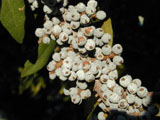
Now, on to the tricky part, getting berries on the plants you purchase at the nursery. The truth of the matter is, all of the wax myrtle plants at the nursery probably do have berries, because they are all females. Customers generally want the berries, because of the attractions to birds, and you may find it difficult to locate a male for purchase. The nursery trade reproduces many of the woody plants, including wax myrtle, by cloning, so that all the plants are females, exact copies of the parent plant. As we mentioned, the plants at the nursery are likely all female; they have berries when they are placed in the nursery, because they have been pollinated in the growers' fields before being shipped to the nursery. However, comes the next Fall, with no nearby male, the females will have no berries, and will be indistinguishable from males. Both males and females bloom, only the pollinated female has berries. Generally, one male plant can pollinate any number of females within about a 40-ft. radius. Unfortunately, the nursery staff may not have a clue what you are talking about, and possibly will assure you the plants will all have berries. We would suggest you go to our National Suppliers Directory, put your town and state in the "Enter Search Location" box, and you will get a list of native plant nurseries, seed suppliers and consultants in your general area. They all have contact information and you can find out which ones either will have or can get you some male plants to assure your birds will have berries.
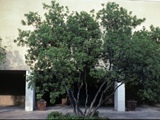
From our Native Plant Image Gallery:

More Wildlife Gardens Questions
Wildlife management tax exemption
May 15, 2007 - I live on 10 acres of prairie land near Austin. I want to learn about drying and pressing and gluing and preserving wildflowers as art in pictures and bookmarks and cards. My attempts have failed an...
view the full question and answer
Drought tolerant plants for butterflies and hummingbirds
November 16, 2009 - I have about 150 sq ft of space in our backyard (urban OKC residence) that gets direct sun in the morning but is 100% shaded by 11-Noon from 2 large Sycamore trees. The space is on the west side of t...
view the full question and answer
Butterflies and larval hosts in Dallas County
June 19, 2007 - My class is starting a butterfly habitat at school. We have researched plants that attract butterflies, however we forgot to look for plants that feed the caterpillars and we want to provide the expe...
view the full question and answer
Need suggestions for plants for a bird/small wildlife refuge in Wichita Co, TX.
August 26, 2011 - With our continuing drought in North Texas, I'm planning to transform my small backyard into a bird/small wildlife "refuge". What types of native plants and grasses can I plant in dry, hot Wichita ...
view the full question and answer
Latin name for botany mist in McAllen TX
November 10, 2009 - What is the latin name or formal name of botany mist which is a Queen butterfly nectar source in the Rio Grande Valley?
view the full question and answer
| Support the Wildflower Center by Donating Online or Becoming a Member today. |