Native Plants
Q. Who is Mr. Smarty Plants?
A: There are those who suspect Wildflower Center volunteers are the culpable and capable culprits. Yet, others think staff members play some, albeit small, role. You can torture us with your plant questions, but we will never reveal the Green Guru's secret identity.
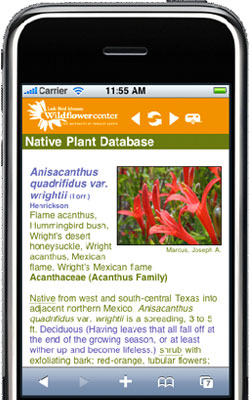
Did you know you can access the Native Plant Information Network with your web-enabled smartphone?

Ask Mr. Smarty Plants
Ask Mr. Smarty Plants is a free service provided by the staff and volunteers at the Lady Bird Johnson Wildflower Center.

rate this answer

Thursday - August 20, 2009
From: San Antonio, TX
Region: Southwest
Topic: Non-Natives, Diseases and Disorders, Shrubs
Title: Non-native red-tip photinias dying in San Antonio
Answered by: Barbara Medford
QUESTION:
A 17 year old Red tip Photinia in a hedge shows signs of dying. The main stalks are quite large and offshoots from two of the stalks have brittle, drooping leaves. The center of the plant looks normal and healthy; other leaves on the plant show no signs of fungus or insects. Although we are in a severe drought, we have carefully drip irrigated the entire hedge and this is the only plant that shows these signs. I am greatly concerned because the same situation occurred in one of our other Red tips last year and the whole plant ended up dying. Can you identify the problem and what can we do to arrest this problem? Many, many thanks.ANSWER:
For openers, the red-tip photinia is non-native to North America, originating in the Far East. At the Lady Bird Johnson Wildflower Center, we are committed to the planting, protection and propagation of plants native to North America. Native plants are recommended because they are adapted to an area's soil, rainfall, heat (or cold), and so require less water, less fertilizer, less maintenance. We're not saying that your plants are suffering because they're non-native, necessarily, but that choosing the right plant, in advance, can save you a lot of grief and probably money because of lost plants. Unfortunately, the red tip photinia has been widely overused because it is cheap, fast-growing and the red leaves in the Spring are quite attractive. As it happens, the fact that your plants lived 17 years is a tribute to your care for them.
In this Mississippi State University Extension Service Red-tip Photinia Almost Eliminated, you will likely find out why your plants are not prospering. Here is a quote from this article:
"Red-tip is highly susceptible to the fungal pathogen known as Entomosporium that causes leaf spots and ultimately defoliation. The disease has all but eliminated Red-tip from the list of recommended shrubs for Southern landscapes. In fact, the disease is so widespread that one plant pathologist jokingly explained that there are two types of Red-tip, those that have the disease and those that are going to get it! So, even though newly planted Red-tip bushes may stay disease free for many years, ultimately they will succumb to the inevitable."
Cotton Root Rot is also responsible for the loss of many ornamental plants in clay soil, and photinias are especially vulnerable. An article by Lynn Rawe from the Texas A&M Home Horticulture site describes the symptoms. There is no cure.
We're sorry that we can't give you the name of a spray or fungicide that would cure these plants, but we're afraid there is no such panacea. If the seemingly inevitable happens, try replacing the plants with plants native to Central Texas. If and when the photinias die, remove them and dispose of them in such a way that whatever disease has killed them will not be readily able to spread to other plants. Then incorporate compost or other humus into the soil, digging and mixing it deeply, and raising the bed, again to improve drainage. Don't try to plant new shrubs until late Fall, so they won't suffer from heat shock. Mulch them with shredded hardwood mulch, which will help keep the roots cool (or warm) and, as it decomposes, add still more organic matter to the soil, and keep this mulching up.
More Non-Natives Questions
Non-native Jacaranda interfering with concrete wall from Los Angeles
August 17, 2011 - We have been replanting the area surrounding our 2 story apt bldg and on one area, there is Jacaranda that started growing in an enclosed cement block wall area. The cemented walled in area which is ...
view the full question and answer
Are Castor Bean Leaves Toxic to Pets?
September 13, 2014 - I understand that the beans of the castor plant on lethal if chewed on. Are the leaves that toxic? I would love to plant this plant and not let it flower, but I do have visiting grandchildren and dog...
view the full question and answer
Bark splitting on non-native Royal Poinciana in tree in Merritt Island FL
August 10, 2010 - Information on splitting bark along the branches like an overstuffed sausage: A royal Poinciana tree, about 5 years old. The upper branches are doing this, although I'm afraid little splits or tear...
view the full question and answer
Non-native pomegranate in Albuquerque
September 07, 2009 - I don't know if they are now considered native or not but I am interested in planting Principia or Pomegranates in Albuquerque, windy and a mile high. Do I have a chance?
view the full question and answer
Plants for hanging baskets in Austin
October 06, 2009 - Can you suggest some plants for winter hanging baskets in the Austin, TX area?
view the full question and answer
| Support the Wildflower Center by Donating Online or Becoming a Member today. |