Native Plants

Q. Who is Mr. Smarty Plants?
A: There are those who suspect Wildflower Center volunteers are the culpable and capable culprits. Yet, others think staff members play some, albeit small, role. You can torture us with your plant questions, but we will never reveal the Green Guru's secret identity.
Did you know you can access the Native Plant Information Network with your web-enabled smartphone?

Ask Mr. Smarty Plants
Ask Mr. Smarty Plants is a free service provided by the staff and volunteers at the Lady Bird Johnson Wildflower Center.

rate this answer

Tuesday - January 20, 2009
From: MACON, GA
Region: Southeast
Topic: Erosion Control
Title: Plants to prevent bank erosion in Georgia
Answered by: Janice Kvale
QUESTION:
I NEED LIST OF PLANTS TO HELP PREVENT BANK EROSION. WE LIVE AT BOTTOM OF HILL THAT FURTHER SLOPES TO A POND. THE AREA IS SHADY AND WET FACING NORTHEAST. ANY RAIN CAUSES THE POND TO MUD UP. WE HAVE LOTS OF FRENCH DRAINS BUT HOUSE IS NEW AND COULD USE SOMETHING BESIDES CONTRACTOR GRASS AND HAY TO STOP EROSION. ANY IDEAS?ANSWER:
Grass is the answer to erosion control. Native grasses have extensive fibrous root systems that are excellent for erosion control, and they tend to reseed themselves. Some will grow tall. So, for an area that is shady and wet in Georgia, Mr. Smarty Plants suggests the following native plants:The many sedges are a lower growing species and generally like a moist or wet environment. The Carex plantaginea (plantainleaf sedge) is an evergreen with a tinge of red-purple.
Bouteloua curtipendula (sideoats grama) grows to 2 or 3 feet in height in sod-forming clumps that help stabilize a slope. It is a warm season grass that may turn red or purple in the fall.
Chasmanthium latifolium (Inland sea oats) is one of our favorites. The plant shoots spikelets of large pods on 2-4 foot slender stems that arch gracefully. In fall they turn a lovely yellow and are candidates to add to a dry bouquet.
Andropogon glomeratus (bushy bluestem) is another attractive grass that thrives in low moist areas.
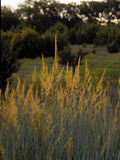
Sorghastrum nutans (Indiangrass), another sod-former, is a tall (3-8 feet) yellow, prairie grass that can be quite showy and grows in almost any degree of light or moisture. Our resource, Native Plant Database, notes it favors an occasional flooding.
Speaking of our resource, the Wildflower Center webpage, you may want to search for some alternatives on your own at this site. Click on Explore Plants, then Native Plant Database. In a Combination Search, you can indicate your location and site characteristics. In addition to our suggestions, you will find a wide variety of other sedges and a few other grasses suitable for your situation. You may also use this resource to locate flowering species (herbs) to combine with the grasses for color, should you wish.
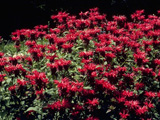
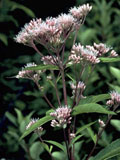
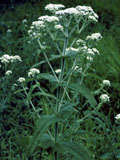
Some shade and moisture loving herbaceous specimens you might consider include Solidago juncea (early goldenrod). At 3-10 feet tall, it will keep pace with the tall grasses and adds its lovely golden plumes to the grassy mix. Add the Monarda didyma (scarlet beebalm), another tall shade-loving plant that is showy. Eupatorium purpureum (sweetscented joepyeweed) has a large pinkish flower and Eupatorium perfoliatum (common boneset) has fuzzy clusters of tiny white blossoms.
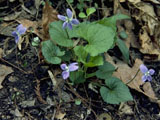
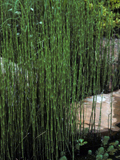
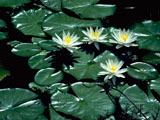
With a pond at the bottom of the slope you have an opportunity to plant practically into the water with wet loving plants. Consider the Viola cucullata (marsh blue violet), Equisetum hyemale (scouringrush horsetail), or plunge right in with the Nymphaea odorata (American white waterlily).
Oops! Mr. Smarty Plants digresses. Letʼs stick to the slope and consider how you will plant your choices. First, at our webpage, still in Explore Plants, click on Suppliers and enter your city and state. Several sources will come up for nurseries and seed companies, some of which we hope are close to Macon.
Next is planting the area. You may find grass plugs but seeding is more common. You could just broadcast the seeds but you risk having them wash down the hill at the next downpour. You may want to consider using an erosion-control blanket to hold those seeds where you want them. The seeds are sown under the material and grow through the blanket matting. The roots below anchor the soil. Ask for a biodegradable material so the blanket gradually disappears leaving your lovely planted hillside.
Good luck!


More Erosion Control Questions
Erosion control from Lakeland FL
November 03, 2012 - What native Ground cover is best for erosion control on slope of lake-front? Prefer not too invasive for this northern facing area behind a seawall and near large Oak tree.
view the full question and answer
Liriope spicata for erosion and dust suppression from Bonifay FL
August 16, 2011 - I want to plant Liriope 'spicata'. I know it can be aggressive and that's what I want. We live on dirt road and need something by road for help in erosion and it's also hard to mow this are...
view the full question and answer
Erosion control near creek in Kansas City, MO
July 26, 2008 - I'm looking for something to plant to help stop erosion on my property. The spot I have in mind is on a slight natural grade heading toward the creek at the back of my property. Any ideas on what t...
view the full question and answer
Landscaping on South Padre Island
June 07, 2008 - I'm in charge of landscaping at my beachfront condo in South Padre Island and find the wind, salt air, and heat challenging for growing almost anything. We would like to incorporate native plants, b...
view the full question and answer
Erosion control on partially shaded slope
November 27, 2010 - Mr. Smarty Plants,
I live in Atlanta, GA. My house is on a hill, and I am beginning to have erosion at my backyard porch (concrete slab, on the corners especially). The soil is mainly red clay, a...
view the full question and answer
| Support the Wildflower Center by Donating Online or Becoming a Member today. |