Native Plants

Q. Who is Mr. Smarty Plants?
A: There are those who suspect Wildflower Center volunteers are the culpable and capable culprits. Yet, others think staff members play some, albeit small, role. You can torture us with your plant questions, but we will never reveal the Green Guru's secret identity.
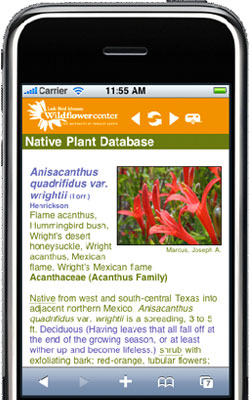
Did you know you can access the Native Plant Information Network with your web-enabled smartphone?

Ask Mr. Smarty Plants
Ask Mr. Smarty Plants is a free service provided by the staff and volunteers at the Lady Bird Johnson Wildflower Center.

rate this answer

Saturday - October 18, 2008
From: Boynton Beach, FL
Region: Southeast
Topic: Non-Natives, Herbs/Forbs
Title: Watering for Scarlett Milkweed in Florida
Answered by: Barbara Medford
QUESTION:
I have a Scarlett Milkweed and it was doing very well until this last week. It now has yellow leaves that are falling off and no flowers. It says on the tag that the water is low once it is established. It was given to me and at that time it was only 12" tall, now it's almost 3' feet tall. Was wondering what would be the best way to take care of it? Do I water weekly, bi-weekly? Thank you for your assistance!ANSWER:
Asclepias currassavica, Scarlet Milkweed, is a native of South America but has become a naturalized weed in tropical and subtropical areas all over the world including Central and South Florida. Since it is a non-native to North America, it falls out of the range of expertise of the Lady Bird Johnson Wildflower Center. We only recommend, and grow in our Gardens, plants native to North America and to the area in which they are being grown. This is because, being adapted to the conditions, they will require less water, fertilizer and maintenance. And, of course, as in the case of your plant, non-natives can sometimes become invasive and crowd out more desirable native plants.
Although we do not have information on this plant in our Native Plant Database, here is a website from Floridata on Asclepias currassavica that might be a source of the information you need. We suspect that it is approaching the end of its season and starting to drop leaves and cease to flower. Asclepias tuberosa (butterfly milkweed), which is native to Florida, is listed as deciduous, which means it is dropping its leaves, will die back and return in the Spring.
More Herbs/Forbs Questions
Native plants for gravesite in North Central Massachusetts
May 18, 2008 - I live in North Central Mass. Would like to plant something on my parents gravesite that would not be invasive or require a lot of care. Any suggestions? I just took 2 shrubs out that had become way...
view the full question and answer
Plants for sunny dry soil location
August 22, 2010 - Do any native plants exist in a highly sunny very dry soil location? (high overhang prevents rain but allows sun)
view the full question and answer
Plants for northern exposure in Wichita, KS
March 17, 2009 - What are good plants for the north side of the house with acidic soil in Zone 6, Wichita, KS?
view the full question and answer
Propagation of Texas sage from Bastrop, TX
March 01, 2013 - Am I wasting my time trying to transplant texas sage runners? Any advice?
view the full question and answer
Interested in a mini food forest
February 04, 2013 - I am interested in starting a mini "food forest" in a twelve foot by twelve foot patch of earth next to my house. I'd like to put a focus on making sure that the bulk of the plants I introduce are ...
view the full question and answer
| Support the Wildflower Center by Donating Online or Becoming a Member today. |