Native Plants
Q. Who is Mr. Smarty Plants?
A: There are those who suspect Wildflower Center volunteers are the culpable and capable culprits. Yet, others think staff members play some, albeit small, role. You can torture us with your plant questions, but we will never reveal the Green Guru's secret identity.
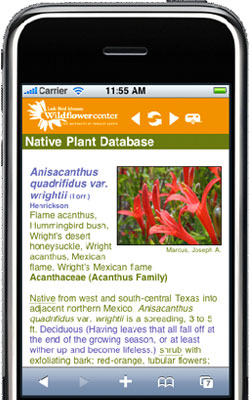
Did you know you can access the Native Plant Information Network with your web-enabled smartphone?

Ask Mr. Smarty Plants
Ask Mr. Smarty Plants is a free service provided by the staff and volunteers at the Lady Bird Johnson Wildflower Center.

rate this answer

Wednesday - August 27, 2008
From: Leicester, England
Region: Other
Topic: Edible Plants
Title: Are gourds poisonous, edible?
Answered by: Nan Hampton
QUESTION:
Are all the Gourds edible? How can I know which one is which? If it is not edible, is it poisonous? If not, what is stopping us from eating them?ANSWER:
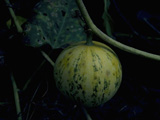
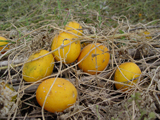
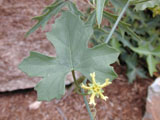
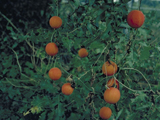
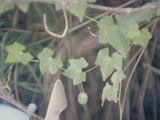
Since our expertise is with plants native to North America I can tell you about our native gourds. Cucurbita foetidissima (buffalo gourd) is the species I am most familiar with since it occurs locally. There are four native species of Cucurbita that are called gourds: Cucurbita foetidissima (buffalo gourd), Cucurbita digitata (fingerleaf gourd), C. palmata (coyote gourd) and the endangered C. okeechobeensis (Okeechobee gourd). None of my favorite toxic plant databases (Poisonous Plants of North Carolina, Canadian Poisonous Plants Information System, Cornell University Plants Poisonous to Livestock or other Animals or Texas Toxic Plant Database lists any species of Cucurbita. Delena Tull (Edible and Useful Plants of Texas and the Southwest) says about the buffalo gourd (C. foetidissima): "Though related to the edible squashes, the fetid odor and the extremely bitter taste of the buffalo gourd make the fruit inedible." However, archeological investigations show that native Americans used the seeds as food. They also used the green fruit and roots as a detergent and the dried fruits as a rattle. Although javelinas dig up and eat the bitter root and coyotes, porcupines and humans eat the seeds, apparently no one eats the fruits.There are two other native North American plants that have a fruit called a gourd—Ibervillea lindheimeri (balsam gourd) and Melothria pendula (speckled gourd)—but these fruits are very small and probably don't look like what you think of as a gourd. Poisonous Plants of North Carolina lists M. pendula as causing "only low toxicity if eaten"—its berries act as a strong laxative. None of the toxic plant databases above lists I. lindheimeri.
You can read about the gourds of other places (Africa, South America) and their many uses on Wikipedia. This article says that very few gourds are used for food, but there are some Asian species that are consumed.

More Edible Plants Questions
Texas plants useful to early settlers
June 05, 2012 - I'm working on some interpretation for a prairie heritage trail in SE TX (near Houston). I'd like to know where I can find some good information on plant remedies which might have been used by early...
view the full question and answer
Wild plum tree failing to bloom from Simonton TX
May 04, 2013 - I have a wild plum tree that has been in the ground for 3 or 4 years and it has not ever flowered. Why? I don't know what kind it is. I dug it up from a friends yard. Her wild plum trees have flowere...
view the full question and answer
Plants for floodplain in Fairfield, New Jersey
March 21, 2010 - I have an easy question for you... I hope... We just moved into the floodplains of NJ in Fairfield and are interested in some plants. We would like to know what plants are best suited to grow in flood...
view the full question and answer
Recommendation for red raspberry species for Connecticut
May 31, 2009 - Hello, I was wondering if you could recommend any red raspberries that I can grow in Connecticut. Thanks!
view the full question and answer
Plant identification in Georgia
September 14, 2011 - I saw the same question that I was going to ask about the plant that folds its leaves at dusk, with sparse branches, rapid growth, small yellow flowers and long (whisker-like, but do not appear to be ...
view the full question and answer
| Support the Wildflower Center by Donating Online or Becoming a Member today. |