Native Plants
Q. Who is Mr. Smarty Plants?
A: There are those who suspect Wildflower Center volunteers are the culpable and capable culprits. Yet, others think staff members play some, albeit small, role. You can torture us with your plant questions, but we will never reveal the Green Guru's secret identity.
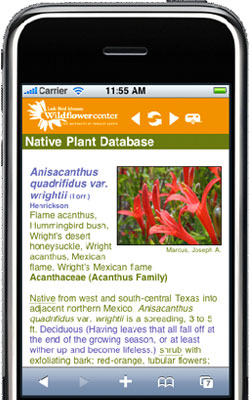
Did you know you can access the Native Plant Information Network with your web-enabled smartphone?

Ask Mr. Smarty Plants
Ask Mr. Smarty Plants is a free service provided by the staff and volunteers at the Lady Bird Johnson Wildflower Center.

rate this answer

Saturday - August 23, 2008
From: Rapid City, SD
Region: Midwest
Topic: Plant Identification
Title: Weird-looking rootless plant, perhaps a fungus
Answered by: Nan Hampton
QUESTION:
While out it my backyard (i.e. the Black Hills of South Dakota), I spotted a weird-looking rootless plant (I think it may be a fungus) growing beneath the Ponderosa Pines. It was the only one in the area and the only one I've ever seen. Anyway, further identifying features: ~18 inch stem -- bright pink and sticky Inverted yellow bell-like "flowers" at the top with not many "leaves" to speak of I know fungi aren't plants, but do you have any idea what it is?ANSWER:
Mr. Smarty Plants believes you saw Pterospora andromedea (woodland pinedrops). Here is more information from Michigan Natural Features Inventory and here are some more photos. It is a very interesting plant since it has no chlorophyll and can't make its own food. it forms an association with a mychorrihizal fungus which is then associated with tree roots, generally pine tree roots. Botanists consider it to be saprophytic (living on dead organic matter), instead of parasitic on the pine tree or, alternatively, parasitic on the fungus. There is also the thought that this is a beneficial relationship with the mychorrhizal fungus in which the fungus increases the supply of nutrients to the plant by increasing the surface area by which it can absorb decaying matter. The fungus may benefit by using some of the carbohydrates that the plant produces. Such plants that associate with mychorrhizal fungi are called mycotrophic plants.
Here are some more flowers that resemble fungus.
Here are mycotrophic orchids that occur in South Dakota.
Corallorhiza odontorhiza (autumn coralroot)
Corallorhiza maculata (summer coralroot)
Corallorhiza striata (hooded coralroot)
Corallorhiza trifida (yellow coralroot)
Corallorhiza wisteriana (spring coralroot)


More Plant Identification Questions
Plant identification
September 05, 2011 - This incredible plant has grown up in the past two months. Considering the extreme heat of this summer, my husband assumes it must be a weed. We have had this skinny strip of dirt for four years, and ...
view the full question and answer
Plant identification of a trillium in New Jersey
June 23, 2011 - I have several Trillium grown from one seed source. The plant looks like Trillium cuneatum, but unlike that plant, the stems of these plants -- which seed freely in my Northwest New Jersey garden -- l...
view the full question and answer
Plant identification
June 25, 2011 - I see a previous question from Ohio on this plant, so I will copy the description and try to submit photos. "A year later a weed-like plant started growing beside it. It has very thorny leaves, stem...
view the full question and answer
Identity of flowering yellow trees in Austin
March 21, 2012 - There are numerous flowering yellow trees in my Austin neighborhood. Are they mesquite or goldenball lead trees? They are quite fragrant, like a new bar of soap.
view the full question and answer
Identification of a vine in Tennessee
November 08, 2013 - I am trying to identify a vine growing on the ground under what looks to be a holly bush. I have pictures of it if there is an email I can send them to?
Thank You!!!!
view the full question and answer
| Support the Wildflower Center by Donating Online or Becoming a Member today. |