Native Plants
Q. Who is Mr. Smarty Plants?
A: There are those who suspect Wildflower Center volunteers are the culpable and capable culprits. Yet, others think staff members play some, albeit small, role. You can torture us with your plant questions, but we will never reveal the Green Guru's secret identity.
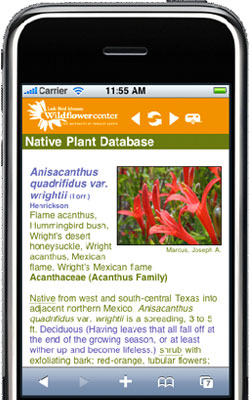
Did you know you can access the Native Plant Information Network with your web-enabled smartphone?

Ask Mr. Smarty Plants
Ask Mr. Smarty Plants is a free service provided by the staff and volunteers at the Lady Bird Johnson Wildflower Center.

rate this answer

Thursday - July 31, 2008
From: Shreveport, LA
Region: Southeast
Topic: Planting, Transplants, Herbs/Forbs
Title: Transplant shock in Texas Star hibiscus
Answered by: Barbara Medford
QUESTION:
Why is my Texas star plant wilting and now is starting to turn yellow? I just bought it from a nursery and put it in a new pot.ANSWER:
We are assuming that you are referring to Hibiscus coccineus (scarlet rosemallow), which is frequently sold in nurseries under the trade name Texas Star Hibiscus. The name is a little bit of a misnomer as the plant is not native to Texas, but to several southeastern states, including Louisiana. For more information on its general cultivation, see this Mississippi State University Office of Agricultural Communications article on Hibiscus coccineus, Texas Star Hibiscus.
However, that is all neither here nor there in regards to what is wrong with your plant. It would seem highly possible that it is suffering from transplant shock. The plant you purchased has probably been living under sheltered greenhouse conditions, mostly in shade, since it was first sprouted. It would be shock enough to suddenly enter the real world in your garden, but doing so in the middle of the summer would make anything wilt and turn yellow. Quick, get it out of the sun. It does need some sun every day, but get it in some shade for now. Then, trim off about 1/4 to 1/3 of the upper part of the plant (yes, including any flowers), but leave as many leaves as you can for plant nutrition. Don't fertilize, never fertilize any plant under stress. Water it, every day. Any plant in a pot outside in the summer, especially in the South, needs watering every day. The soil (and the pot) can heat up to temperatures that will simply cook the roots if you are not careful. Make sure the drainage in the pot is good, you don't want to drown it, either, but keep the soil moist. Give it some morning sun every day and in a few weeks, when it begins to perk up, you can give it a balanced fertilizer.
Oh, yes, and make sure all your neighbors know what plant you are growing, or you might get reported for growing marijuana!


More Planting Questions
Possibility of contaminants leaching from asphalt driveway to adjacent vegetable garden in Tucson
April 13, 2011 - We have planted a vegetable garden next to a driveway. The driveway has recently (within the last 2 years) been covered with asphalt. My concern is that the oil may leach into my vegetables. Is thi...
view the full question and answer
Competition between peony and bulbs
November 06, 2015 - I am planting 3 herbaceous peony bare roots 3 feet apart from each other. I am told it will take 3 years before I get blooms. In the meantime, can i safely plant springtime flowering bulbs in th...
view the full question and answer
Slow development in Shumard Oak from Porter TX
April 02, 2013 - We had two Shumard Oaks Planted in Sept of last year (2012). About a month later, they started browning and dropping their leaves (no color change). Now I noticed on one of the trees the buds have sta...
view the full question and answer
Putting in native grass in June in Manor TX
May 31, 2012 - We are moving into a new-built house in the middle of June. We opted to not have them put in Bermuda grass as we wanted to seed a native mix. From my understanding, mid June will be too late to start ...
view the full question and answer
Soil for native Chilopsis linearis and Salvia greggii
February 08, 2010 - I want to plant a desert willow and a salvia greggii in my small lot. The developer used sandy loam to fill in the small garden in the front. I am 73 and a bit impaired. Do I really need to remove ...
view the full question and answer
| Support the Wildflower Center by Donating Online or Becoming a Member today. |