Native Plants
Q. Who is Mr. Smarty Plants?
A: There are those who suspect Wildflower Center volunteers are the culpable and capable culprits. Yet, others think staff members play some, albeit small, role. You can torture us with your plant questions, but we will never reveal the Green Guru's secret identity.
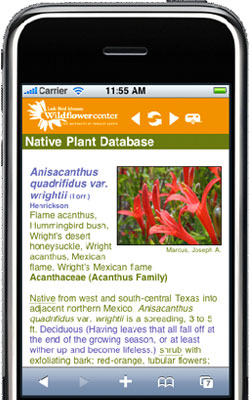
Did you know you can access the Native Plant Information Network with your web-enabled smartphone?

Ask Mr. Smarty Plants
Ask Mr. Smarty Plants is a free service provided by the staff and volunteers at the Lady Bird Johnson Wildflower Center.

rate this answer

Tuesday - May 13, 2008
From: WOODLANDS, TX
Region: Southwest
Topic: Plant Identification, Wildlife Gardens, Transplants
Title: Hummingbird plants and Indian Hawthorn
Answered by: Barbara Medford
QUESTION:
I live in The Woodlands in a new section of homes. I planted some hummingbird plants in full sun and they did ok last year for 4 months, then lost all their leaves and died when the winter came. At least I think the plant is dead. I cut it all the way back to about 6 inches above the ground. Why do you think it died? I also transplanted some Indian Hawthorns that no one wanted and they look real dry but not dead. Do they go into shock when transplanted? I am sure glad I found your web site. I am going to have a ton of questions.ANSWER:
We're afraid we don't have quite enough information to answer your first question. There is not a specific plant named "hummingbird plant" that we have been able to find. There are a number of plants which attract hummingbirds; perhaps if you gave us a more precise description we might be able to figure out what it is. There is one shrub, native to Florida as well as parts of Central and South America, Hamelia patens (scarletbush), that is sometimes called a hummingbird bush. In The Woodlands, Zone 8a or 9, it would probably die back to the ground and come back in the Spring. If, in the middle of May, your plant has shown no sign of growth, it is probably dead, regardless. There are a number of reasons why it may have died: it could have had too much or too little sun, too much or too little water, or might even have been an annual instead of a perennial. If you bought it at a nursery that does not specialize in native plants, it is probably either not a native of the area or a hybrid. Here is a Floridata website on Hamelia patens (scarletbush).
As for the Rhaphiolepsis indica, Indian Hawthorns, we know that is a non-native, but we can try to get some information for you to help you in their care. Almost any plant will go into transplant shock if it is not properly prepared. Any time you move an established plant, there is a chance it will die. Whenever possible, they should be transplanted in late Fall or Winter, when the shrub is semi-dormant. Indian Hawthorns are native to India and Southern China. Most failures in transplanting them result from taking up too little of the root/soil system, planting too deeply and not watering correctly afterwards - for months. Some gardeners who have tried them find them not worth the room they're taking up in the garden; perhaps that was why no one wanted the bushes you tried to transplant. Rhaphiolepsis indica likes alkaline soil, and with all the pine trees in The Woodlands, it's more likely you have acid soil. They bloom best in full sun, and are very susceptible to bad leaf leaf spot fungus if grown in shady conditions. Here is a North Carolina State University website on Indian Hawthorns.
At the Lady Bird Johnson Wildflower Center we are dedicated to the care, use and propagation of plants native to North America, because they will grow with less fertilizer, water and general maintenance. They are already used to where they are growing. We are also glad you found our site, and hope we can help you again. To be able to better use our website, we suggest you start with our How-To Articles; we particularly recommend the articles on Why Natives?, A Guide to Native Plant Gardening and Gardening Timeline. Next, go to Recommended Species and click on East Texas. This will give you a list of native plants recommended for East Texas planting. Now, the fun begins. You can click on "Narrow Your Search" and ask for herbs (herbaceous plants), or shrubs, or trees. You can specify if you are interested in perennials or annuals, how much sun exposure there is and how moist the soil is. As you learn to use the site, you will discover you can go into the Native Plant Database and look for flowers by color and months of bloom. You can go to the Image Gallery and find over 20,000 pictures of native plants. And if you get stumped again, come on back, we'll still be here.
More Wildlife Gardens Questions
Wildlife gardening in Georgia
February 19, 2008 - I am looking for native shrubs/flowers that will attract butterflies and/or birds. I live in Milledgeville, GA which is in central GA, 1 mile from the Oconee River. Some areas of my yard are full sun...
view the full question and answer
Planting for parrots
March 23, 2005 - I have 2 parrots, a sun conure and a nanday conure, and I would like to find some plants to put in their aviary room that are safe for parrots. Can you help me with this question?
view the full question and answer
Hungry turtles trample pond in Houston Texas
October 17, 2011 - I have a very large back yard pond (actually, a former swimming pool) that's home to a bullfrog, four Red-eared slider turtles, and scads of gambusia (little mosquito eating fish). I'd like to add n...
view the full question and answer
Grasses and wildflowers for Houston meadow
February 28, 2008 - I recently bought a house in a new subdivision just south of Houston -
as with most new developments, the area is devoid of nature for the
most part... I have planted many bird/butterfly/bee fr...
view the full question and answer
Plants for a mixed hedgerow for privacy and for the birds
May 07, 2010 - What are the best native plants for a mixed hedgerow in a small backyard? I want privacy (heights 5'-10') and bird friendly.
Thank you for your information.
view the full question and answer
| Support the Wildflower Center by Donating Online or Becoming a Member today. |