Native Plants
Q. Who is Mr. Smarty Plants?
A: There are those who suspect Wildflower Center volunteers are the culpable and capable culprits. Yet, others think staff members play some, albeit small, role. You can torture us with your plant questions, but we will never reveal the Green Guru's secret identity.
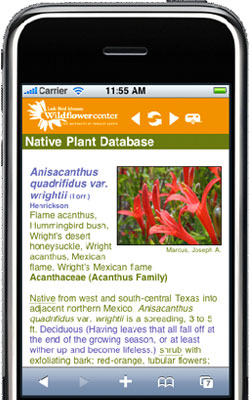
Did you know you can access the Native Plant Information Network with your web-enabled smartphone?

Ask Mr. Smarty Plants
Ask Mr. Smarty Plants is a free service provided by the staff and volunteers at the Lady Bird Johnson Wildflower Center.
rate this answer

Tuesday - February 19, 2008
From: Bennington, NE
Region: Midwest
Topic: Seed and Plant Sources, Soils
Title: Difference in natural soil and potting soil.
Answered by: Nan Hampton
QUESTION:
If you buy store bought soil is it different than soil from the ground?ANSWER:
Soil from the ground, or natural soil, is composed of finely ground rock (mineral component) and humus (organic material). One way to classify soils is by their texture. The basic texture of soil depends on the different sizes of ground rock in its composition. There are, essentially, three different sizes of ground rock particles—sand has the largest particles, silt particles are smaller, and clay has the smallest particles. The size of the particles determines how porous the soil is; that is, how quickly water and nutrients move through it. Porosity is important also for gas exchange—roots need oxygen from the air. Sand with its large particles is the most porous and clay with its very small particles is the least porous. Water moves very quickly through sand and moves through clay very slowly. Natural soils are classified by the mix of the different particle sizes and the organic humus. You can read descriptions of the twelve major textural classes of soils as defined by the United States Department of Agriculture (USDA).
Different parts of the country have different types of soil. In Austin, Texas, where Mr. Smarty Plants lives, the soils have a high clay content and, thus, are not very porous. We have native plants here that are well-adapted to our clay soil; but, if we want to grow something that isn't native to our area, we usually have to loosen up our soil by adding sand and/or humus to it. You can read about your Nebraska State Soil which is more porous than ours here in Texas. Your soil will grow plants that our Texas soil won't grow. The bottom line is that different soils will support different plants.
Although texture is the major way to classify soils, there are other components of the soil that are important, too. The acidity or alkalinity (the pH) of the soil is important and also the nutrients (for example, potassium (K), nitrogen (N), and phosphorus (P) which are the most important).
Interestingly, however, most commercial potting soils don't contain "soil" at all. They are made up of peat moss, finely shredded barks, compost, and perlite (puffy volcanic glass to increase porosity). Potting soils, or store-bought soil, is made to support house plants although there are different mixes for different types of plants. The ideal potting soil is porous enough so that water is able to flow through it and deliver nutrients but not so quickly that the water is immediately lost. There are different mixes for flowering plants, orchids, and cactuses, to mention a few. For instance, potting mix for orchids is composed almost completely of bark. You can read how to make your own potting soil mixes,
Since I believe, from your e-mail address, that you are an elementary school student, you can find more information about soils geared to kids from University of Illinois Extension Service.
More Soils Questions
Plants that will grow in clay in North Carolina
March 14, 2008 - I have a small fenced back yard, predominately hard red clay, that is a major focal point. I am designing my own garden/yard area (to cut cost) and have a list of plants that will grow in this soil w...
view the full question and answer
Plants for a Shaded Slope in Philadelphia
April 17, 2015 - I have a small slope along the North side of my house in a suburb of Philadelphia. A small maple tree grows there but most of it gets no sun at all (a large segment is under the tree). I had the soil ...
view the full question and answer
Is cement leaching into flower beds in Colorado Springs?
May 16, 2009 - I have posed this question to a number of garden centers in our area around Colorado Springs--only to rec. a repeated--"Gee, I don't know." When we moved to our new home there was a rock concrete ...
view the full question and answer
What grows in Tampa FL
July 01, 2013 - Please let me know what grows in the backyard in Tampa, FL to provide screening and privacy?
view the full question and answer
Agarita suggestion for Houston area
March 05, 2013 - Another possible plant for the following question is agarita. The question: "Looking for a very, very, thorny three or four foot tall shrub for in front of windows to deter break-ins. Considering Ro...
view the full question and answer
| Support the Wildflower Center by Donating Online or Becoming a Member today. |