Native Plants

Q. Who is Mr. Smarty Plants?
A: There are those who suspect Wildflower Center volunteers are the culpable and capable culprits. Yet, others think staff members play some, albeit small, role. You can torture us with your plant questions, but we will never reveal the Green Guru's secret identity.
Did you know you can access the Native Plant Information Network with your web-enabled smartphone?

Ask Mr. Smarty Plants
Ask Mr. Smarty Plants is a free service provided by the staff and volunteers at the Lady Bird Johnson Wildflower Center.

rate this answer

Monday - October 08, 2007
From: Leander, TX
Region: Southwest
Topic: Groundcovers
Title: Marbleseed (Onosmodium sp.) propagation and use as groundcover for
Answered by: Nan Hampton
QUESTION:
I am interested in any information, esp. propagation & suitability as a landscape plant, (possible ground cover?) for marble seed. I have found it growing in deep shade on stream banks. It has a 4--6" strap-like, dark green leaf. The seed is perfectly round, smooth and white, and about the size of a small piece of perlite. I have asked other native plant friends, but no one knows of this plant and I have been told it is rather rare.ANSWER:
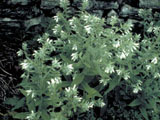
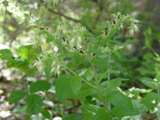
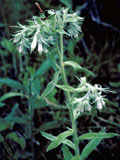
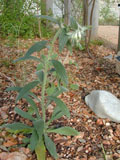
There are two species of marbleseed, Onosmodium helleri (Heller's marbleseed) and Onosmodium bejariense var. bejariense (soft-hair marbleseed) that occur in Texas and both have been reported from Williamson and Travis counties. Of the two, O. helleri is the rarer, endemic to only eight counties of the Edwards Plateau and Lampasas Cut Plain. I suspect you have found O. bejariense var. bejariense (syn. Onosmodium molle), but you can find a key in Shinners & Mahler's Flora of North Central Texas on pp. 453-454 (the entire book is accessible online in downloadble pdf files) to determine which you have found. Both species are attractive but can grow as tall as 3 feet so they may be more suitable for including as accent plants rather than as a groundcover.
From Sean Watson, the nursery manager of the Lady Bird Johnson Wildflower Center:
"We sow seeds in Spring in our greenhouse, using sterile seed germinating mix and intermittent misting (about every hour for 6 seconds). Just cover the seed with media, about 1/8" deep. They do benefit from some shade when trying to germinate them. I have also sown them as late as July with success (again I gave them more shade)."
There is also information about the propagation of O. bejariense var. bejariense (syn. Onosmodium molle) from Dave's Garden.com.
More Groundcovers Questions
Shady Groundcovers for NC
April 23, 2015 - I have a side yard that gets very little sun during the day and have tried St. Augustine grass unsuccessfully. Can you recommend a groundcover? We live close to the coast in Southeastern N. Carolina...
view the full question and answer
Low groundcover for Possum Kingdom
March 02, 2011 - I am seeking a very low ground cover (advised so snakes and rats won't take cover), that is drought resistant and grows on a rocky steep incline to the lake in full afternoon/evening sun at Possum ...
view the full question and answer
Ground cover for North Central Texas
January 24, 2009 - I live in north central Texas. My backyard has very fine, powdery sand soil. The previous owners of the property let the grass die out and now every time it gets windy, the sand gets into our patio an...
view the full question and answer
Ground cover for heavily traveled walkway from Redondo Beach CA
April 23, 2013 - I am looking for a drought resistant ground cover that you can walk on. I live on a south facing, sunny corner lot, 2 blocks from the beach where people park and need to cross over to get to the sidew...
view the full question and answer
Drought tolerant ground cover for Winter Park, FL
March 09, 2009 - I'm looking to replace my lawn with a drought tolerant ground cover. I do not have a watering system.
view the full question and answer
| Support the Wildflower Center by Donating Online or Becoming a Member today. |