Native Plants

Q. Who is Mr. Smarty Plants?
A: There are those who suspect Wildflower Center volunteers are the culpable and capable culprits. Yet, others think staff members play some, albeit small, role. You can torture us with your plant questions, but we will never reveal the Green Guru's secret identity.

Did you know you can access the Native Plant Information Network with your web-enabled smartphone?

Ask Mr. Smarty Plants
Ask Mr. Smarty Plants is a free service provided by the staff and volunteers at the Lady Bird Johnson Wildflower Center.

rate this answer

Thursday - July 19, 2007
From: Port Ontario, NY
Region: Northeast
Topic: Erosion Control
Title: Erosion control after loss of large trees
Answered by: Nan Hampton and Joe Marcus
QUESTION:
Our steep 40' river bank (NY near eastern shore of Lake Ontario - zone 4) has recently lost two 50' oaks, leaving enormous holes in the bank itself where they tore out. What should we do immediately to cover/fill the bank? (Top soil into the holes? Something else into the holes? Netting or branches to cover the bank on the short term?) What indigenous grasses/shrubs/trees/other would you suggest to reduce erosion and rebuild the structure of the bank ASAP? (Notes: Bank faces south. On the flat next to the top of bank are a beech and more oaks, shading the bank considerably. The water is generally slow moving on our part of the river. Base of the bank is moist, of course, but the top can get dry, especially in summer heat.)ANSWER:
Mr. Smarty Plants is very sorry for the loss of your large oaks. While we have expertise in the area of native plants, you would be well-served to employ an engineer to assist you in the erosion abatement project. Due to the nature of rivers and the dynamics of natural, river bank erosion processes, it's possible that there is really not much you can do to stop the gradual erosion on your side of the river.Assuming your engineer tells you that it makes sense to do so, you will want to quickly stabilize the soil to prevent losing more of your bank and perhaps even the trees growing above it. Filling the hole with soil material similar to that of the bank might be the best bet. Next, you might consider using erosion-control blankets to stabilize the erosion area. The erosion-control fabric works by slowing the runoff water and allowing sediments to fall out rather than be washed away. Seeds are sown under the erosion-control material and grow up through the matting when they germinate. You can insert plants into the soil by cutting through the matting. The roots of the plants that are growing through the erosion-control material anchor the soil to stop the erosion. If you use erosion-control blankets made of biodegrable material, they will eventually disappear leaving the plants to control the problem. You can read about a stream bank stabilization project implemented by Department of Environmental Services, Arlington, Viriginia.
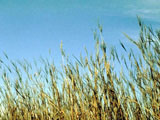
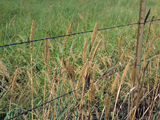
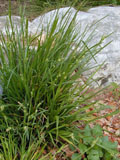
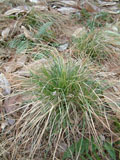
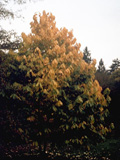
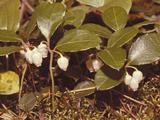
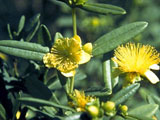
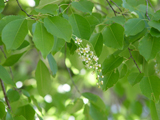
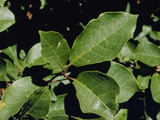
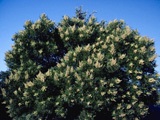
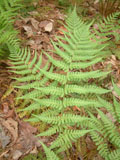
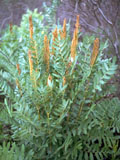
Grasses are excellent plants to control erosion because of their extensive fibrous root systems. Along with the grasses you can add shrubs and small trees. Ferns in the shaded areas and smaller perennial herbs will also help. The following recommendations are plants native to Oswego County, New York, and have characteristics that address your particular problem. Some of them do well in damp riparian areas and some will be more suitable to drier areas.
Grasses and Sedges
Andropogon gerardii (big bluestem)
Elymus riparius (riverbank wildrye)
Elymus virginicus (Virginia wildrye)
Panicum virgatum (switchgrass)
Sporobolus cryptandrus (sand dropseed)
Carex blanda (eastern woodland sedge)
Carex pensylvanica (Pennsylvania sedge)
Shrubs/Trees
Gaultheria procumbens (eastern teaberry)
Hypericum prolificum (shrubby St. Johnswort)
Prunus serotina (black cherry)
Prunus virginiana (chokecherry)
Rhus copallinum (winged sumac)
Ferns
Dryopteris marginalis (marginal woodfern)
Osmunda cinnamomea (cinnamon fern)
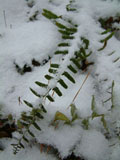
Polystichum acrostichoides (Christmas fern)
Perennial Herbs
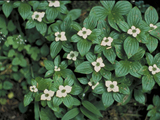
Cornus canadensis (bunchberry dogwood)
Podophyllum peltatum (mayapple)


More Erosion Control Questions
Erosion control on partially shaded slope
November 27, 2010 - Mr. Smarty Plants,
I live in Atlanta, GA. My house is on a hill, and I am beginning to have erosion at my backyard porch (concrete slab, on the corners especially). The soil is mainly red clay, a...
view the full question and answer
Native plants for erosion control in sun in Canton PA
August 03, 2010 - We just cleared a bank and need native plants and shrubs to grow for erosion control. Much sun.
Thank you.
view the full question and answer
Erosion Control for Shady Ditches
January 24, 2013 - What plants can you recommend for erosion control along shady ditches in Northwest Indiana?
view the full question and answer
Smoky Mountains Shaded Slope Plant Suggestions
April 29, 2013 - We live in a very shady spot in Great Smoky Mountains in Western North Carolina. We would like to plant vegetation on a sloped area behind our cottage to stop erosion after building an addition. Our h...
view the full question and answer
Deer-resistant groundcovers for erosion control
September 26, 2012 - I need a ground cover (vine??) that will help me with erosion on a sloped front yard. It gets about 6-8 hours of sun and my main need is for something that the rats in our neighborhood will not destro...
view the full question and answer
| Support the Wildflower Center by Donating Online or Becoming a Member today. |